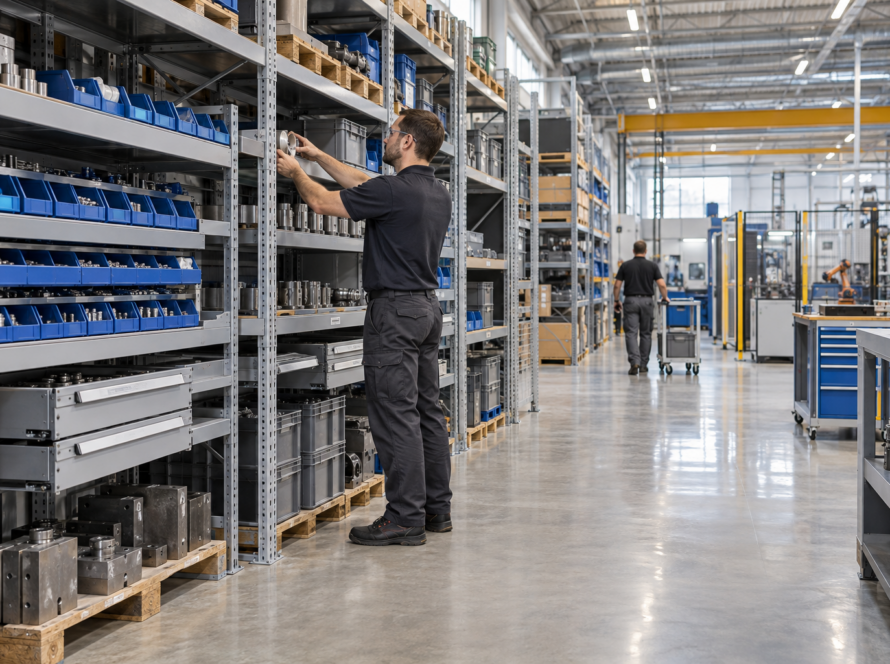
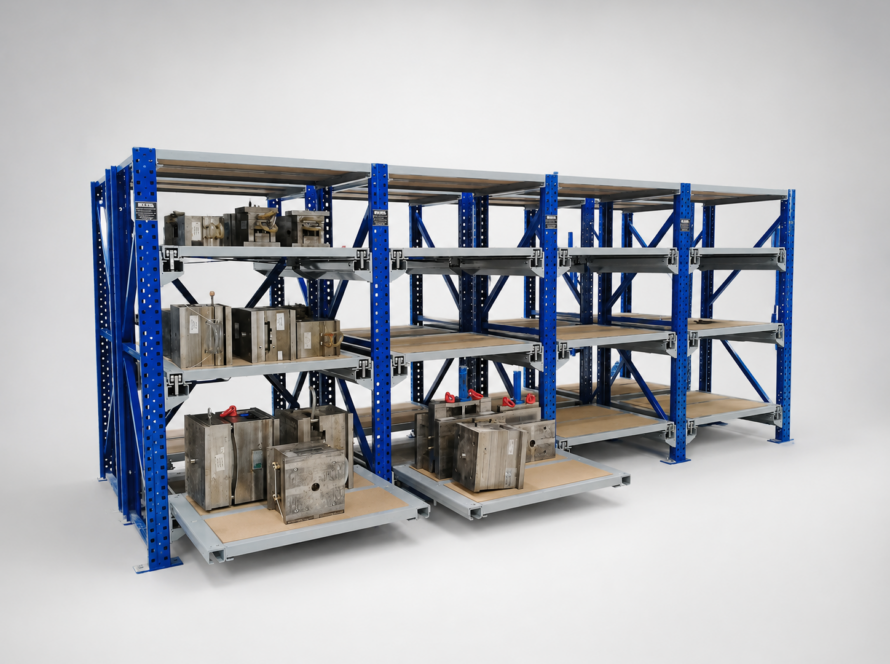
In fact, modern design is based on one very simple idea: managing the complete lifecycle of the mold rather than merely storing it. When a mold leaves production, it is cleaned, inspected, transferred to storage, placed in a specific location, retrieved again for the next production order, periodically maintained, sometimes left unused for long periods, and occasionally sent for modification; throughout this cycle, there is a major difference between using the storage system as a passive waiting point and turning it into an active infrastructure that supports every stage of the process. The physical expression of this approach can be seen clearly in drawer type mold rack systems, where the platform carrying the heavy mold can move outward along a rail system, allowing lifting equipment to approach the load more directly and helping eliminate many of the accessibility limitations associated with traditional fixed racks.
How Does Modern Mold Rack Design Differ from Traditional Approaches? 🧠
In a traditional heavy duty rack, the main design problem often focuses on the load capacity of the structure while the load remains stationary; uprights, beams, shelf levels, and connections are designed to support specified loads, while products are usually retrieved using forklifts or other handling equipment. In modern mold storage design, however, the load does not always remain stationary, because when a drawer or movable platform is extended, the center of gravity shifts forward, different forces develop in the rail system, the moment transferred to the frame changes, and the anchoring system must resist not only vertical loading but also the additional forces created by movement. For this reason, the difference between industrial mold racks and traditional storage systems is primarily related not to their appearance, but to the way the load is managed.
The ANSI MH16.1 industrial steel storage rack standard published by the Rack Manufacturers Institute in the United States establishes the importance of minimum requirements for structural design, testing, and use of industrial steel storage racks, while OSHA also emphasizes avoiding rack overloading, storing heavy loads at safer levels, and inspecting damaged storage systems. From the perspective of modern mold storage systems, this provides an important message: no matter how advanced the technology becomes, digital sensors or electronic labels can never replace a properly engineered load bearing structure, accurate load calculations, and correct anchoring to the floor. A smart rack must first be a well engineered rack. 🔩
1. Fully Extending Drawers: Bringing the Mold Within Reach of the Operator and Crane
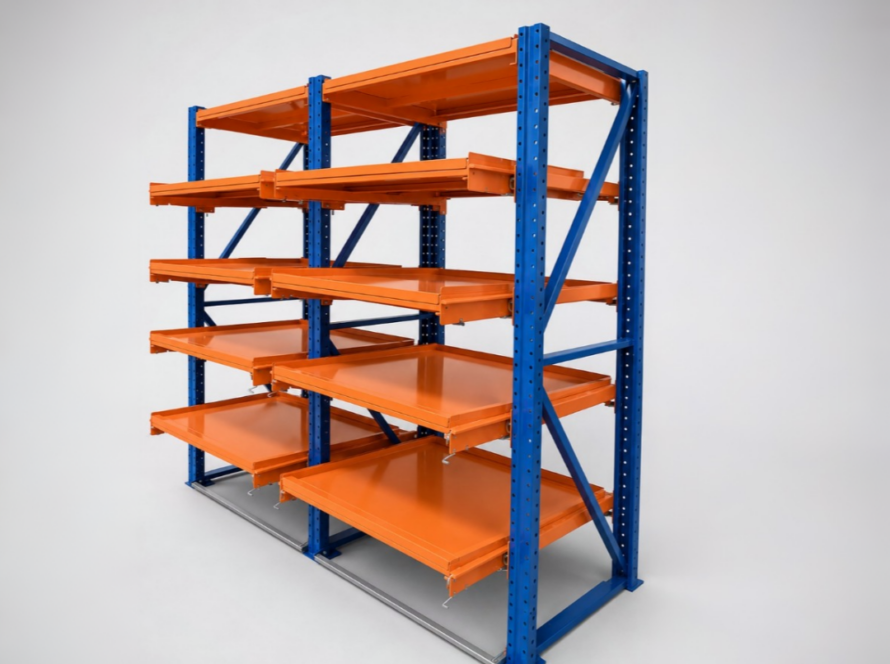
One of the most prominent solutions in modern mold racks is a fully extending design in which the drawer moves almost completely beyond the depth of the rack. 100% extension drawer type mold racks can provide a major advantage, especially in facilities where access to lifting points on the upper surface of the mold is important, where the mold is lifted directly by crane, or where certain preparation and visual inspection procedures are performed while the mold remains on the drawer. The real value of modern design here does not come simply from the drawer opening farther; it comes from changing the access geometry of the mold. Instead of trying to position lifting equipment inside a restricted fixed rack area, the load itself is brought into a zone where the lifting system can work more effectively. 🚀
This design can be compared to a high quality fully extending kitchen drawer rather than a traditional bookshelf; in a deep fixed cabinet, you may need to move the items at the front to see what is stored at the back, while a fully extending drawer brings almost the entire contents toward you, but the major difference in a mold rack is that instead of handling a few kilograms of kitchen equipment, the system may be moving industrial loads weighing hundreds of kilograms or even several tons. Therefore, rail capacity, drawer structure, locking mechanisms, anchoring, load distribution, and single drawer operating principles must all be evaluated together. The reason the full extension approach offered by Detay Endüstri can create real value in the right application is exactly this; the design does not merely say “the drawer should move outward,” but redesigns the working geometry between the mold and the lifting equipment.
2. 65% Extension Systems: Maximum Extension Is Not Necessary in Every Project ⚙️
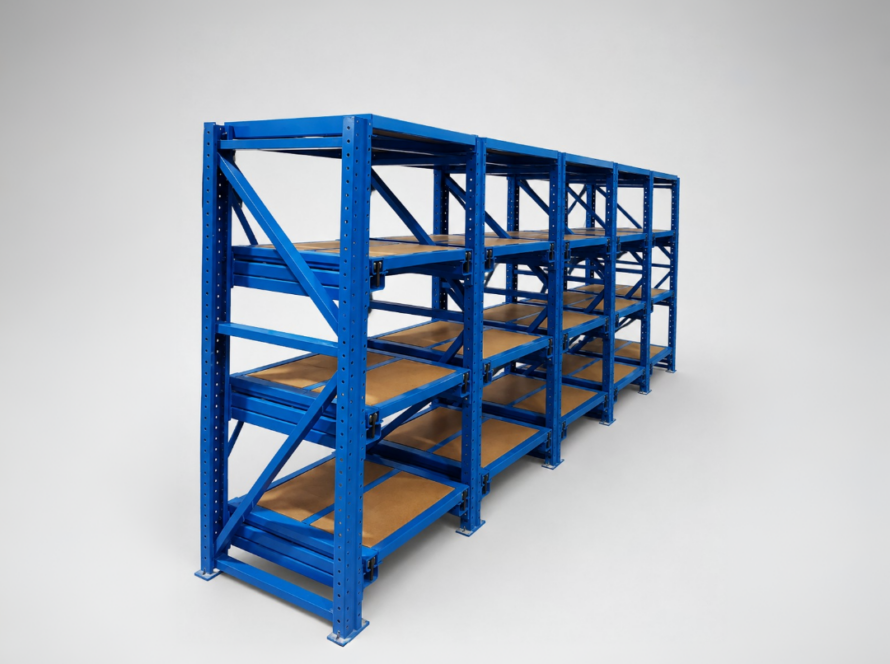
Modern design does not always mean greater movement or more complex mechanisms; in some cases, more controlled movement is the better solution under real operating conditions. In 65% extension drawer type mold racks, the drawer does not move completely outside the rack structure, which means a significant portion of the load remains within the supporting boundaries of the frame. This approach can be considered especially in facilities where aisle width is limited, where full side or overhead access to the mold is not required, where lifting equipment has sufficient working space at partial extension, or where maintaining a more controlled center of gravity is a priority in the project design.
The important point here is not to create an incorrect hierarchy such as “100% extension is more modern and 65% extension is older.” Modern engineering does not mean using the largest available feature, but designing the behavior that best matches the actual requirement. Full extension may significantly shorten production changeover time in one mold shop, while the same extension distance may unnecessarily consume aisle space in another facility; therefore, mold dimensions, crane approach, frequency of access, center of gravity, floor conditions, and workflow must all be evaluated together. The advantage of working with manufacturers such as Detay Endüstri, which can offer systems with different extension characteristics, is that a solution can be created according to the usage scenario instead of applying the same catalog product to every facility.
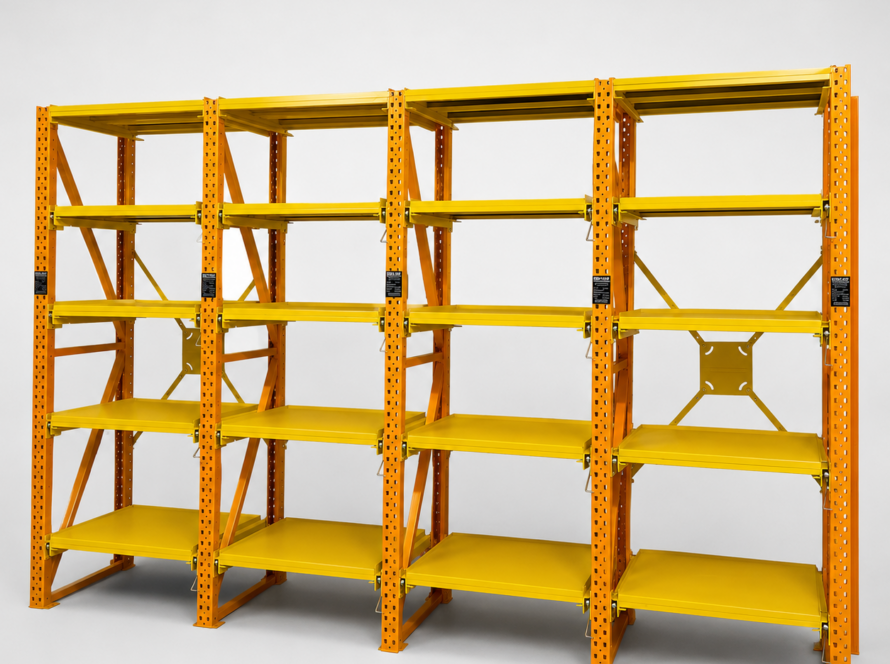
3. Why Are Modern Slide and Rail Systems at the Heart of the Design? 🔧
Although the steel frame is usually the most visually prominent component of a drawer type mold rack, one of the most critical elements determining everyday performance is the rail and sliding mechanism. When designing sliding systems used in drawer type racks, it is not enough for the empty drawer to move smoothly; the mechanism must also be evaluated under actual working loads, including synchronization between the left and right sides, friction generated during movement, industrial environmental factors such as dust and metal chips, accessibility of maintenance points, and long term repetitive opening and closing cycles.
OSHA’s mold preparation solutions document for reducing musculoskeletal injuries in foundries explains that roller surfaces used for heavy mold and pattern storage can reduce pushing and pulling forces by replacing dragging motion with rolling motion, while also showing that storage systems designed for easier access can reduce excessive reaching. The philosophy of modern drawer type mold racks can be viewed as a more advanced version of the same principle: instead of forcing the operator to drag a heavy load across a fixed rack surface, the load bearing platform itself moves through a controlled mechanism.
4. Locking and Interlock Logic: Limiting Human Error Through Design 🔒
In modern mold racks, it is not sufficient to rely entirely on operating instructions for safety; good design should, whenever possible, make unsafe behavior physically more difficult. For example, opening multiple heavy drawers at the same time can significantly change the center of gravity of the entire system, which is why project-appropriate mechanical interlock systems, single drawer opening principles, or locking mechanisms that secure each drawer in the closed position can provide considerable value. Positive locking when the drawer reaches the closed position can limit the risk of accidental opening while helping the operator use the system in a controlled manner.
One of the strengths of modern safety design is that it makes correct behavior part of the natural operation of the system rather than relying on constant reminders. This can be compared to the gear lock in a car 🚗; instead of requiring the driver to consciously remember every time not to shift without pressing the brake, the system prevents movement until the required condition is met. Similar thinking can be applied to mold racks through locking mechanisms, visible capacity labels, drawer position indicators, and, in future applications, electronic access control. anti-slip systems used in drawer type racks form another layer of this safety concept, because preventing the mold from moving uncontrollably forward or sideways on the drawer is just as important as controlling the movement of the drawer itself.
5. Load Distribution Is No Longer Just a Kilogram Calculation ⚖️
One of the most common mistakes in modern mold rack projects is to check the mold label and conclude, “The drawer can carry 1,500 kilograms, the mold weighs 1,200 kilograms, so there is no problem.” In reality, the same 1,200-kilogram load can create very different mechanical effects when it is distributed across a wide area at the center of the drawer compared with when it is concentrated on a small surface near the front corner; furthermore, when the drawer is extended, the forces acting on the frame and anchoring system change again. For this reason, correctly calculating load capacity in drawer type rack systems is a broader engineering problem than simply comparing nominal kilogram values.
In modern design, the mold’s base geometry, contact area, center of gravity, support plate or carrier used beneath it, actual position on the drawer, extension ratio, number of drawers, and the facility’s operating conditions are considered together. Where necessary, support plates or mold-specific carrier surfaces can be designed to distribute the load over a wider area. OSHA’s storage safety guidance also emphasizes avoiding rack overloading and positioning heavy loads securely. OSHA warehousing guidance makes it clear that storage safety does not end with initial installation, but must continue throughout the life of the system through capacity management and damage inspection.
Main Design Solutions Used in Modern Mold Racks 📊
| Design Solution | Main Purpose | Operational Contribution | Key Planning Consideration |
|---|---|---|---|
| 100% extending drawer | Full access to the mold | Can improve crane, maintenance, and preparation access | Moment, anchoring, and aisle space |
| 65% controlled extension | Keep a larger portion of the load within the rack frame | Can provide balanced access in restricted spaces | Whether crane access remains sufficient |
| Heavy duty rail system | Smooth movement under load | Can reduce pushing and pulling forces | Performance under actual load and maintenance requirements |
| Interlock and locking | Limit uncontrolled drawer movement | Adds an additional safety layer against operator error | Single drawer opening scenario |
| Anti-slip surface and barrier | Reduce movement of the load on the drawer | Provides more controlled load behavior | Mold base geometry and weight |
| Modular drawer levels | Adapt to different mold dimensions | Makes future reconfiguration easier | Future mold investments |
| RFID and digital addressing | Track mold identity and status | Can reduce search time and recording errors | ERP or maintenance software integration |
| Load and movement sensors | Make operating conditions visible | Can provide early warning of overload or abnormal behavior | Sensors must not replace engineering controls |
| Predictive maintenance infrastructure | Detect wear at an earlier stage | Can help reduce unplanned failures | Requires sufficient and reliable data |
| Digital twin and 3D layout | Evaluate the system virtually before installation | Can reveal crane and aisle conflicts early | Accurate site measurements and real workflow data |
6. Modular Design: One of the Quietest but Most Valuable Features of Modern Systems 🧩
When modern design is mentioned, many people immediately think about sensors, displays, and automation, but I believe one of the most important innovations in industrial racking is mechanical modularity. Manufacturing facilities are not static environments; new molds are introduced, old molds are retired, machinery changes, new product families are added, and mold heights and weights vary over time. If a rack system is designed only around the mold inventory available on the day of installation and cannot later be reconfigured, it may become unsuitable for the facility within only a few years. This is why the criteria to consider when selecting a drawer type mold rack should include not only today’s load requirements but also future change scenarios.
Modular design can provide significant flexibility by allowing drawer levels to be configured according to mold heights, additional units to be planned, the rack to be adapted to another area under appropriate conditions, and auxiliary storage modules to be integrated into the system. It is more accurate to compare this not to children’s building blocks, but to standardized connection points in industrial infrastructure; modularity does not mean adding random components, but safely managing change through connections that were designed for future adaptation from the beginning. From the perspective of Detay Endüstri, a strong modular system should not only carry today’s one-ton mold, but should also be ready for tomorrow’s sensor, identification tag, or new mold group with different dimensions.
7. Material Selection and Surface Protection Are Fundamental to Modern Design
A mold rack does not need complex electronics to be considered modern; the correct choice of steel, suitable profile geometry, high quality welding and connections, wear resistant movement points, and surface treatment appropriate for the working environment are often among the most valuable design decisions. When evaluating material selection for drawer type mold racks, it is important to consider not only the load capacity on the first day, but also humidity, oil, metal chips, temperature changes, cleaning chemicals, and possible impact conditions within the production environment.
Just as thicker sheet metal does not automatically mean better design, lighter construction does not necessarily mean weakness; geometry, material grade, bending method, connections, and the way forces are transferred through the structure collectively determine performance. The goal of modern engineering is not to use unnecessary amounts of steel, but to provide sufficient strength exactly where it is required. This creates both economic and resource efficiency advantages. 😊
8. Designs That Prevent Mold Movement on the Drawer
Once a movable drawer is introduced, another movement must also be considered: the movement of the mold itself. The drawer may extend in a controlled manner, but if the mold slides forward or sideways on the drawer surface, the behavior of the complete load changes; particularly with heavy molds that have irregular base geometries, even a few centimeters of unintended movement can affect the center of gravity. For this reason, modern designs may include anti-slip surfaces, mechanical restraints, front barriers, support plates, or product-specific seating solutions.
From the perspective of Detay Endüstri, the important point is not merely to select a single “non-slip material,” but to understand the actual base geometry of the mold. A mold with a wide flat base and another resting on several small feet may require different supporting surfaces, while round or protruding components may require physical restraints. For this reason, a modern mold rack should know not only how much the mold weighs, but also how the mold sits on the drawer.
9. RFID, QR Codes, and Digital Addressing: The Rack Can Now Tell You Where the Mold Is 📡
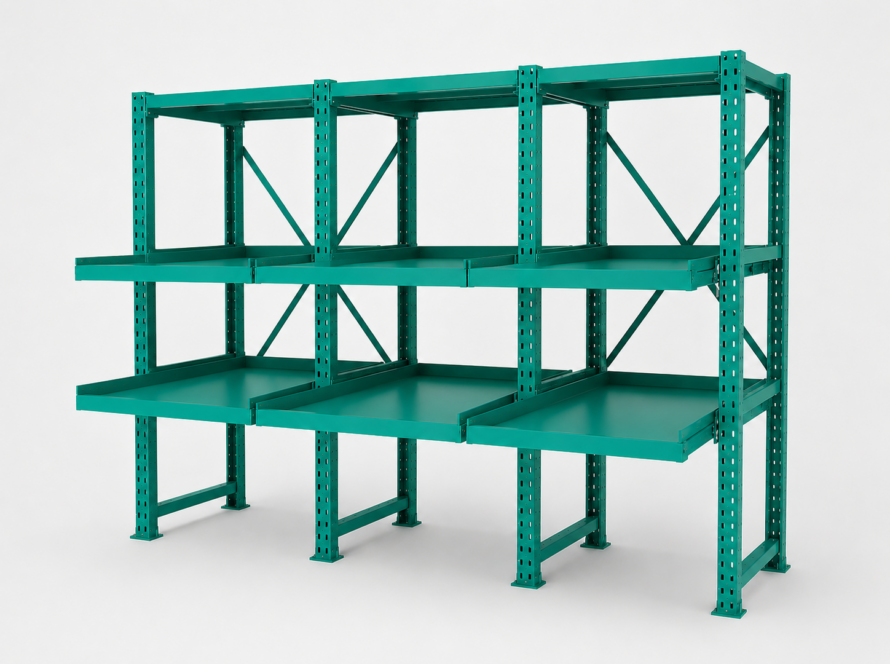
One of the most important modern developments in mold storage is the integration of the physical rack address with the digital record of the mold. In a traditional system, a simple label such as “Rack 3, second row” may be sufficient, whereas modern systems can assign a unique QR code, barcode, or, in suitable applications, an RFID tag to every mold; when the mold leaves the rack, the system can record that it is in production, when it enters the maintenance area its maintenance status can be updated, and when it returns to storage its location can be registered again. new technologies used in industrial racking are increasingly strengthening the relationship between the physical rack and ERP, maintenance software, or inventory management systems.
At an international level, the GS1 EPC/RFID framework provides a standardized approach for identifying physical products and assets using RFID, while data standards such as GS1 EPCIS can support visibility into when, where, why, and within which process an asset has moved. In mold management, the practical value of this can be significant: in addition to asking “Where is the mold?”, companies may be able to answer questions such as “When was it last used?”, “Has maintenance been completed?”, “Is the mold physically stored in the drawer where the system says it is?”, and “When is the next maintenance date?” from the same information chain.
However, an important warning is necessary here 😊 Adding an RFID tag does not automatically turn a disorganized mold shop into a smart facility. If physical rack locations, mold codes, and return procedures are not clearly defined, technology simply transfers the same disorder into a digital environment. In the Detay Endüstri approach, the strength of a modern rack lies in its ability to align mechanical organization with digital addressing; every mold should first have a clear physical location, and only then should that location become visible in the digital system.
10. Sensor Supported Load Control and Smart Racks 🤖
It is reasonable to expect sensor technology to become increasingly visible in the future of next generation mold racks. In suitable projects, load cells can help monitor the weight carried by the drawer, position sensors can indicate whether the drawer is open or closed, usage counters can show how frequently individual drawers are accessed, and vibration sensors can help identify unusual changes in the behavior of rails or the rack structure. These data should not be used to replace operator judgment, but to make otherwise invisible mechanical changes easier to detect at an earlier stage.
For example, if a specific drawer has operated with similar resistance for months but gradually becomes more difficult to move, the cause may be rail contamination, alignment problems, wear, or incorrect loading. A sensor or usage record could help alert maintenance personnel to this change earlier. A 2025 NIST review of condition monitoring based industrial maintenance technologies discusses the potential of sensor and IoT based condition monitoring to detect, diagnose, or predict failures in industrial maintenance. The same philosophy can also be applied to mold racks by using operational data from rails, drawers, and other moving components.
11. Predictive Maintenance: Intervene When Behavior Changes, Not Only After Failure 🔍
In traditional rack maintenance, many businesses perform visual inspections at defined intervals or call for maintenance after a visible problem occurs. In a modern approach, however, maintenance frequency can also be influenced by usage intensity rather than calendar time alone. For example, if one drawer is opened only five times per month while another is operated forty times per day, applying the same maintenance schedule to both mechanisms may not always be the most effective solution. When opening cycles, average load, movement resistance, and maintenance history are evaluated together, maintenance planning can become more risk based.
Nevertheless, it would be incorrect to assume that digital predictive maintenance can completely replace physical inspections. Impact marks on uprights, loose anchors, leaking oil from molds, deformation, or physical obstructions may not always be detected accurately by sensors. Therefore, in heavy duty storage systems such as those developed by Detay Endüstri, the healthiest modern maintenance model combines periodic physical inspections with digital condition monitoring where appropriate.
12. Digital Twins and 3D Layout Planning: Identifying Problems Before Installation 🖥️
One of the most interesting aspects of modern design is the ability to evaluate the system in a virtual environment before the rack is even manufactured. Ranging from simple three dimensional layout models to advanced digital twin applications, this approach can combine rack dimensions, drawer extension distances, crane movement, columns, workbenches, pedestrian routes, and mold handling paths in the same digital environment. Questions such as whether a fully extended drawer conflicts with a crane column, whether the aisle between two racks is wide enough, whether the crane hook can comfortably reach the top mold level, or whether mold movement toward the maintenance area blocks operator access can therefore be assessed before installation.
The economic value of this should not be underestimated; moving a heavy racking system by only a few hundred millimeters after installation can create significant revision costs due to anchoring, floor work, crane paths, and production schedules. In systems such as those offered by Detay Endüstri, which can be dimensioned according to the project, sharing the mold inventory, facility layout, and crane movements during the design stage not only simplifies engineering work but also reduces unexpected problems after installation.
13. Crane Integration Should Not Be an Afterthought in Rack Design 🏗️
No matter how advanced a mold rack may be, the system remains incomplete if the mold cannot be safely removed from the drawer. When an overhead crane, jib crane, or hoist is used, the hook must be able to reach the load center above the drawer, slings must be attached at suitable angles, and the lifted mold must clear the rack structure vertically without impact. For this reason, in modern design the crane path should not be checked only after the rack has been produced; it should be one of the initial inputs that determine rack dimensions.
When drawer type mold racks and industrial storage solutions are planned together, storage, lifting, and maintenance points can be treated as a single process. The mold leaves the drawer, moves along a short and clear route to the preparation area, and after inspection or maintenance continues toward the production machine; in an ideal design, unnecessary transfer pallets, forklift changes, and temporary floor storage are minimized wherever possible.
14. Mold Shop Design Should Not Treat the Rack as an Isolated Element
For modern mold storage racks to operate efficiently, the surrounding area must be planned just as carefully as the rack itself. When aisles, maintenance stations, auxiliary fixture cabinets, lifting equipment, cleaning areas, and unused mold locations are selected independently, even a well designed rack can become trapped inside an inefficient workflow. From the perspective of space management and racking solutions in mold shops, the main objective is to create a layout that can move the mold from storage to production and from production to maintenance with as few unnecessary handling steps as possible.
This can be compared to an airport baggage system ✈️; placing a suitcase on a high quality rack is not enough if the route it follows to the aircraft is complicated and filled with unnecessary transfers. The same is true for a mold: if it must be transferred between several different pieces of handling equipment, temporarily placed on the floor, or moved past unrelated storage areas just to reach the maintenance table, the operational value of the storage system is reduced.
Decision Diagram for Modern Design
MOLD INVENTORY
Weight + dimensions + base geometry + lifting points
            ↓
USAGE BEHAVIOR
Daily use + infrequent use + maintenance frequency
            ↓
ACCESS REQUIREMENT
Full access or controlled partial access?
            ↓
DRAWER DESIGN
100% extension / 65% extension / project-specific solution
            ↓
LOAD ENGINEERING
Center of gravity + point loads + rails + frame + anchoring
            ↓
SAFETY LAYER
Lock + interlock + anti-slip control + capacity labels
            ↓
CRANE AND WORKFLOW
Hook access + aisle + maintenance station
            ↓
DIGITAL LAYER
QR / RFID + rack address + ERP / maintenance system
            ↓
CONDITION MONITORING
Usage cycles + load + sensors + maintenance history
            ↓
MODULAR EXPANSION
New molds + new drawers + new technology
            ↓
LONG-TERM MOLD SHOP INFRASTRUCTURE
Representative Application Example: Transitioning from an Old Mold Storage Area to a Modern System
Consider a representative company producing components for the automotive supply industry; the facility contains 42 injection molds of different sizes, some of which are used only a few times per month while eight of them are changed almost every day, and in the existing layout the molds are stored on pallets in heavy duty racks, requiring a forklift to move each mold from the rack area to a location accessible by the overhead crane during every changeover. The maintenance team occasionally needs to check physical labels to confirm which pallet holds the correct mold, while auxiliary fixtures stored separately from the molds create additional search time during preparation.
In the modernization project, the molds are first classified according to weight, size, and frequency of use. Frequently used molds that require full access from above are placed in fully extending drawers, while less frequently used molds for which partial access is sufficient are placed on controlled extension levels. Each drawer receives a capacity and location label, mold QR codes are linked to asset records in the maintenance software, frequently used drawers are positioned at ergonomically convenient levels with strong crane access, special support plates are prepared for molds with irregular bases, and expansion space for two additional modules is reserved in advance for six new molds expected in the future.
The real modernity in this project is not the sensor or QR code; it is the fact that every decision is based on the same operational data. Mold weight determines drawer capacity, usage frequency determines position, lifting points determine extension type, maintenance requirements determine digital records, and future investment determines modular expansion. This is exactly where I see the essence of modern industrial design 😊 Every individual feature can be impressive on its own, but real value appears only when all features support the same workflow.
Modern Design Does Not Always Mean a More Complicated System
It may be technically possible to add sensors, RFID, electronic locks, displays, and automated maintenance alerts to a mold rack, but if none of these features solves a real operational problem, the investment becomes unnecessarily complicated. In a small mold shop where only a few molds move each day, well structured QR code addressing may be sufficient, while in a large factory where hundreds of molds move between shifts, RFID and software integration may provide genuine value. Similarly, 100% extension is not required in every facility, just as every mold does not need a dedicated sensor.
For this reason, when planning a modern mold storage system with Detay Endüstri, the first question should not be “Which technologies can we use?” but rather “Where are we currently losing time, safety, or space?” If the problem is access, mechanical drawer design becomes the priority; if the issue is incorrect location, addressing is more important; if overloading is the concern, capacity control comes first; if maintenance is being delayed, condition monitoring may be valuable; if mold dimensions frequently change, modularity becomes the key priority. A modern solution is not about using every feature in the technology catalog, but about solving the right problem with the simplest effective method. 👍
A Short Anecdote: A “Bigger Rack” Is Not Always the Solution
One of the most educational scenarios in mold storage projects occurs when an area believed to have a capacity problem actually turns out to have an accessibility problem. In a representative mold shop, the racks appear completely full and the team wants to add another row, but when mold movements are analyzed, the four most frequently used molds are found to be located in different aisles and on difficult-to-access levels, causing operators to temporarily leave certain molds on the floor. By readdressing molds according to usage frequency, moving frequently used molds into suitable drawers, and positioning them closer to the maintenance area, floor clutter is eliminated without installing additional racks.
This example demonstrates an important aspect of modern design: modern rack design is not about using more steel, but about making better decisions. Sometimes a new sensor is necessary, sometimes a stronger rail, sometimes full extension, and sometimes simply placing the correct mold at the correct level is enough.
Benefits Modern Mold Storage Racks Can Provide to Businesses 💡
More controlled access: Drawer type platforms can bring the mold into the working area and make lifting equipment access easier. Improved space utilization: Keeping molds vertically organized and individually addressed can reduce temporary floor storage. Better ergonomics: Suitable drawer heights and movable platforms can reduce unnecessary reaching and dragging movements. Greater traceability: QR, barcode, or RFID integration can improve records related to mold location and status. More structured maintenance: Usage history and, where appropriate, sensor data can support maintenance scheduling. Easier scalability: Modular structures can adapt to new molds and production investments. More organized workflow: Mold storage, cranes, maintenance areas, and auxiliary equipment can be planned as parts of the same process. 😊
Questions to Ask When Selecting a Modern Mold Rack ✅
- What is the verified weight of our heaviest mold?
- Where is the mold’s center of gravity and base contact area?
- Do we need full overhead access to the mold?
- Is 100% extension or controlled partial extension more suitable for our operation?
- How does the drawer behave under actual working load?
- Is simultaneous opening of multiple drawers mechanically prevented?
- Do we need a solution to prevent the mold from sliding on the drawer?
- On what type of floor and with which anchoring system will the rack be installed?
- Can the overhead crane safely reach the full drawer area?
- Can the user easily see the capacity of each drawer?
- Will molds be tracked using QR codes or RFID?
- Is integration with existing ERP or maintenance software required?
- Is condition monitoring necessary for heavily used moving components?
- Can rail and locking mechanisms be easily accessed during maintenance?
- Will it be possible to add new modules in two or five years?
- Have the likely dimensions and weights of future molds already been considered?
People Also Asked
Are sensors mandatory in modern mold racks?
No. Sensors can provide significant value in certain operations, but proper structural design, load calculations, locking, anchoring, and user procedures remain the fundamental requirements. Sensors support this mechanical safety infrastructure; they do not replace it.
Is 100% extension or 65% extension the more modern solution?
Both can be modern design approaches. Full extension is advantageous where broad access is required, while controlled partial extension can be suitable where space and center of gravity behavior need to be managed differently. The correct choice depends on the application.
Can RFID really be used for mold tracking?
Yes. With suitable RFID tags, readers, and software infrastructure, molds can be identified as assets and their physical movements can be connected with digital records. Because metal surfaces can affect RFID performance, the tag and mounting method should be selected according to the application.
Can a smart rack prevent overloading?
Load sensors can help detect unexpected weight or loads approaching defined limits in certain applications, but user training, capacity labels, and correct loading procedures are still required.
Is a digital twin necessary for mold rack projects?
An advanced digital twin is not required for every project. However, even a simple 3D layout model can help evaluate drawer extension, crane movement, aisles, and workstation conflicts before installation.
Frequently Asked Questions
1. What is a modern mold storage rack?
A modern mold storage rack is an industrial storage system that addresses not only heavy mold storage but also access, load control, safety, ergonomics, addressing, maintenance, and, where necessary, digital traceability within the same overall solution.
2. What is the main advantage of drawer type mold racks?
One of the main advantages is that the platform carrying the mold can move outward in a controlled manner, making the load more accessible to lifting equipment and potentially reducing unnecessary handling and access steps.
3. Why is an interlock system important in a mold rack?
An interlock system can limit simultaneous opening of multiple heavy drawers, providing an additional layer of safety against unwanted changes in the center of gravity of the complete rack.
4. What does adding a QR code to a mold rack provide?
A QR code can connect the mold with identification data, technical documentation, maintenance history, rack location, or production records, creating a quick access point between the physical asset and its digital information.
5. What is the main difference between RFID and QR codes?
QR codes generally require direct visual scanning with a camera. RFID, when used with suitable readers and tags, can support identification without requiring direct optical visibility. The better option depends on the number of molds, movement intensity, and software infrastructure.
6. How can predictive maintenance be applied to mold racks?
Data such as opening cycles, movement resistance, vibration, load, and maintenance history can be monitored to identify changes in the behavior of moving components. When an unusual pattern is detected, a planned technical inspection can be performed.
7. Why is modularity important in mold racks?
New molds and production investments can change storage requirements over time. A modular system can make it easier to rearrange drawer levels or rack units within defined limits and expand capacity in a controlled way.
8. How can mold movement on the drawer be prevented?
Depending on the mold geometry, non-slip surfaces, mechanical barriers, support plates, dedicated carrier seats, or other physical restraints can be used. For heavy loads, the solution should not rely only on friction; the actual behavior of the mold must be evaluated.
9. Can a modern rack system be installed in an existing mold shop?
In many cases, yes, but floor quality, anchoring area, ceiling height, crane movement, columns, aisles, and the mold inventory should all be measured and checked for suitability. Digital or physical layout analysis before installation can provide significant advantages.
10. What is the most important criterion when investing in a modern mold rack?
The most important criterion is not purchasing the system with the largest number of technologies, but selecting a solution that matches the company’s actual mold weights, usage frequency, lifting methods, and future plans. Technology creates investment value only when it solves a real operational problem.
Conclusion: The Mold Rack of the Future Should Be Strong, Intelligent, and Adaptable 🎯
When we examine the modern design solutions used in mold storage racks, it becomes clear that development is not limited to thicker profiles or greater load capacities; full and controlled extension options, heavy duty slides, interlock mechanisms, anti-slip carrying surfaces, modular structures, mold-specific support plates, QR and RFID based addressing, sensor based condition monitoring, predictive maintenance, and digital layout planning all solve different layers of the same problem. Their shared objective is clear: to store the mold more safely, locate it faster, move it more controllably, and return it to production with fewer unnecessary steps whenever it is needed.
However, underneath all these technologies remains an unchanging foundation: correct load capacity, accurate center of gravity calculations, a strong frame, high quality movement mechanisms, suitable anchoring, correct loading procedures, and trained users. Digital technology can make this infrastructure more visible and measurable, but it cannot compensate for weak mechanical design. From the perspective of Detay Endüstri, the real value of modern mold storage emerges when the steel structure and operational logic are brought together within the same project.
I think of this system like a well designed smart building 🏢; the building has strong concrete foundations and structural columns, while access control, sensors, automation, and software are added on top of that physical structure. If the foundation is weak, even the most advanced building automation means very little, but when a strong foundation is combined with the correct technology, the building becomes much more functional. A mold rack works in the same way. A strong frame, correctly designed drawers, and safe load transfer form the foundation, while addressing, sensors, data, and maintenance technologies are added on top. This is why, when planning a new mold storage investment with Detay Endüstri, companies should think not only about where today’s molds will be stored, but also about how the facility will operate in the years ahead.
Ultimately, a truly modern mold rack is not the rack with the largest number of electronic features; it is the rack that adapts to changing operational requirements, reduces unnecessary physical strain on employees, controls load behavior, simplifies maintenance, and delivers the correct information to the user at the right time. When such an infrastructure is established, mold storage solutions developed by Detay Endüstri become much more than steel racks standing in a corner of the factory; they become active components of mold shop organization, maintenance management, and production efficiency. 🏭🔧📡✨