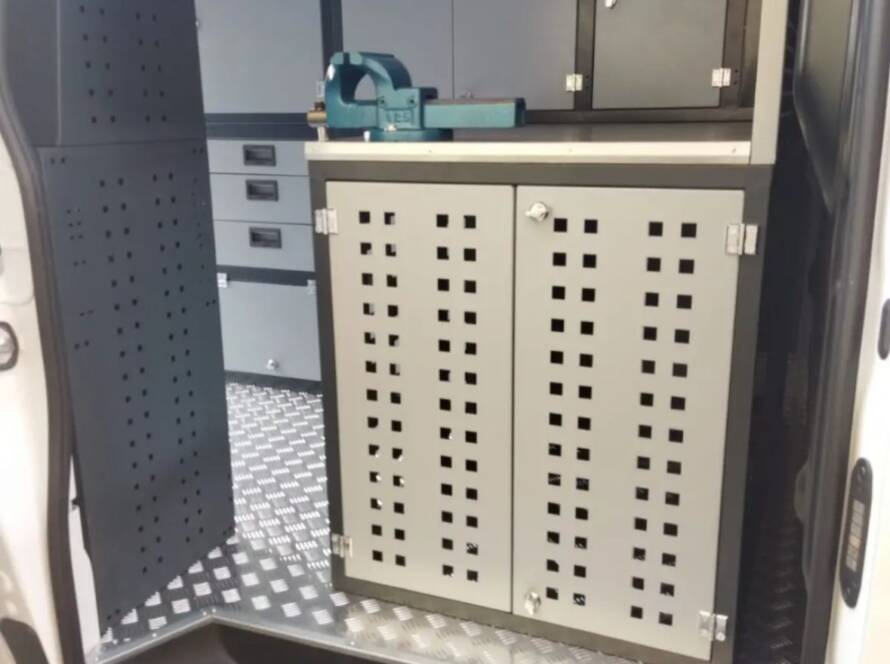
The light and medium duty shelving and drawer mold racks in the Detay Endüstri product range provide physical storage infrastructure for different loads. How this infrastructure will connect with digital processes must be planned separately around product identifiers, storage addresses, the company’s software, and the selected technology. The RFID, sensor, and automation options discussed here are general technology applications; they do not imply that a particular rack model includes standard smart equipment or ready-made integration.
What Is Smart Racking, and Which Problems Does It Solve? 🧠
Smart racking can be understood as a storage arrangement that collects data about stored materials or guides users during a task. In some applications, verifying the storage address with a barcode is sufficient, while monitoring bin weight or illuminating the correct compartment may be more useful elsewhere. Technology selection should therefore begin with a specific problem, such as misplaced items, stock shortages, lengthy picking times, or unrecorded material movements, rather than a list of devices.
The first question I would ask in a project like this is, “Which decision will we be able to make better once we have collected this data?” A number on a screen creates value when it leads to an action: opening a replenishment task for a bin that has reached a critical level, preventing a mold undergoing maintenance from being allocated to production, or flagging an incorrectly stored part for checking. If we think of the racking as a library and the digital records as its catalog, the catalog and the physical arrangement must consistently reflect the same information. 📚
Matching Material Identity with Storage Locations Using Barcodes and RFID
In a barcode or QR code application, users can confirm a putaway or retrieval transaction by scanning the material first and then the storage address. Consistent definitions of product codes and locations are fundamental to this arrangement. For example, an address such as “aisle A, bay 03, level 02, compartment 04” should refer to the same place on both the label and in the software. Codes must remain readable, damaged labels should be replaced, and digital addresses must be updated whenever the physical layout changes.
RFID uses radio frequencies to read tags; with a suitable reader and tag configuration, multiple objects may be identified. The GS1 RFID standards explain the technology’s role in product identification and supply chain visibility. However, reading a tag does not mean that its presence in a particular storage compartment has been conclusively established under all conditions. Read zones, reads originating from neighboring racks, and the direction of material movement must be validated for the application.
Tag selection is particularly important when metal racks and metal parts are involved. GS1’s explanation of RFID around metal and liquids notes that tags designed for metal surfaces are available and that liquids can affect reading performance. 🔍 Rather than assuming that a catalog read range will translate directly into results at the facility, conduct a pilot using actual parts, packaging, rack occupancy, and movement conditions.
Monitoring Stock Levels with Weight Sensors ⚖️
For bins containing identical small parts, weighing can help estimate the quantity remaining. The basic approach is to subtract the container’s tare weight and divide the net weight by the average weight of one part. For example, purely to illustrate the calculation, if a bin has a net contents weight of 2,000 grams and the average part weighs 20 grams, the estimated quantity is 100 pieces. The reliability of this result depends on measurement resolution, variation in part weights, an accurate tare value, and the absence of unrelated items in the bin.
METTLER TOLEDO’s guidance on counting parts by weight emphasizes that even standardized parts can vary in weight and that the average piece weight must be established correctly. Mixing different products in the same bin, failing to record packaging changes, or temporarily placing a hand tool in the bin can therefore produce misleading stock information. Sensor-based tracking should include reference counts, appropriate calibration, and checks for discrepancies.
A weighing system that estimates stock quantities does not perform the same function as a system monitoring the structural safety of a rack. A sensor underneath a bin cannot assess all the connections in the rack frame or the condition of its anchors. If overload warnings are required, the load covered by the measurement, the basis for the alarm threshold, and the operator’s response must be defined separately.
Supporting Picking and Assembly with Light Guidance 💡
In systems known as pick to light, an indicator at the relevant storage compartment directs the user to the correct location according to the task sequence; some applications display the quantity to retrieve and ask the user to confirm completion. Banner Engineering’s pick-to-light applications explain how this approach is used in assembly, kitting, and order picking. Visual guidance can help users find the correct compartment, particularly where similar-looking parts are stored.
Pressing a confirmation button and retrieving the correct product in the correct quantity are different events. Depending on the risk associated with the task, barcode verification, a weight check, or another validation step may be necessary. The business should assess not only whether an indicator lights up, but also how to handle picking from the wrong compartment, insufficient quantities, unavailable products, and interrupted tasks. Providing text, numbers, or location information alongside color makes the indicators easier for users to understand.
Which Technology Suits Which Requirement?
| Technology | Primary application | Main limitation | What to check during the pilot |
|---|---|---|---|
| Barcode or QR code | Verifying the product and storage address during a transaction | Requires consistent scanning and readable labels | Skipped transactions and incorrect location records |
| RFID | Tracking tagged material movements with less manual scanning | Metal, liquids, and read zone design affect the result | Missed reads, reads from neighboring areas, and repeated reads |
| Weight-based tracking | Estimating quantities of identical parts | Tare and part weight variations can introduce errors | Counting discrepancies at different fill levels |
| Light guidance | Indicating the correct compartment for picking or assembly | May not independently verify product identity and quantity | Incorrect selections and task completion time |
| Temperature and humidity sensors | Monitoring the environment around products sensitive to storage conditions | A sensor’s location may not represent the entire area | Measurement accuracy, coverage, and alarm delay |
| Impact or vibration detection | Recording events that may require inspection | Does not independently diagnose structural damage | Comparison of detected events with physical inspections |
Preserve the Meaning of Data in WMS and ERP Integration 🔄
A warehouse management system, or WMS, can manage locations and warehouse transactions, while an enterprise resource planning system, or ERP, can manage broader business processes associated with purchasing, production, and inventory. A smart racking project must establish which system holds the authoritative record for each type of information. Otherwise, the quantity detected by a sensor, stock available for use in the warehouse, and the accounting record may be presented as a single “stock” figure even though they differ.
GS1’s explanation of the relationship between EPC and EPCIS states that EPCIS supports the sharing of visibility data within organizations and across supply chains and can work with different data carriers, including barcodes and RFID. A practical principle for the project is to retain the time, location, and transaction context alongside each read. This allows repeated reads of the same tag to be distinguished from new stock receipts and helps separate movements such as returns, transfers, and shipments.
For example, moving a part from material cabinets to a job at a workbench may represent either a transfer or consumption, depending on the company’s process. This distinction should be defined at the outset. Pending records during an outage, the time of the latest data, and reconciliation rules after reconnection should also be visible; information that is no longer being updated should not be presented as “real-time stock.”
Digital Identification and Maintenance Status Tracking in Mold Storage 🔧
A mold tracking application can record not only the storage address but also the mold code, verified weight, associated product, last maintenance date, and operating status. This keeps “present on the rack” separate from “ready for production.” Appropriate status checks can be configured in the software to prevent a mold awaiting maintenance from being allocated to a work order by mistake, while physical labeling makes this information understandable on the shop floor.
In a hypothetical scenario, an operator scans a mold’s code when retrieving it from the rack and sees that maintenance approval is missing. The task is stopped according to the defined procedure and referred to the responsible person. In this example, the benefit comes not only from the label but also from keeping the maintenance record current and assigning responsibility for the warning. Records that users can trust also make communication between shifts easier. 🤝
Sensors Should Support Physical Rack Inspections 🦺
A system that detects impact, tilt, or changes in load may make the need for inspection visible sooner; however, the absence of an alarm does not prove that a rack is undamaged. The HSE warehousing safety guidance emphasizes suitable rack design and installation, damage reporting, and regular inspections. Digital monitoring supports this approach; it does not replace capacity labels, connection checks, or assessment by a competent person.
Unauthorized holes should not be drilled into structural members to add sensors or cables, and modifications that could affect load transfer through the rack should be reviewed with the manufacturer. Following a suspected impact or damage report, use of the affected area should be controlled; if unloading is necessary, competent people should determine a safe method. A software status showing “alarm closed” must not be treated as proof that the physical defect has been corrected.
Cybersecurity and Outage Management for Connected Racking 🔐
When readers and sensor gateways connect to the company network, device access permissions and maintenance responsibilities become part of the project. The NIST SP 800-82 Rev. 3 Guide to Operational Technology Security provides a framework for considering security, availability, and safety requirements together in systems that interact with the physical environment. Device inventories, appropriate network segmentation, restricted permissions, controlled remote access, and restorable backups should be considered within this framework.
Outage scenarios should also be part of the design: which tasks will continue manually if a reader stops working, where will records be kept, and how will duplicate entries be prevented when connectivity returns? Updates and maintenance should be planned around production conditions; a general-purpose inventory application should not perform a safety function without a separately designed and validated safety system.
Start with a Small Pilot and Measure the Results 📊
For the initial implementation, select a clearly defined material group and rack section rather than converting the entire warehouse. First record existing inventory count accuracy, material search time, and picking error rates; then test the selected technology under the same working conditions. Success criteria should be agreed before installation, and the assessment should cover not only average results but also busy shifts, low batteries, connectivity failures, and incorrect labels.
- Define the problem: Specify the error or delay to be reduced in measurable terms.
- Organize the data: Clarify product codes, storage addresses, units of measure, and responsibilities.
- Set up the pilot: Work in a limited area with representative products and actual users.
- Investigate discrepancies: Compare sensor results with physical counts and transaction records.
- Decide whether to expand: Assess the benefits, maintenance workload, and total cost together.
To demonstrate the calculation, suppose an average of 20 seconds is saved on each of 120 picking tasks per day. This amounts to 40 minutes daily and approximately 14 hours and 40 minutes of labor time over 22 working days. This figure is neither a customer result nor a performance promise; comparisons involving different workloads can also be misleading. Time saved does not directly equal cash savings either; how employees use that time should be examined.
The investment assessment should include label replacement, batteries, software licenses, integration, training, calibration, and support costs alongside readers and sensors. If AI-based consumption forecasts or storage layout recommendations are being considered, establish reliable movement history first and compare the recommendations with straightforward planning methods. An AI recommendation does not, on its own, constitute technical approval for rack capacity or a maintenance decision.
Design Technology Around Daily Warehouse Operations
Smart technology in industrial racking creates value when it connects the correct product with the correct location and current transaction information. In a successful implementation, user training, maintenance, data quality, and exception handling matter as much as sensors, labels, and software. The practical value of the technology is reflected in employees being able to find the required part, understand how current a record is, and know whom to contact when they identify a problem.
When evaluating your racking infrastructure with Detay Endüstri, consider load characteristics, access requirements, and mounting space for future digital applications together. A project that starts with a measurable problem, is validated through small pilots, and has clearly defined responsibilities can help make storage operations more traceable and manageable. 🏭✅