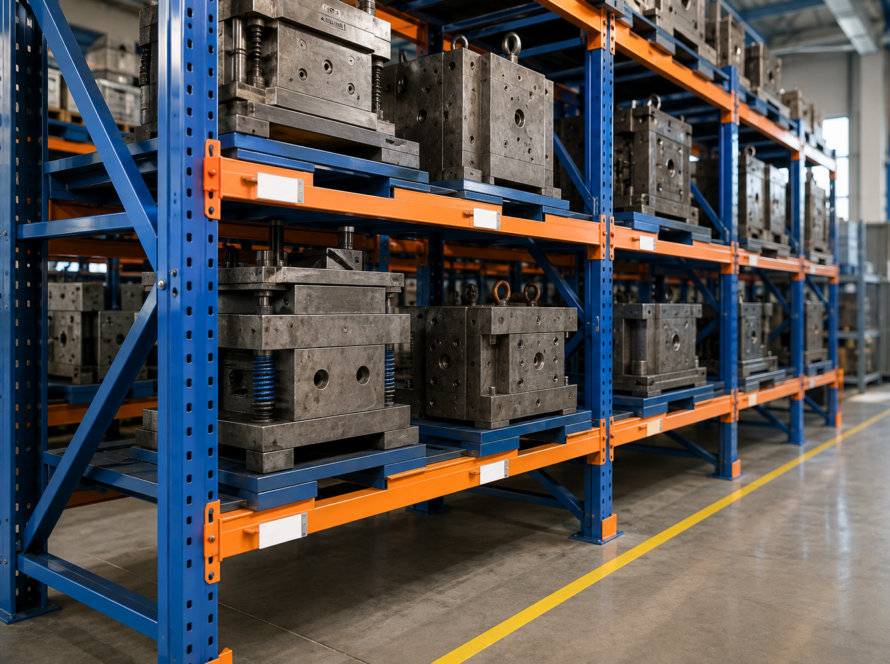
I always see this topic as the invisible backbone of the factory 🤝 Because no matter how modern the production line is, if mold changes take too long, if heavy equipment is waiting in the wrong place, if auxiliary apparatus is stored in a scattered way, or if a maintenance team spends unnecessary time just trying to find the right tool, then there is a quiet but serious loss of efficiency in that facility. Drawer mold racks become not just metal storage products here, but systems that directly generate speed. In fact, on the product pages of Detay Endüstri, safe storage of heavy-tonnage molds with minimum space use, ergonomic access through telescopic-rail drawers, and a more controlled pickup and placement flow with cranes are especially emphasized. For that reason, the drawer rack solution should not be read on its own, but as the central element of an industrial storage structure.
Why Are Drawer Mold Racks a Separate Category?
Evaluating standard racks and drawer mold racks in the same way often leads to the wrong conclusion 🙂 Because molds are not ordinary loads. They are heavy, bulky, often have irregular geometry, require lifting equipment, and when stored incorrectly they can create serious risks both for equipment and operators. In a conventional fixed-rack logic, you place a mold into a rack bay and access usually requires additional maneuvering. By contrast, in drawer mold rack systems, because the load can be pulled out in a controlled way with telescopic rails, both visibility increases and access becomes much more ergonomic for cranes, lifting devices, and maintenance teams. That single difference alone can create major time savings on both the production and maintenance side.
The real issue here is not only access 😊 A drawer system makes it possible to store molds without stacking them on top of each other, without leaving them on the floor, without losing them in the back row, and without exposing them to unnecessary friction during transport. This affects mold lifespan, operator safety, and workplace discipline at the same time. Especially in the approach discussed in how a mold storage area should be organized, it is clear that efficient storage is not just about having many racks, but about correctly designing which load should be kept with which access logic. This is exactly why the drawer systems of Detay Endüstri stand in a much more strategic place than a conventional shelving solution.
Which Industrial Storage Solution Is Better Suited to Which Need?
There is no single right answer in industrial storage 🙌 Because every facility has a different load profile, area, aisle width, lifting equipment, and usage frequency. Even so, in practice, when drawer mold racks are considered for heavy molds and dense metal equipment, light and medium-duty racks for auxiliary apparatus and consumables, cabinet systems for sensitive and controlled storage, and suitable work areas for preparation and maintenance, a far more efficient structure emerges. In other words, the issue is not only the question of “which rack is better,” but rather “which rack should take on which role.”
| Solution Type | Main Role | Strongest Advantage | Most Suitable Area of Use |
|---|---|---|---|
| Drawer Mold Rack | Store heavy molds in an organized and safe way | Ergonomic access and high space efficiency | Mold shops, press lines, injection departments |
| 65% Extendable System | Provide controlled and balanced extension | Safer behavior in narrow aisles | Facilities with limited space |
| 100% Extendable System | Full access and fast maintenance or changeover | Ease of crane and maintenance maneuvering | Facilities with frequent mold changes |
| Light and Medium Duty Racks | Auxiliary equipment and consumables organization | Relieves the main mold area | Storage of apparatus, boxes, and auxiliary materials |
| Material Cabinets | Locked and controlled auxiliary storage | Reduce clutter and part loss | Measurement equipment, maintenance tools, small parts |
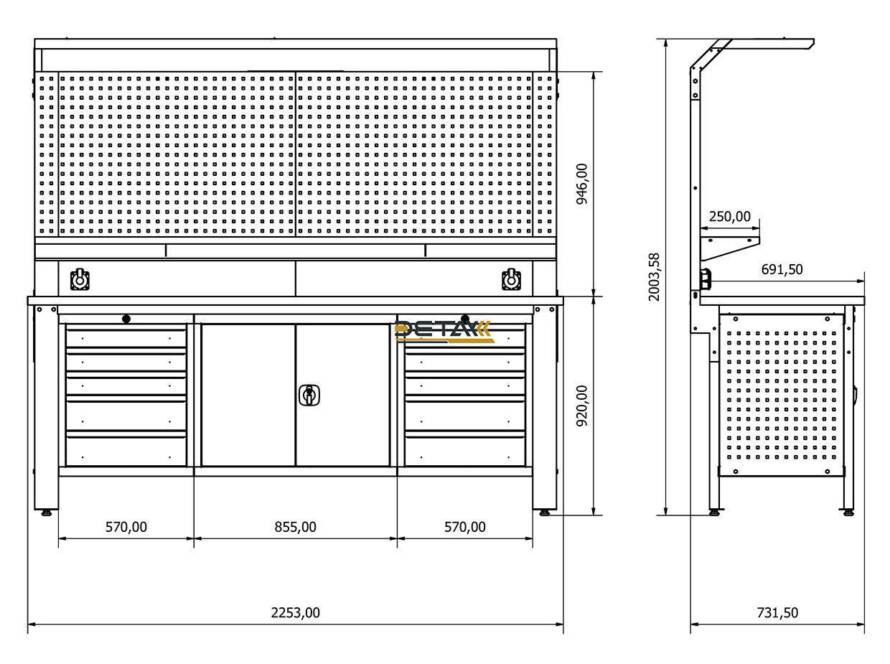
| Workbenches | Create preparation, maintenance, and inspection areas | Gather the operational flow in one point | Mold preparation and maintenance points |
Main Advantages of Drawer Mold Racks
In my opinion, the strongest advantage of drawer mold racks is that they enlarge access without enlarging the area 💪 Because you can store heavy molds in a vertical and controlled structure instead of spreading them across the floor. This both relaxes floor usage and makes it easier to assign a separate address to each mold. Because the mold can be pulled out, cranes or lifting equipment can approach in a more controlled way, the maintenance team can access the entire mold more comfortably, and unnecessary intermediate handling steps are reduced. In international practice as well, telescopic or pull-out structures stand out in heavy mold storage in terms of safety and ergonomics. That is why, in the solutions of Detay Endüstri, the drawer structure is not only a mechanism, but directly a tool of operational efficiency.
The second important side of this is the sense of order 😊 Keeping each mold in its own drawer, under its own label, and in its own access logic significantly reduces the operator’s mental load. Time-wasting questions such as “Was this mold in the back, was it in another bay, do we need to lower that mold first?” disappear. Especially in solutions such as the 100% extendable drawer mold rack, where full access is provided, maintenance, cleaning, and mold preparation can be performed more comfortably, which can create visible improvement in mold changeover times. That is why, in the approach of Detay Endüstri, the drawer mold rack is not merely a heavy-load rack, but a storage logic that accelerates the process.
How Should 65% and 100% Extendable Drawer Mold Racks Be Chosen?
The choice between these two systems often depends on the real use scenario of the facility 🙂 If your area is more limited, the aisles are narrow, and you want to prioritize safety and balanced use behavior slightly more, the 65% extendable drawer mold rack may be a very logical option. Because in this type of system, an important portion of the center of gravity remains on the rack frame, which provides controlled extension. In narrow mold shops, dense but tight layouts, and areas where safe maneuvering is highly important, this structure can work in a calmer and more balanced way.
If mold change frequency is high in your facility, if maintenance teams need access to the entire mold surface, and if direct crane pickup and placement flow is highly important, systems with full extension offer a stronger advantage 🚀 The real value here is not only that the drawer opens more, but that process time is shortened. Preparation, cleaning, and inspection steps on the mold move much more comfortably. For that reason, the most accurate selection should be made not with the question “which one opens more,” but with the question “in our site, which is more critical, speed or controlled compactness?” At this point, the different extension logics in the product range of Detay Endüstri are very valuable in terms of building solutions according to the real needs of the facility.
How Are Industrial Storage Solutions Completed with Drawer Racks?
A basic mistake many businesses make is trying to solve the entire storage problem in the mold shop or heavy-equipment area only with the main rack system 😌 Yet a drawer mold rack is an excellent solution for managing the main load, while apparatus, fasteners, consumables, measuring tools, and maintenance equipment should be stored according to a different logic. If all of these elements are kept in the same drawer or in the same main area, chaos quickly develops. That is why light and medium duty racks are the natural complement of drawer mold racks. By separating auxiliary equipment from the main mold area, they create both visual order and access speed.
In the same way, for sensitive equipment, maintenance kits, measuring tools, or small parts that need to be kept under control, material cabinets also play a very important complementary role. Because industrial storage determines not only where to put large products, but also how not to lose small but critical parts. When approached with this holistic point of view, drawer rack systems work at the center, while cabinets and auxiliary racks work as the support layer. This is exactly where the value of Detay Endüstri solutions emerges; the systems are thought of not as isolated products, but as a storage architecture that works together.
Why Are Maintenance, Preparation, and Work Areas as Important as the Rack System?
A mold or heavy piece of equipment is not only stored; from time to time it is prepared, inspected, cleaned, worked on, and returned to use 🔧 That is why industrial storage solutions remain incomplete when they consist only of racks. If there is no preparation or maintenance point where the mold can be directed directly and in an orderly way after leaving the storage area, a new kind of disorder appears on the floor. For that reason, workbenches and preparation areas are the operational complement of drawer rack systems. Especially in facilities where maintenance and adjustment work is frequent, these two should be considered together.
I always interpret it this way 😊 A good storage area should answer not only the question “where are we storing it,” but also the question “where does it go when it comes out.” If the mold comes out of the drawer rack but requires unnecessary maneuvering before reaching a suitable surface for maintenance, then the system still wastes time at another point. That is why planning the racks together with preparation surfaces, aisles, and crane flow makes a very big difference. One of the reasons that makes the solutions of Detay Endüstri valuable is exactly this: it treats storage not as an isolated subject, but as part of the workflow.
How Is a Balance Built Between Space Efficiency, Safety, and Speed?
In industrial storage decisions, three basic pressures are often felt at the same time 😊 More products need to be stored, operations need to be safer, and at the same time the processes should not become slower. Real success, however, lies in creating an intelligent balance between these three headings. A very compressed but hard-to-access arrangement may seem to save space, but it wastes time. A very accessible but unnecessarily spacious layout may reduce space efficiency. Drawer mold racks offer a strong advantage in establishing this balance, because they use vertical space more effectively while providing controlled access. In international heavy mold storage practices as well, safe and fast access, especially for heavy molds, is emphasized as something that supports operational safety by reducing manual handling.
The healthiest method here is to classify products according to frequency of use. The most frequently used molds can be kept in more active access zones, while those used less often can be kept in more passive zones. The same logic applies to apparatus and consumables. For example, auxiliary sets belonging to active molds can be located in complementary zones close to the drawer system, while rarely used parts can be kept in more remote but orderly shelving. This layered way of thinking improves not only storage space, but also decision speed. That is why the process-oriented approach seen in the Detay Endüstri blog structure makes product selection much more meaningful.
How Does the System Work in a Sample Setup?
Let us say you have a medium-sized facility working with plastic injection molds, and mold changes are not part of a weekly routine, but almost part of the daily rhythm. In such a facility, using drawer mold racks for the main heavy molds makes a great deal of sense. Frequently used molds that require full access can be kept in full-extension systems, while molds near the line that require more controlled storage and where space is tighter can be kept in systems with more limited but safer extension. Bolts, apparatus, small connection sets, and consumables related to the molds can be categorized on light and medium duty racks. Maintenance kits and sensitive measuring tools can be protected in material cabinets. And once the mold is pulled from the drawer, it can be directed straight to a workbench for preparation and inspection. A real industrial storage solution works in exactly this kind of layered way.
In this kind of setup, the most important difference is that every product is stored in a place appropriate to its own function 👍 The mold is in the main drawer system, auxiliary parts are on supporting racks, sensitive products are in controlled cabinets, and the work surface is in the operation area. This way, everyone on the floor knows where everything is, the crane path does not become unnecessarily crowded, the maintenance team focuses on the work instead of searching for items, and the production plan becomes more predictable. In my opinion, this kind of setup is not only order, but also a sign of organizational maturity. Because the more systematic the storage logic in a facility is, the calmer and more controlled the production behavior usually becomes.
A Short Anecdote
One of the most instructive examples I saw in a production plant was a mold room that was physically strong but operationally exhausting 😊 The racks were solid, the space was not bad, and the equipment was not insufficient, but the molds, apparatus, and auxiliary materials had not been separated according to the right flow. As a result, everyone could find what they needed, but everything was found with a delay of a few minutes. Later, when the auxiliary racks and cabinets were reclassified with the drawer system taken as the center, the total area hardly changed, but the workflow sped up significantly. That day reminded me once again that strong equipment and an efficient system are not the same thing.
There Is an Emotional Side Too: Order Creates a Sense of Confidence and Control
This issue also has a human side, not only a technical one 💙 In areas working with heavy molds and equipment, order gives workers a powerful but often unnoticed feeling of confidence. When people know where everything is, they move in a more controlled way. The crane operator works more calmly. The maintenance team feels less pressure. The production supervisor experiences less stress over whether preparation will be delayed. In other words, a good storage system does not only balance metal, but also the rhythm of human work. That is why I believe it is very valuable to think about the correct project-based solution starting from the contact stage; because a good system is not an order added afterward, but a work culture established from the beginning.
A Simple Diagram Related to the Topic
HEAVY MAIN LOAD
Molds / dense metal equipment / large tool sets
      ↓
MAIN SOLUTION
Drawer mold rack
      ↓
COMPLEMENTARY LAYER
Light-medium duty racks + material cabinets + workbenches
      ↓
FLOW MANAGEMENT
Safe access + crane compatibility + maintenance preparation + orderly return placement
      ↓
RESULT
Faster process + safer floor + higher space efficiency + more professional appearance

Frequently Asked Questions
1. Which businesses are drawer mold racks suitable for?
They are highly suitable for injection, press, automotive, metal processing, and similar production areas where molds are used and heavy equipment is central.
2. What is the biggest advantage of a drawer system?
It provides safer, more orderly, and more ergonomic access to heavy molds.
3. Is a 65% extendable system or a 100% extendable system better?
That depends on the space structure and the use scenario. The choice should be based on whether controlled safe access or full access is more important.
4. Why should industrial storage solutions be considered together?
Because main molds, auxiliary apparatus, consumables, and maintenance equipment should not all be stored in the same way.
5. What do light and medium duty racks do inside a mold room?
They create order by separating apparatus, boxes, and auxiliary parts from the main mold area.
6. Why are material cabinets necessary?
They provide more controlled and cleaner storage for measuring tools, maintenance kits, and small parts.
7. Is a workbench part of the storage system?
Yes. Because it completes preparation, maintenance, and inspection flow, it indirectly increases storage efficiency.
8. Does a drawer mold rack save space?
Yes. It helps store heavy molds in a more controlled and vertical way instead of spreading them across the floor.
9. Do these systems really improve safety?
Yes. They support safety through controlled access, more orderly placement, and fewer unnecessary handling movements.
10. How should the right solution be selected?
Product weight, frequency of use, aisle structure, crane access, and auxiliary equipment flow should all be evaluated together.
People Also Ask
- What is the difference between a drawer mold rack and a classic heavy-duty rack?
- Why is one type of rack not enough in mold shops?
- How does a 100% extendable system affect maintenance speed?
- Which mold rack makes more sense in a narrow aisle?
- How should auxiliary apparatus and connection elements be stored?
- How should workbenches and rack systems be planned together?
- What is the first step for safety in an industrial storage area?
- Does mold room organization really affect production time?
- Which storage solution provides the highest space efficiency?
- Why is crane access so important in drawer systems?
Conclusion
To sum it up 😊 When drawer mold racks and industrial storage solutions come together, what emerges is not just an area where products sit, but a working infrastructure that produces speed, safety, visibility, and control. Supporting the main heavy loads with drawer systems, auxiliary equipment with suitable racks, sensitive parts with cabinets, and preparation processes with work areas creates a much healthier order within the facility. That is why the best solution is not to install the most racks, but to build the most suitable storage logic for each type of load.
My clear opinion is this 👍 If a business wants to reduce mold changeover time, use its space more efficiently, ease maintenance flow, and prevent teams from wasting unnecessary time, then the storage decision should be addressed not only under the heading of capacity, but under the heading of process. That is exactly why moving forward with manufacturers such as Detay Endüstri, which read the system as a whole, leads to much more meaningful results. Because the best storage system is not the one that only looks strong, but the one that makes the work flow more smoothly every day.
And perhaps the most important part is this 💙 A well-organized, safe, and intelligently planned industrial storage area does not tire the worker, protects the equipment, relieves the manager, and gives confidence to the customer. If, when the door of the mold shop or heavy-equipment area opens, what is felt is not chaos but control, then the right system has been established. Real efficiency usually begins exactly there.