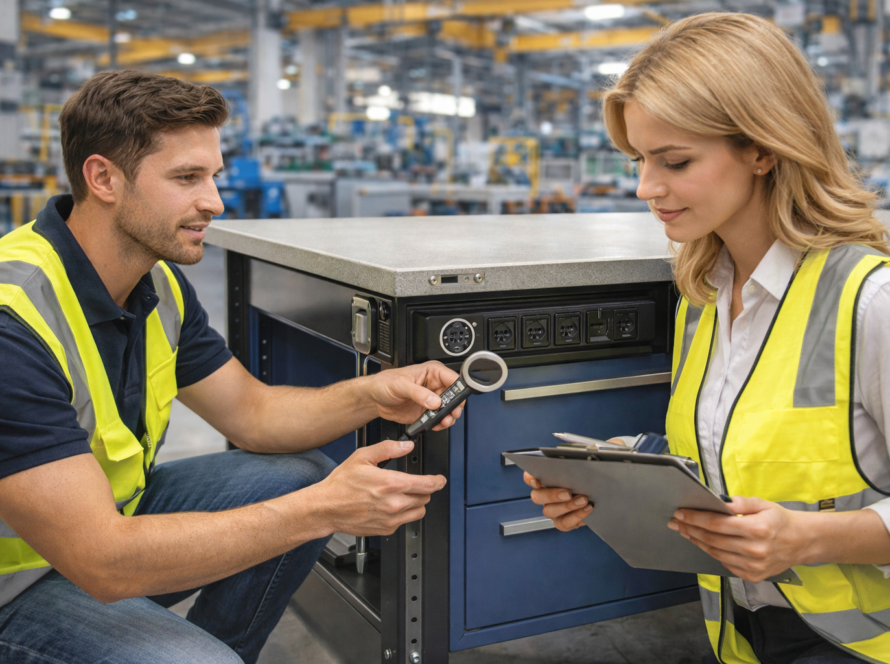
I always think about this subject in the following way 🤝 A well-designed in-vehicle system is like a second teammate quietly working alongside the technician. It knows where everything belongs, keeps materials stable during driving, allows tools to be found quickly, prevents small parts from getting scattered, keeps sensitive devices protected, and when the vehicle doors open at the end of the job, it shows the customer order instead of chaos. That is exactly why in-vehicle cabinet and shelving systems are not simply storage products, but efficiency infrastructure. A few extra minutes spent in the field by a technician can turn into hours by the end of the day; a properly organized in-vehicle equipment system quietly gives that time back.
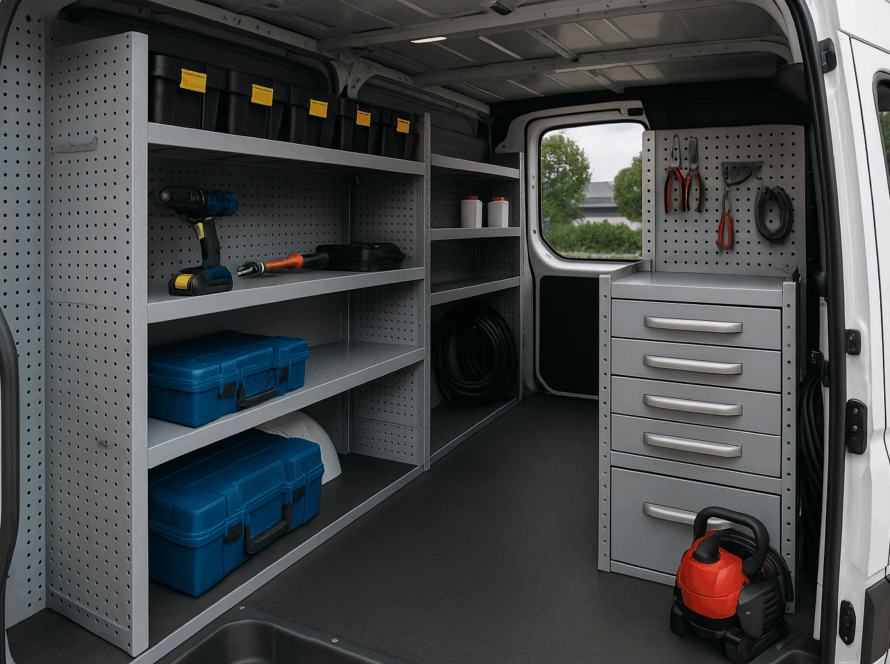
What Does Functionality Really Mean?
In in-vehicle equipment, functionality is not, as many people assume, simply a matter of saying “there should be a shelf, there should be a drawer, there should be a cabinet” 🙂 Real functionality means positioning equipment according to its frequency of use, placing heavy parts safely close to the floor, storing small and frequently used components without letting them mix together, protecting sensitive devices from impact, preventing materials from shifting during driving, creating a setup that reduces unnecessary bending and reaching for maintenance personnel, and doing all of this without making the vehicle interior feel cramped. In fact, when you look at the product and blog structure of Detay Endüstri, this is exactly the point: not putting things inside a vehicle, but turning the vehicle interior into a place that actively supports the work.
The efficiency side is simply the daily operational result of that functionality 😊 In other words, if a drawer is positioned correctly, the required socket set is found in thirty seconds; if an open shelf is designed in the right size, consumables are visible at a glance; if a lockable compartment is planned correctly, an expensive test device can be transported safely; and if a work surface is integrated properly, the technician can complete a small task on site without leaving the customer area to search elsewhere. That is why, in the approach of Detay Endüstri, functionality and efficiency are not two separate topics, but two sides of the same system.
Which Type of Equipment Delivers Which Efficiency Advantage?
Now let us move to the more concrete part 🙌 There is no single correct answer for everyone in in-vehicle equipment solutions. Because as the service scenario, the nature of the transported equipment, the type of vehicle, and the frequency of daily use change, the most efficient configuration also changes. But in general terms, open shelves provide speed, drawers create order, enclosed cabinets provide protection, upper shelves improve space usage, and custom compartments deliver precise personalization.
| Equipment Type | Functional Benefit | Efficiency Contribution | Most Suitable Scenario |
|---|---|---|---|
| Open Shelves | Provide quick visibility and instant access | Reduce search time | Frequently used boxes and consumables |
| Drawer Modules | Keep small parts categorized | Reduce clutter and increase working speed | Hand tools, fasteners, kits |
| Enclosed Cabinets | Protect sensitive and valuable equipment | Reduce risk of loss and damage | Measurement devices, documents, electronic equipment |
| Upper Shelves | Prevent upper space from being wasted | Increase usable volume | Light and bulky materials |
| Custom Compartments | Provide fixed spaces for specific equipment | Eliminate layout confusion | Cable reels, devices, cylinders, special kits |
| Mini Work Area | Turns the vehicle into a mobile workshop | Shortens on-site task time | Assembly, testing, small repair jobs |
1) Open Shelves: The Star of Speed-Focused Operations
Open shelves provide a major advantage especially for teams that repeatedly access the same boxes, consumables, or basic hand tools throughout the day 🚐 Because they eliminate the need to open a door, unlock a compartment, or pull out a drawer. Open modules placed close to eye level allow the technician to see what is where at a glance. This logic is also clearly reflected in the approach of choosing in-vehicle equipment for mobile service vehicles; the order inside the vehicle directly affects field performance. The value of open shelving starts exactly there: it shortens access time.
Of course, there is a small but important balance here 🙂 Open shelves are not ideal for every single part. If the transported material is fragile, expensive, or likely to shift during driving, then using open shelves alone is not enough. In that case, it becomes necessary to support them with dividers, front barriers, box systems, or enclosed modules. In other words, functionality does not mean “choosing one module”; it means matching the right module to the right type of material. And that flexibility is one of the strongest aspects of Detay Endüstri solutions.
2) Drawer Systems: The Strongest Tool for Organization
For technical teams working with small components, drawer modules are almost indispensable 😊 Screws, connectors, fuses, clamps, socket sets, measuring accessories, hand tools, and different small parts are all highly prone to getting mixed together. Drawer systems turn that confusion into categorized order. Thanks to drawer dividers, labeling, different depth options, and rail systems chosen according to carrying capacity, small components stay under control. This allows the technician to find the required item not by guessing, but by knowing exactly where it is.
At this point, functionality is not only about storage; it is also about ergonomics. Placing the most frequently used items at waist height, storing heavier materials in lower drawers, and creating inner layouts that reduce vibration for sensitive equipment all reduce daily fatigue. It is no coincidence that in the topic of ideal shelf and cabinet solutions for mobile service vehicles, efficiency, safety, and professionalism are handled together. Because when drawers are designed correctly, they produce not only order, but also speed and confidence.

3) Enclosed Cabinets and Lockable Areas: Protection Is Also Part of Efficiency
Sometimes efficiency is not just about speed, but about preventing loss 🔒 If expensive testing devices, sensitive electronic equipment, documents, or customer-owned special parts need to be transported safely, enclosed cabinets make a major difference. Because unprotected equipment can be lost, scratched, broken, or delayed in access due to disorder. Lockable and controlled compartments, on the other hand, provide both confidence and a professional appearance. In this sense, when the logic of material cabinets is brought into the vehicle interior, a very powerful level of functionality emerges.
Even more importantly, fixing the load securely inside the vehicle is not merely a good habit, but a real safety requirement. HSE clearly emphasizes that every load carried in a vehicle must be secured to the vehicle, while OSHA stresses that stored materials must not create slip, fall, or collapse hazards. That is why enclosed cabinets, lockable drawers, and solid installation details are not only about comfort, but part of safe driving and safe working discipline. This perspective also makes the subject of the importance of locking mechanisms much more meaningful.
4) Upper Shelves and Vertical Space Use: Turning Empty Volume into Practical Value
One of the most frequently overlooked points in vehicle interior efficiency is the correct use of vertical space 😌 In many vehicles, the floor area fills up while the space near the roof remains unused. Yet upper shelves are an excellent solution for light but bulky materials, protective equipment, cleaning supplies, packaging materials, and accessories that are only needed occasionally. This allows the lower zones to remain available for heavy and frequently used equipment. This does not just save space, but also makes the working flow smarter.
The critical rule here is this: heavy equipment should stay below, light equipment should go above. Because if the center of gravity is disturbed, both driving safety and access logic inside the vehicle are negatively affected. One of the most important aspects of in-vehicle shelving and storage layout in mobile workshops is exactly this; order is not created merely to look good, but to function in a balanced way. I usually explain this with a small metaphor 😊 Vehicle interior organization is like a chessboard; the place of every piece is determined not randomly, but by a logic that affects the outcome.
5) Custom Compartments, Accessories, and Mini Workstations: The Advanced Level of Efficiency
True efficiency often comes not from standard modules alone, but from small details developed according to the nature of the work ✨ Special slots for cable reels, cylinder restraints, device compartments, charging units, laptop spaces, document pockets, LED lighting, non-slip flooring details, integrated small bench surfaces, and even mini vise points elevate in-vehicle equipment to a completely different level. Because at that point, the vehicle stops being only a place where equipment is transported and becomes an active part of the work itself.
The approach summarized in experience the ease of a mobile workshop with vehicle shelves captures this very well. Drawers provide storage, the integrated work surface creates a task area, and the right accessories simplify movement inside the vehicle. Likewise, choices discussed in materials used in in-vehicle shelves also affect efficiency, because material type determines weight, durability, and long-term usage behavior. At this point, the modular approach of Detay Endüstri systems is one of the most important advantages that makes functionality tangible.
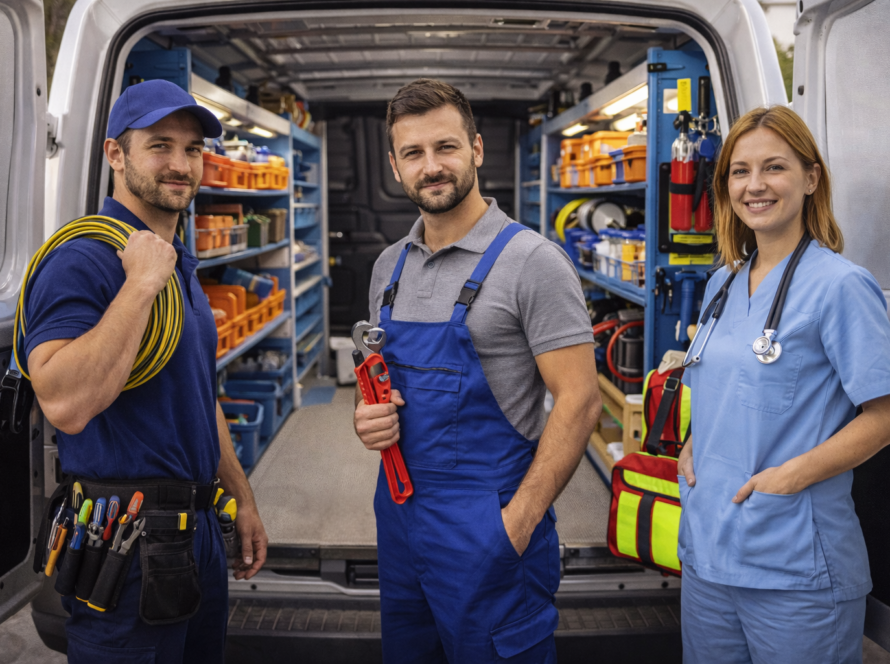
What Really Increases Efficiency Is Not the Number of Modules, but Workflow Design
In my opinion, this is the most important point of the whole topic 🙂 The number of modules placed inside a vehicle does not always mean a more efficient solution. Sometimes an overfilled vehicle works like a badly organized desk; everything is there, but nothing flows smoothly. A truly efficient system, however, understands the order of use. Where is the first piece of equipment that needs to be taken in the morning, which drawer is reached most often during the day, where is the first emergency tool, which module is opened in front of the customer, and which materials are returned most quickly when the job is complete? If these questions are answered correctly, the in-vehicle layout silently accelerates the daily pace.
That is why, instead of copying a standard layout, it is necessary to read the real usage habits of the vehicle. The question of standard or custom design? actually leads exactly to this point. If the team constantly searches for the same parts, if some modules are never used, if small equipment is always left scattered around, or if heavy materials are placed in the wrong position and make access harder, then the problem is not the number of shelves, but the workflow design. Brands that can see this difference, such as Detay Endüstri, make in-vehicle equipment much more meaningful.
Example Scenario
Let us say you operate an electrical maintenance service. During the day, the team carries fuses, cables, measuring devices, pliers, screwdrivers, connectors, and small consumables. In such a vehicle, heavy tool and cable drawers in the lower section, a labeled small-parts drawer system in the middle section, an enclosed cabinet on the side for sensitive devices, light protective equipment in the upper section, and a small working surface near the rear door could be highly efficient. But if the same vehicle were assigned to a roadside assistance team, the share of open shelving might increase, larger equipment compartments could become necessary, and a rapid-response logic would come forward. That is why the question asked in which industries cannot do without in-vehicle shelving systems is not just a marketing title, but directly a planning question.
A Short Anecdote
I still remember one technician saying: “Half of the job starts in the vehicle.” 😊 And that is really true. Because the first minutes after arriving at the customer site are extremely valuable. Losing three minutes just to reach the needed tool can sometimes disrupt the rhythm of the entire day. But a properly organized in-vehicle system quietly removes that loss. This is the point where functionality turns into an emotional value as well; when workers can find what they need, transport it safely, and access it comfortably, they feel more in control.
There Is an Emotional Side Too: Order Creates a Sense of Professionalism
This is not just about metal modules and shelves 💙 A messy vehicle mentally exhausts people. Constantly searching for something, worrying that materials may have shifted, thinking that small parts may have gone missing, and presenting a disorganized image in front of the customer all create invisible pressure on the worker. A well-designed in-vehicle system, on the other hand, calms the technician down. Seeing everything in its place when the vehicle doors open creates a small but powerful sense of confidence. And that confidence is reflected in the quality of the work.
For this reason, it would be incomplete to look at Detay Endüstri solutions only as “shelves.” These are also systems that improve work habits, reduce the margin of error, and make daily life inside the vehicle much more orderly. Good in-vehicle equipment does not show itself loudly; it quietly saves time, provides safety, and makes the work look more professional.
A Simple Diagram Related to the Topic
WORK SCENARIO
Maintenance / Electrical / HVAC / Roadside Assistance / Mobile Service
      ↓
EQUIPMENT ANALYSIS
Heavy / Light / Fragile / Frequently Used / Must Stay Locked
      ↓
EQUIPMENT SELECTION
Open Shelf + Drawer + Enclosed Cabinet + Upper Shelf + Custom Compartment
      ↓
SAFETY and ERGONOMICS
Secured load + Correct weight distribution + Fast access + Reduced bending/reaching
      ↓
RESULT
Faster workflow + Less lost time + Safer driving + More professional service

Frequently Asked Questions
1. What does functionality mean in in-vehicle equipment?
Functionality means placing equipment according to its frequency of use, safety needs, access convenience, and the actual workflow inside the vehicle.
2. Which module improves efficiency the most?
Not a single module on its own; efficiency increases through the right combination of open shelves, drawers, and enclosed cabinets.
3. Which is more efficient, open shelves or drawers?
Open shelves are more efficient for frequently used larger items, while drawers are better for small parts that are likely to get mixed up.
4. Are enclosed cabinets really necessary?
Yes, they are very useful for sensitive, expensive, or protected devices and components.
5. Does in-vehicle organization affect driving safety?
Yes. Loads that are not secured and not placed in balance can create risks for both driving and cargo safety.
6. Are upper shelves practical in every vehicle?
Yes for light and bulky materials; they are not suitable for heavy equipment.
7. Is a mini work surface necessary?
For teams that perform small assembly, testing, or repair tasks in the field, it can be highly efficient.
8. Does customization really increase efficiency?
Yes. A layout tailored to the vehicle, team, and equipment structure reduces search time and creates a smoother workflow.
9. Why are locking mechanisms important?
They prevent drawers and cabinets from opening during driving and help protect both the equipment and the user.
10. Is investment in in-vehicle equipment worth it in the long term?
Yes. It creates more orderly access, less lost time, better equipment protection, and a more professional service image.
People Also Ask
- Do in-vehicle shelving systems affect fuel efficiency?
- How should the ideal drawer layout be designed in mobile service vehicles?
- How should sensitive devices be protected inside a vehicle?
- How is weight balance maintained in in-vehicle equipment?
- Can open shelves and enclosed cabinets be used together?
- Is a mini workbench inside the vehicle really useful?
- Is the same in-vehicle shelving system suitable for every industry?
- How much do lockable modules improve safety?
- For which types of equipment are custom compartments necessary?
- Which is more efficient, a standard system or a custom design?
Conclusion
To sum it up 😊 In in-vehicle equipment solutions, functionality and efficiency are not separate concepts, but two core ideas that continuously feed one another. Open shelves create speed, drawers establish order, enclosed cabinets provide protection, upper shelves expand usable space, and custom compartments shape the system according to the actual user. But the real value of all these parts emerges only when they are combined correctly. The most efficient in-vehicle solution is not the one with the largest number of modules, but the one that aligns best with the rhythm of the work.
That is why my clear opinion is this 👍 If your vehicle is not just carrying materials during the day but actively producing work, then its interior organization should no longer be left to chance, but designed consciously. Which part is used most often, which one is heavy, which one is sensitive, which one should stay visible, which one should remain locked, which one requires fast access… the answers to these questions determine the right in-vehicle equipment plan. When viewed with this logic, working with application-focused manufacturers such as Detay Endüstri becomes far more meaningful.
And perhaps most importantly 💙 A well-designed in-vehicle system does not just save time; it also makes the worker more comfortable, gives confidence to the customer, protects the equipment, and allows the whole operation to flow in a more controlled way. In other words, good in-vehicle equipment is not simply the sum of metal modules. It is a quietly working efficiency infrastructure. So when you start looking at Detay Endüstri solutions and seeing workflow instead of just shelves, that means you are looking from the right perspective.