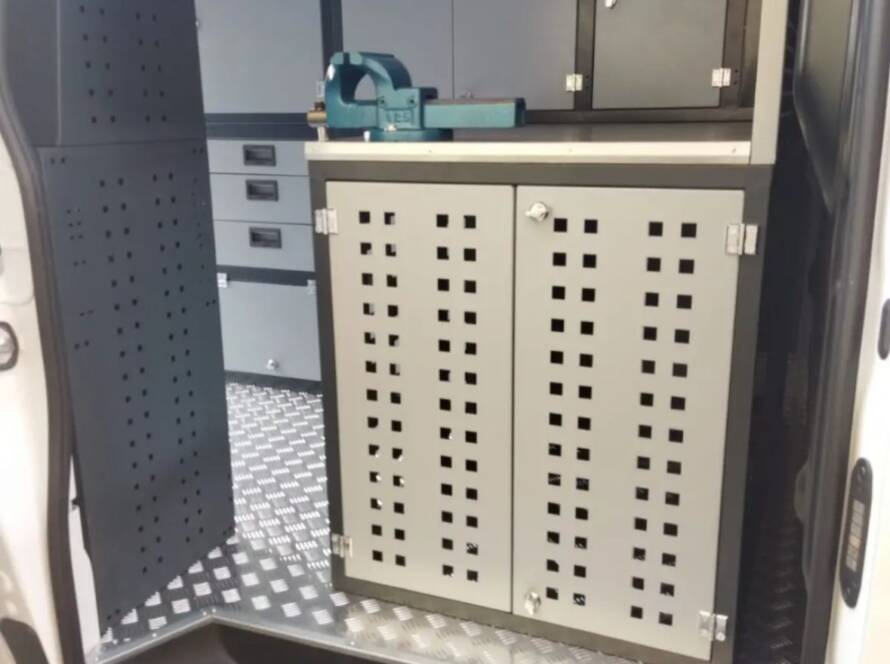
I always think about this subject in the following way 🤝 A roadside assistance vehicle is like a small but extremely active mobile operations center. Lug wrenches, wheel chocks, jump-start equipment, hand tools, cables, warning equipment, small consumables, measuring devices, safety gear, and sometimes customer-specific extra parts are all carried in the same vehicle. If these parts are placed randomly, even the simplest intervention takes longer. But if the system is designed correctly, the technician knows where to reach, does not have to think about where things are kept, and does not lose those critical first minutes searching for equipment. That is why in-vehicle cabinet and shelving systems in roadside assistance vehicles are not about comfort; they are directly about service quality.

Why Does Efficiency in a Roadside Assistance Vehicle Begin with Organization?
In roadside assistance teams, efficiency is often associated with field skill, but the reality is that field skill can only produce fast results if the vehicle interior layout works at the same pace 🙂 Because no matter how experienced the technician is, if they have to search in different places every time for a tool kit, cable, support equipment, or safety item, the operation naturally slows down. That is why an efficient roadside assistance vehicle is not simply a fully loaded vehicle; it is a vehicle planned according to the sequence of intervention. In other words, the equipment that needs to be reached first should not be stored at the same access level as the items used last. Heavy equipment and small consumables should not be stored using the same logic either. This is exactly where the approach in shelving systems for roadside assistance vehicles becomes important; order, speed, and safety are considered together.
Moreover, this organization affects not only work speed, but also safety. Securing the load and equipment carried in the vehicle, reducing the risk of shifting and tipping during driving, keeping heavy equipment at lower levels, and avoiding loosely stacked materials are extremely important both for interior safety and road safety. That is why, when evaluating the solutions of Detay Endüstri, it is necessary to look not only at the variety of modules, but also at the kind of workflow logic those modules create. Because an efficient system is one that reduces movement, and a safe system is one that reduces surprises.
Which Layout Is the Most Efficient in Roadside Assistance Vehicles?
Here, the most critical point should be stated clearly from the beginning 🙌 There is no single “best” layout for roadside assistance vehicles. The most efficient layout changes according to the type of vehicle, the scope of roadside assistance services provided, the weight of the carried equipment, the variety of intervention scenarios, and the working habits of the team. However, in practice, the most efficient systems are generally built on the combination of four main principles: a fast-access area, a controlled storage area, a secure heavy-equipment zone, and a secondary support or additional storage area.
| Layout Type | Main Feature | Advantage | Risk / Point to Watch |
|---|---|---|---|
| Open Shelf Dominant Layout | Visible placement for fast access | Instant access to frequently used equipment | If securing is weak, the risk of scattering increases |
| Drawer-Based Layout | Keeps small parts categorized | Very strong in organization and part control | Access may slow down if planned incorrectly |
| Hybrid Layout | Open shelves + drawers + enclosed sections together | The most balanced and flexible solution | If not planned correctly, unnecessary complexity can appear |
| Heavy Low, Light High Layout | Layering focused on center of gravity | Improves driving balance and safety | Upper shelves should never be used for heavy loads |
| Mini Workshop Layout | Includes a work surface and custom compartments | Makes on-site operations easier | Aisle space must be preserved |
1) Open Shelf Dominant Layout: Effective in Speed-Priority Interventions
An open-shelf layout is one of the most commonly used and fastest-performing systems in roadside assistance vehicles 🚐 Because when wheel chocks, flashlights, cables, some hand tools, reflective equipment, small boxes, and frequently used basic intervention items are placed visibly, the technician can immediately see the required material as soon as the door is opened. This creates a serious advantage especially during night work, roadside emergency interventions, and high-stress situations. In the logic of ideal shelving and cabinet solutions for mobile service vehicles, the fast-access side of open shelves is highly valuable.
However, there is a small but very important balance here 🙂 An open-shelf layout is not suitable for everything on its own. Because a roadside assistance vehicle is not a stationary workshop; vibration, sudden braking, road conditions, and constant door opening and closing can cause equipment to move out of place. That is why, if open shelves are used, front barriers, box systems, dividers, and a strong securing logic must be built properly. This is exactly why the approach in in-vehicle shelving and storage layout in mobile workshops values not only visibility, but also movement control. In other words, open shelving is good, but uncontrolled open shelving is not efficient.
2) Drawer-Based Layout: This Is Where Real Efficiency Begins for Small Parts
In roadside assistance vehicles, the mixing of small parts creates a much bigger time loss than many people think 😊 Cable tips, connectors, small hand tools, fuses, clamps, measuring tool accessories, and similar equipment, when kept in a messy way, cause the technician’s hand to reach the wrong place again and again. Drawer systems reduce this risk. When each drawer is divided into separate categories, search time becomes significantly shorter. And when drawer dividers and labels are used, the system almost turns into memory itself; the person reaches for the correct section without thinking.
At this point, the real value of a drawer-based layout is not only to create order, but also to reduce mental load. Instead of thinking “it was somewhere,” the technician knows “it is in that drawer.” This may look small, but it creates a serious difference in the field. Especially for teams involved in roadside assistance and field support, small-parts control saves time and also reduces mistakes. That is why drawer systems supported by locking mechanisms also strengthen safety during driving. The reason why the modular logic of Detay Endüstri is so strong here is exactly this; speed and safety can be protected together.

3) Hybrid Layout: Often the Most Efficient Option for Roadside Assistance
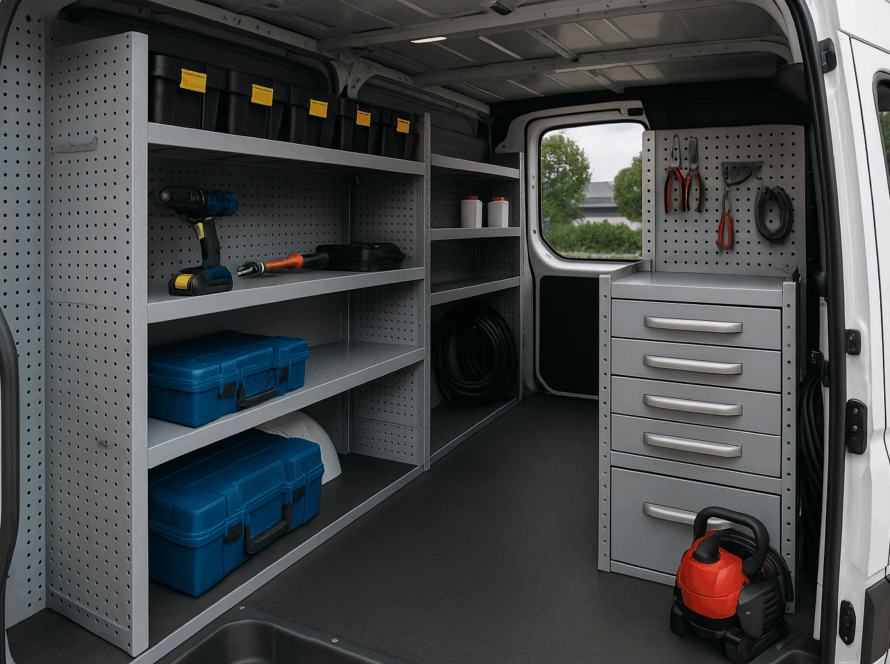
To be very honest, in roadside assistance vehicles the most efficient arrangement is often neither a completely open shelf system nor a fully drawer-based system, but the right combination of both 👍 Because in roadside assistance scenarios, there are both items that must be accessed immediately and small parts that must be stored in an orderly way. In addition, some products should remain visible, while others should stay protected and locked. This is where the hybrid layout comes in. When heavy equipment that should remain stable is placed in the lower section, a drawer-based small-parts system is placed in the middle section, light material shelves are used at the top, and open fast-access zones are positioned on the side, the vehicle works far more efficiently.
In my opinion, the greatest advantage of the hybrid layout is this 😊 It preserves the reflex for fast intervention while also preventing the inside of the vehicle from becoming messy. This flexibility is especially important in towing-supported roadside assistance vehicles or multifunctional teams responding to different kinds of breakdowns. Because not every call is the same. Sometimes a quick battery boost is needed, sometimes a small mechanical intervention, and sometimes safety gear and warning products become the priority. That is why the answer on the roadside assistance side to the question in which industries cannot do without in-vehicle shelving systems is also highly layered. That is exactly why, in the approach of Detay Endüstri, modularity is not only a product choice, but scenario management.
4) Heavy Low, Light High Placement: Essential for Driving Balance and Work Safety
When talking about the most efficient layout in roadside assistance vehicles, not discussing weight distribution would be a serious omission 😌 Because the vehicle is not used only while parked; it moves, takes corners, brakes suddenly, enters uneven terrain, and often carries a significant amount of equipment. That is why keeping heavy materials at lower levels and light materials at upper levels is not only logical, but also a fundamental safety rule. Wheel chocks, heavy tool cases, jump-start units, large hand tools, and dense metal parts should be positioned as close to the floor as possible. Light consumables, protective items, and bulky but low-weight materials, on the other hand, can be stored on upper shelves.
This logic affects both driving safety and comfort while working inside the vehicle. When heavy items are placed high, they not only disturb the vehicle’s balance, but also create risks during access. In addition, the issue of secure fastening becomes critical here. Everything carried inside the vehicle must be safely secured either to the vehicle body or to a fixed module. That is why the topic of materials used in in-vehicle shelving also matters; because the durability, weight, and long-term behavior of the material affect total efficiency. The modular and securable structure seen in the product logic of Detay Endüstri is therefore very valuable.
5) Mini Workshop Logic: A Roadside Assistance Vehicle Should Not Be Only a Transport Space
Some roadside assistance teams do not only carry equipment; they also perform small interventions on-site, either inside the vehicle or immediately next to it ✨ When a cable needs to be organized, a small connection made, a simple measurement taken, a hand tool prepared, or a part separated, having a small but functional working surface or task zone provides major comfort. That is why a small workbench surface, a fixed preparation point, or a controlled work area inside the vehicle can significantly improve efficiency.
The goal here is not to overfill the vehicle with unnecessary modules, but to support the working sequence itself. Because when there is a place where small jobs can be carried out properly in the field, the team does not need to work on the ground, on their knees, or among scattered boxes. This perspective makes the idea in experience the convenience of a mobile workshop with vehicle racks even more meaningful. Sometimes what increases efficiency is not a large module, but a small surface placed in the right spot.
The Real Driver of Efficiency Is Not the Number of Shelves, but the Intervention Sequence
In my opinion, the most important insight for roadside assistance vehicles lies exactly here 🙂 Placing many shelves, many drawers, or many accessories inside a vehicle does not automatically mean efficiency. In fact, when planned poorly, too many modules can slow down the interior flow of the vehicle. Real efficiency is design according to the order of intervention. When the vehicle door opens, where is the first safety item that must be taken, at what level are the main hand tools stored, in which drawer are the small connection materials, how quickly can the heavy support equipment be accessed, and when used items are returned, do they create confusion? When these questions are answered correctly, the system becomes genuinely efficient.
That is why the answer to the question in standard or custom design? for roadside assistance vehicles is often “partly standard, partly scenario-specific.” Because some basic modules can be solved with a standard logic, but real performance appears in small customizations. Personally, I always pay attention to this 😊 If the team keeps searching for the same items repeatedly, if some materials shift during driving, if heavy equipment is in the wrong place, or if small parts are constantly scattered around, then the problem is not the team, but the in-vehicle workflow. That is exactly where the usage-scenario-focused mindset seen in the Detay Endüstri blog becomes highly valuable.
Example Scenario
Let us imagine that you have a roadside assistance team whose most common services are jump-start support, tire changes, small mechanical assistance, and safety marking. In such a vehicle, warning products and fast-access safety equipment can be placed near the rear door, basic hand tools in an open-shelf side panel, heavy battery-support equipment and a large tool case in the lower section, a drawer-based small-parts and connector system in the middle section, and light consumables and protective materials in the upper section. If the vehicle is used more often for night roadside assistance, lighting, visibility, and fast access become even more important. If it is used for long-distance service, securing, locking, and weight balance gain additional importance.
That is why it is not correct to copy the same shelving plan into every roadside assistance vehicle. The vehicle type, service scope, team habits, and call profile should all be evaluated together. When viewed from this perspective, carrying out project-based evaluation with manufacturers such as Detay Endüstri leads to much better results. Because the most efficient layout is not the fullest one in the catalog, but the one that responds best to real-life operating tempo.
A Short Anecdote
I once heard a roadside assistance worker say something I found very meaningful: “In the eyes of the customer, the first repair often begins the moment you open the vehicle door.” 😊 And that is truly accurate. The layout inside the vehicle directly affects the customer’s sense of trust. A messy vehicle can create stress even before the intervention begins. A well-organized vehicle, on the other hand, creates the feeling that “this team knows exactly what it is doing.” My own observation is also in the same direction; teams that work in an organized way usually make fewer mistakes, get less tired, and take fewer unnecessary steps. That directly means efficiency.
There Is an Emotional Side Too: Order Reduces Stress
Roadside assistance work carries psychological pressure as much as technical demands 💙 Because workers often deal with customers who are in a hurry, nervous, or worried. In such an environment, having to search for one’s own equipment does not only waste time; it also increases mental load. But a vehicle layout where everything is in its place gives calmness to the worker. When a person knows exactly where to reach, they think more clearly, move more confidently, and focus better on the work itself. That is why efficiency is not something measured only with a stopwatch; sometimes reduced stress is also efficiency.
That is why it would be incomplete to look at the solutions of Detay Endüstri only as shelving systems. These are also systems that improve working habits, increase the sense of confidence, and reduce chaos inside the vehicle. Good organization works like a quiet but powerful support system.
A Simple Diagram Related to the Topic
ROADSIDE ASSISTANCE SCENARIO
Jump-start support / Tire change / Small mechanical intervention / Safety marking
      ↓
EQUIPMENT CLASSIFICATION
Fast-access items / Small parts / Heavy equipment / Sensitive products
      ↓
LAYOUT STRUCTURE
Open shelf + Drawer + Lockable compartment + Lower heavy-load area + Upper light shelf
      ↓
SAFETY
Secured load + Locking mechanism + Balanced weight distribution
      ↓
RESULT
Faster intervention + Less search time + Safer driving + More professional service

Frequently Asked Questions
1. What is the most efficient shelving layout for roadside assistance vehicles?
In most cases, a hybrid layout using open shelves, drawers, and lockable compartments together gives the most efficient result.
2. Which is better, open shelves or drawers?
Open shelves are better for frequently used large equipment, while drawers are better for small parts that easily get mixed up.
3. Where should heavy equipment be placed?
It should be placed as close as possible to the lower levels and near the floor.
4. Are upper shelves practical in roadside assistance vehicles?
Yes, but only for light and bulky materials. They are not suitable for heavy equipment.
5. Why is a locking mechanism important?
It prevents drawers and cabinets from opening during driving and protects both the equipment and the user.
6. Does the in-vehicle layout really affect intervention time?
Yes. It reduces search time, lowers unnecessary movement, and speeds up the initial intervention.
7. Is a mini work surface necessary in roadside assistance vehicles?
It can be very useful for teams that carry out small adjustments and preparation tasks on site.
8. Can the same shelving system be used for every roadside assistance vehicle?
No. The layout should change according to the vehicle type, equipment structure, and service scope.
9. How can safety be ensured in an open-shelf layout?
Open shelves can be made safer with front barriers, box systems, dividers, and solid securing.
10. Is a customized layout worth the investment?
Yes. It provides less time loss, better equipment protection, and a more professional service perception.
People Also Ask
- How should the first-access equipment be positioned in a roadside assistance vehicle?
- Why is a hybrid layout more advantageous in roadside assistance vehicles?
- How should the interior of a vehicle be organized for roadside assistance teams working at night?
- Where should battery-support devices and heavy tool sets be placed inside the vehicle?
- How can the risk of shifting be reduced in open-shelf systems?
- Is a drawer-based small-parts system essential in a roadside assistance vehicle?
- Is a mini workbench really useful in a roadside assistance vehicle?
- Which makes more sense, standard shelving or custom design?
- Do in-vehicle locking systems affect driving safety?
- Why is a professional appearance important in a roadside assistance vehicle?
Conclusion
To sum it up 😊 The most efficient shelving layout in roadside assistance vehicles is not a layout built around a single module, but one that establishes the logic of speed, safety, and accessibility together. Open shelves provide fast access, drawers keep small parts under control, lockable and enclosed compartments protect sensitive equipment, and keeping heavy materials at lower levels strengthens both vehicle balance and usage safety. For this reason, the most sensible setup for most roadside assistance vehicles is an intelligently planned hybrid layout.
My clear opinion is this 👍 If a roadside assistance vehicle is going to be truly efficient, its interior layout must be planned according to the sequence of intervention. The equipment that must be reached first when the door opens should be in the most visible and fastest-access position. Heavy equipment should be placed low, light equipment should be placed high. Small parts should be kept controlled in drawers. Sensitive devices should be protected. When this logic is followed, the modular solutions offered by brands with strong application knowledge such as Detay Endüstri become much more meaningful.
And perhaps most importantly 💙 In roadside assistance, efficiency manages not only minutes, but also the feeling of confidence. An organized vehicle means a calmer technician, a more reassuring service, and a more controlled intervention. That is why a good shelving layout is not just a storage solution; it is a quietly working performance system. If, when the vehicle door opens, you see flow instead of chaos, then the efficient layout has already been established.