Locking Mechanisms and Security Solutions in Vehicle Interior Cabinet Systems 🔐🚐
When it comes to vehicle interior cabinet systems, many businesses initially focus on the number of shelves, drawer layout, material capacity, or how professional the installation makes the vehicle look, yet the issue that truly makes the difference in the field is often that critical detail people tend to overlook; namely, locking mechanisms and a holistic security setup. Because for a mobile team, a vehicle is not simply a transport space, it is also a moving workspace that is opened and closed many times throughout the day, where equipment is selected, parts are separated, and sometimes expensive hand tools, sensitive devices, or important documents are kept protected 😊 That is exactly why a poorly designed locking system does not merely increase the risk of theft, but can also create a chain of problems ranging from drawers opening during sudden braking to equipment shifting around, time loss, and even compromised employee safety. As emphasized in the approach shared by Detay Endüstri, equipping drawers and cabinet doors with locking mechanisms provides benefits both in terms of security and in preventing them from opening while driving. In addition, the FMCSA cargo securement rules and the NHTSA secure your load guidance clearly show that preventing cargo from shifting, falling, or separating from the vehicle is a fundamental part of safe driving.
I always compare this subject to a simple image in my mind 🧰 A vehicle interior cabinet system is only as valuable as a well-organized workshop, yet a system whose doors cannot be locked, whose drawers do not stay in place, and whose equipment moves around while the vehicle is in motion is very much like a toolbox without a lid. From the outside it may look tidy, but the moment work becomes intense, it lets the user down. That is exactly why the approach of manufacturers such as Detay Endüstri, who treat in-vehicle equipment not only as a matter of layout but also as a matter of security logic, is so valuable; because the real issue here is not just “building cabinets,” but creating a system that is suitable for field operations, resistant to vibration, controlled in terms of access, and protective of the user.
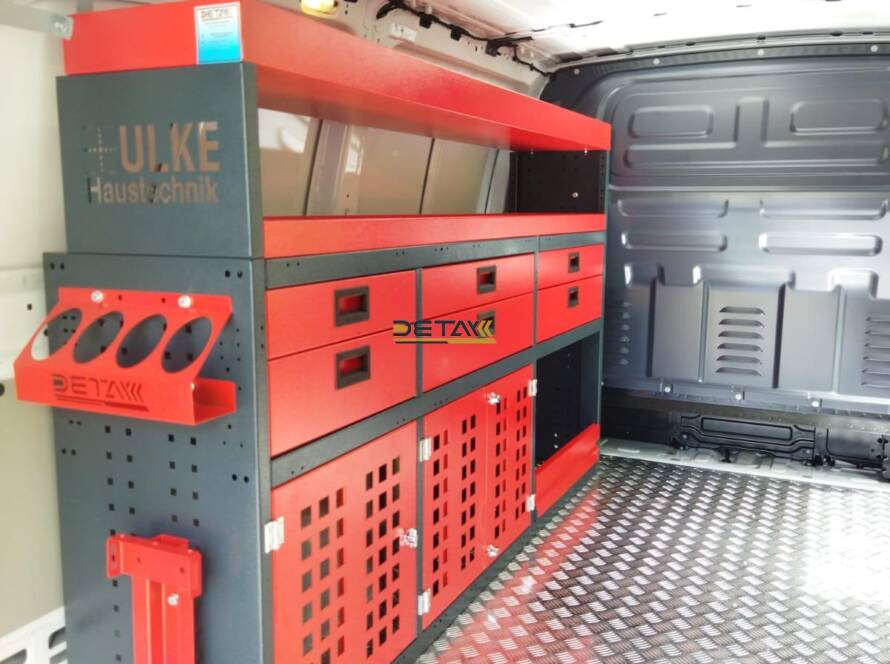
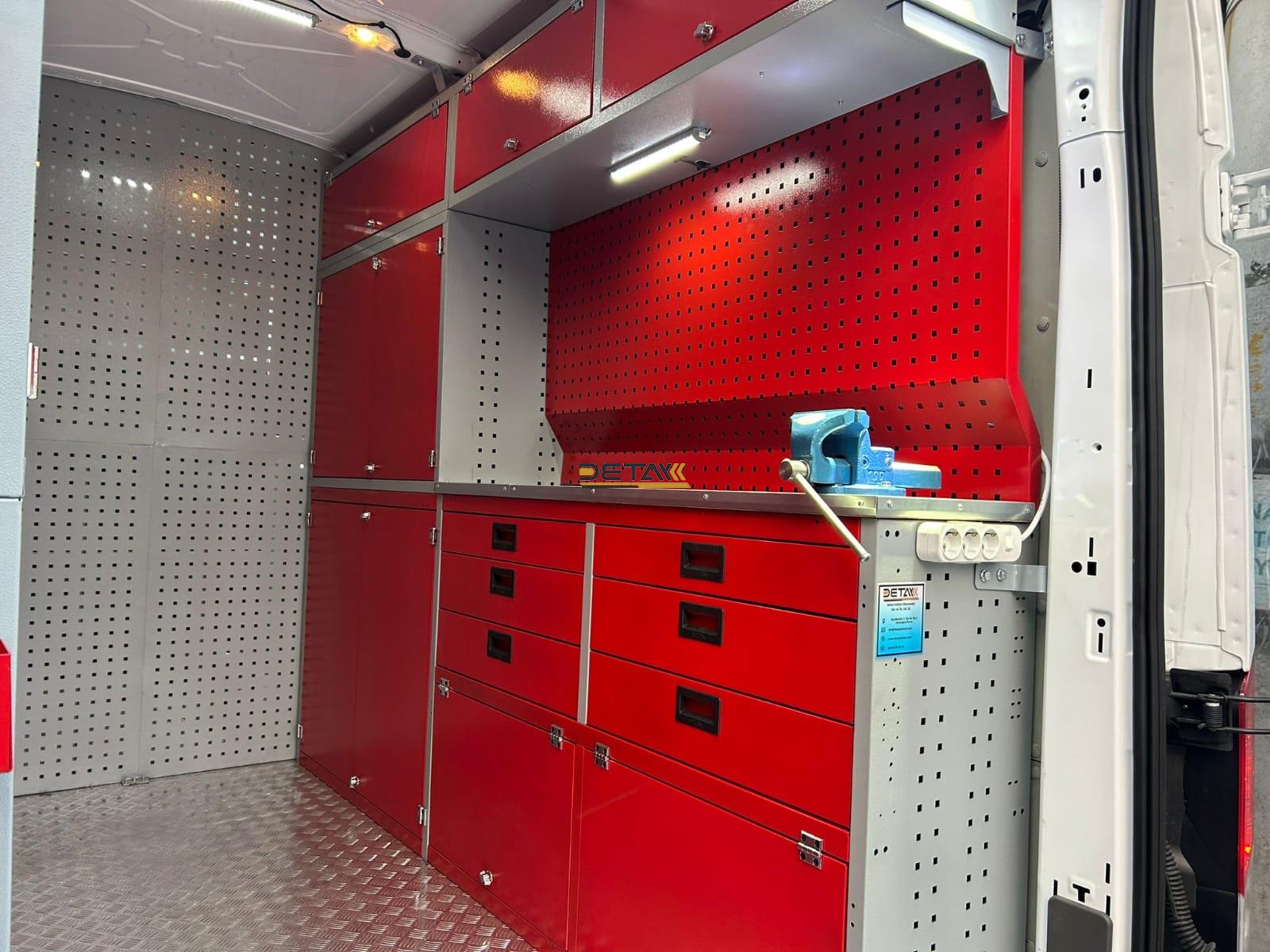
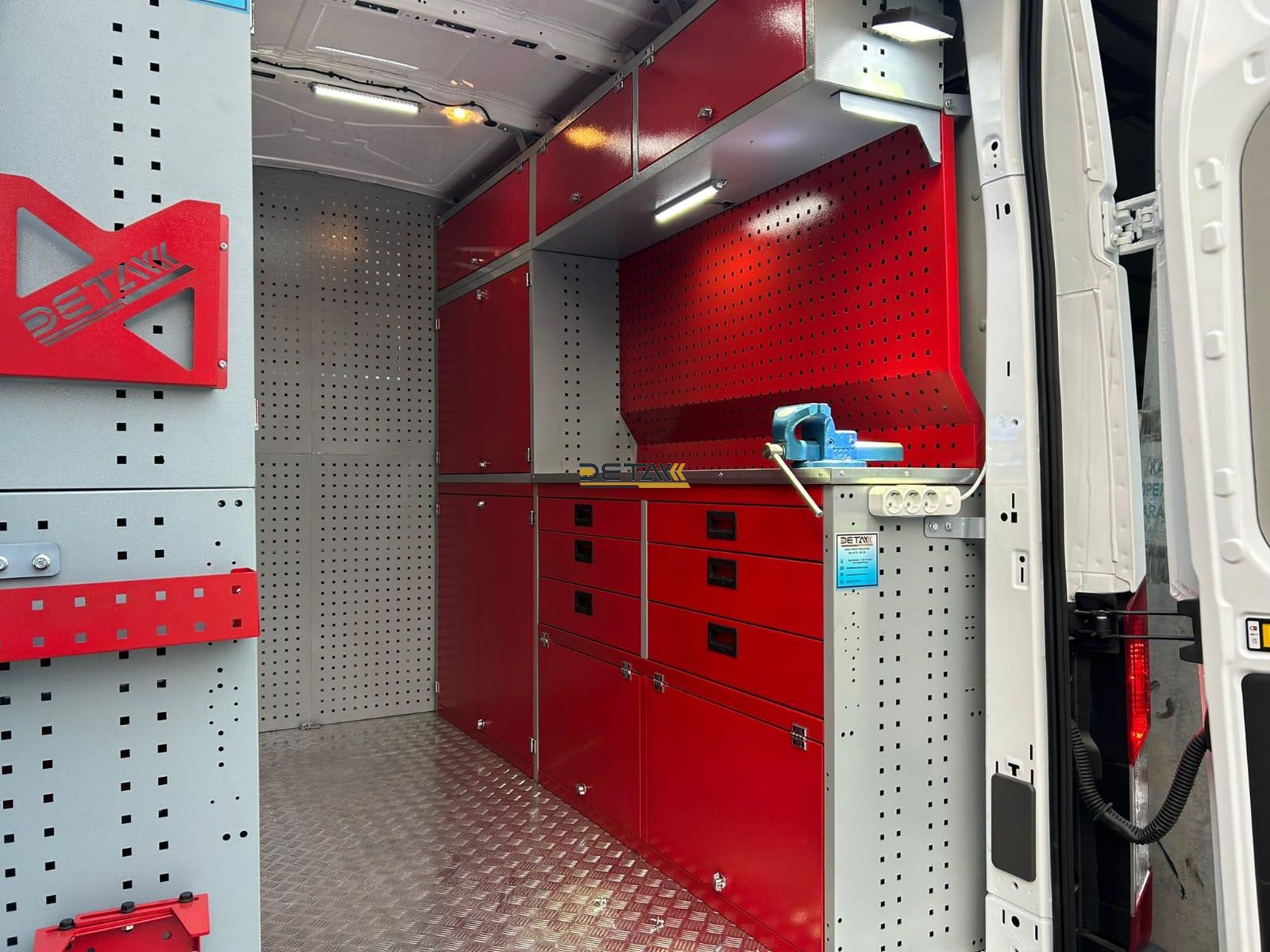
Especially for teams working in technical service, electrical maintenance, telecommunications, natural gas, roadside assistance, mechanical service, and field operations, the type of locking mechanism used in vehicle interior cabinet systems directly affects operational quality. That is because not every drawer inside a vehicle serves the same purpose; some drawers carry consumables, some protect expensive measuring devices, and some hold the equipment that must be reached first in an emergency. For that reason, a one-size-fits-all locking approach is usually insufficient. As can also be seen on the vehicle interior cabinet and shelving systems page, modular structure, multi-point fixing, and project-based load capacity clearly show that the security aspect should never be reduced to the lock alone.
Comparison
Now let us come to the most important question 🤔 Which locking mechanism is safer in vehicle interior cabinet systems? The right answer here is not “the most expensive one” or “the toughest-looking one,” but rather the solution that is most suitable for the usage scenario. When the project examples and product pages shared by Detay Endüstri are examined, it becomes clear that in mobile service vehicles, different layers of protection are designed together for drawers, cabinet doors, upper cabinets, workbench areas, and auxiliary equipment zones. In particular, the content on equipping technical service vehicles, vehicle shelving for mobile workshop convenience, and bringing your workshop into your vehicle with interior equipment shows that security only becomes meaningful when layout, material selection, and access logic are considered together.
| Solution Type | Advantage | Limitation | Best Use Case |
|---|---|---|---|
| Latch + simple closure | Low cost, quick opening and closing | Higher risk of opening under sudden braking and vibration | Lightweight and low-risk material compartments |
| Individual keyed lock | Restricts unauthorized access and offers selective security | Key management may become difficult in multi-drawer use | Valuable tools, measuring devices, sensitive spare parts |
| Central locking | Allows all units to be controlled from one point | If the system is not designed well, it may create a single point of failure | Technical service vehicles with intensive field operations |
| Spring-assisted safety drawer lock | Reduces the chance of drawers opening on their own while driving | Requires periodic maintenance and cleaning | Frequently used consumable and hand tool drawers |
| Multi-point door lock | Provides rigidity and security on large cabinet doors | May require adjustment over time if not installed properly | Tall cabinets and wide equipment compartments |
When you look at this table, one thing becomes very clear 💡 In a service vehicle, security is not only protection against theft; it is also driving safety, access discipline, and time management. The strongest side of the modular approach highlighted in the Detay Endüstri product family starts exactly here; because it becomes possible to design each drawer, upper door, and special equipment compartment according to its own logic based on need. As explained in particular in the content about the importance of locking mechanisms, locks do not exist merely to close something, they exist to protect it. The same logic can also be seen in the OSHA secure storage rule, which clearly states that stored materials must be kept safely so that they do not slide, collapse, or create danger.
At this point, let me give a small but very real example 😊 In a service vehicle, when a multimeter, laptop, cable lug boxes, and cordless hand tools are all placed in the same area, it may seem fine on paper because “everything is inside the cabinet.” Yet once road vibration starts, equipment inside unsecured or poorly locked drawers collides with one another, a drawer may slightly open, and at the next stop the user loses time and experiences that familiar stress of “where did I put it last?” This is exactly why the security solution we are talking about is not only protection from outside threats, but also protection of order inside the vehicle. That is why application pages such as Ford Transit vehicle interior equipment and Fiat Ducato vehicle interior equipment demonstrate how important it is to establish different protection logic for different risk levels through combinations of doors and drawers.
Insight
The most valuable part of this subject is actually this 🌟 A good locking mechanism is not just a piece of “hardware”; when combined with proper project planning, it can even change the psychology of operations. For a technician who enters and exits the vehicle dozens of times each day, knowing where everything is matters, but knowing that the equipment will remain there in the same way matters just as much. That is why it is so valuable that the solutions developed by Detay Endüstri treat modular cabinets, drawers, workbenches, and auxiliary accessories as one single integrated whole; because the feeling of security is born not from one lock, but from system integrity. In addition, the NIOSH motor vehicle safety at work approach also treats employee safety in work-related vehicle use as a primary topic, which supports the idea that in-vehicle equipment design is not merely about aesthetics or storage, but directly about occupational safety.
Whenever I talk with field teams, I hear one sentence more than almost any other: “When work gets intense, small disruptions become big problems.” And that is absolutely true 😌 A drawer lock failing may not look as dramatic as a major equipment breakdown, but when it happens four times in one day, it breaks concentration, wastes time, tires the user, and reduces confidence in the equipment. In contrast, a well-designed security setup works like an invisible assistant; it does not make noise, it does not call attention to itself, but it ensures that everything stays where it should be. That is what transforms a mobile workshop from a messy cargo area into a disciplined working environment. In my opinion, that is precisely the strongest aspect of the Detay Endüstri approach; the solution is not merely shaping metal, but reducing the stress of daily use.
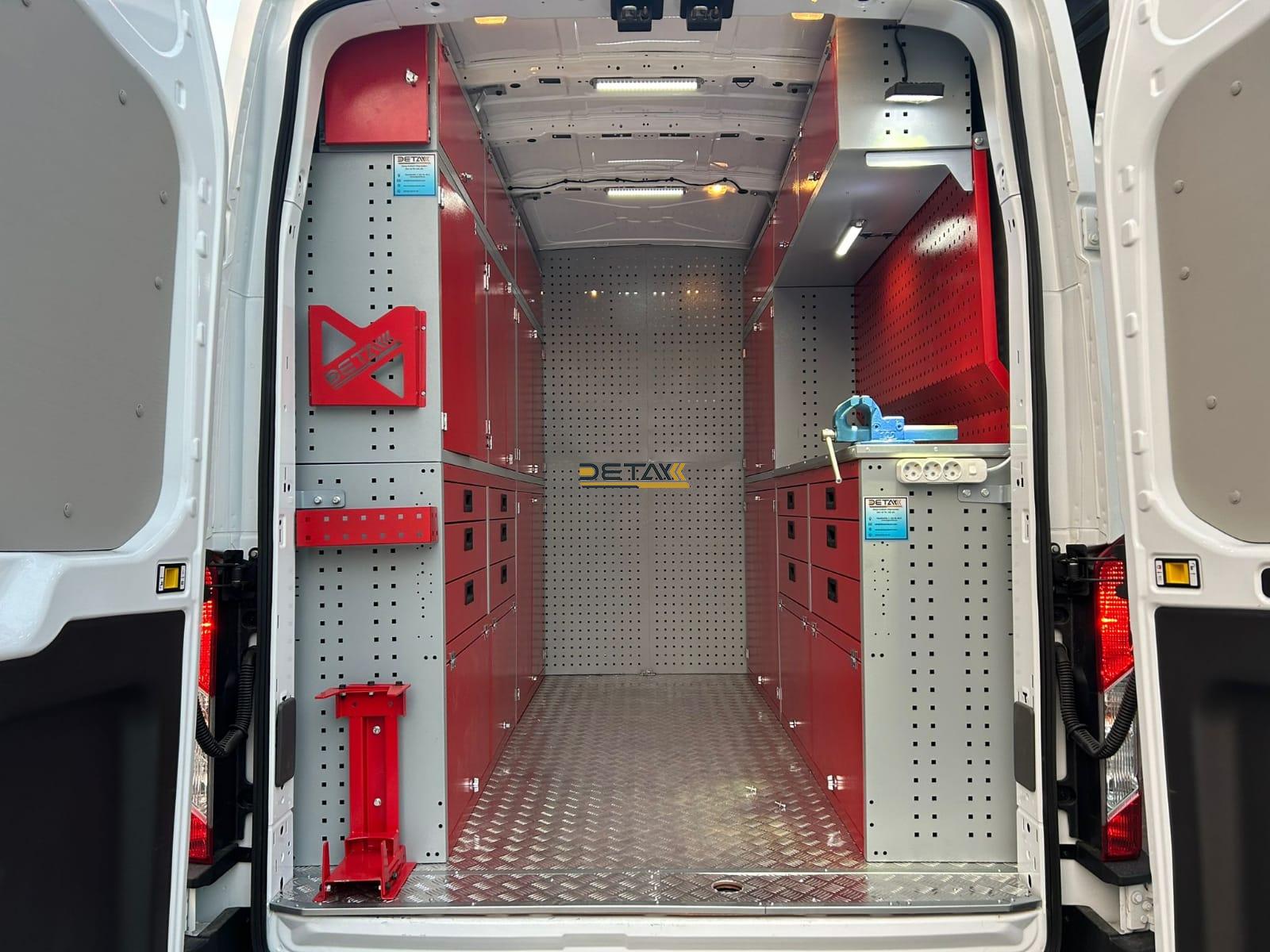
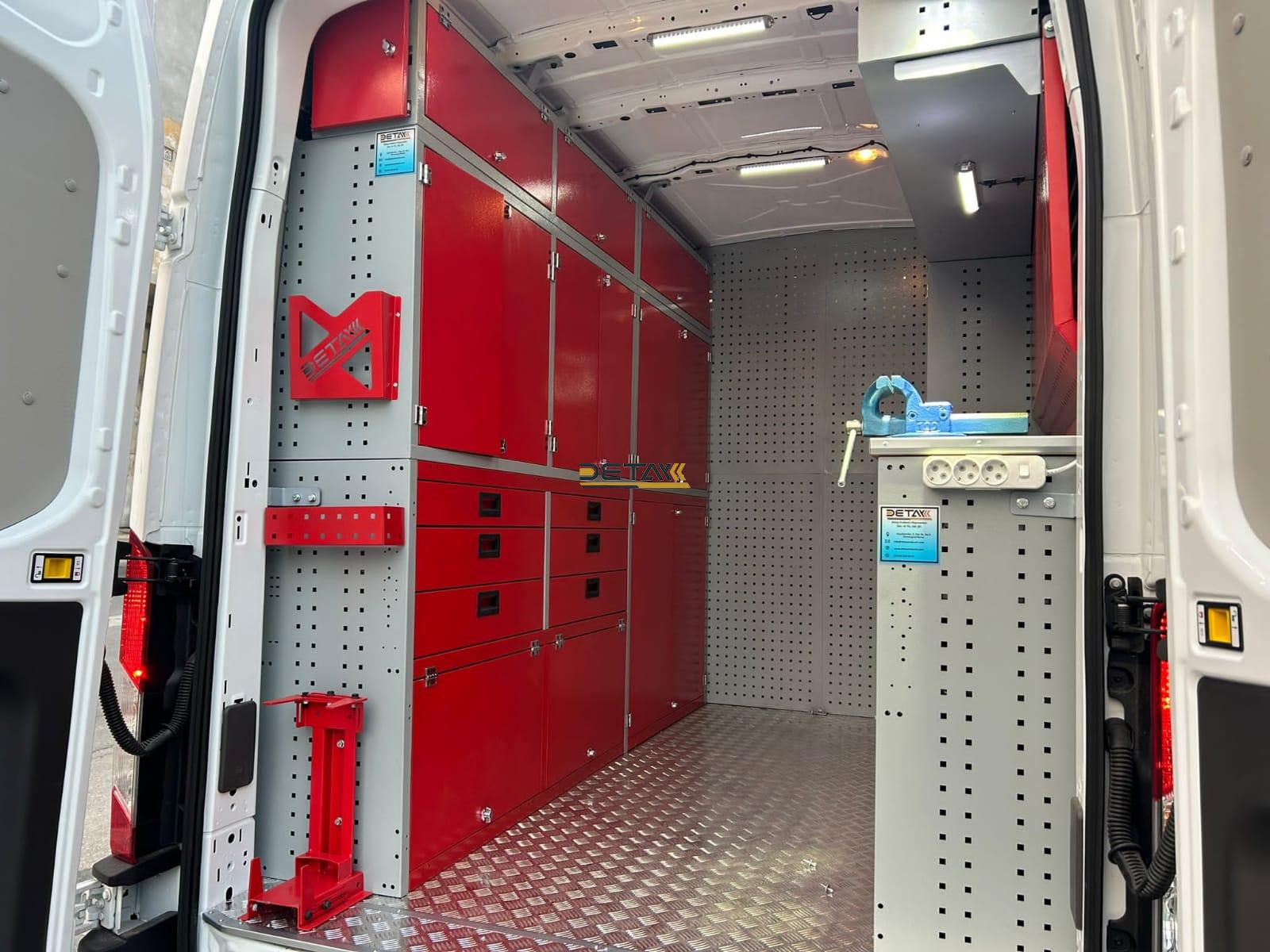
Even more importantly, security solutions are not made up of locked doors alone. In a good vehicle interior system, the locking mechanism is completed by multi-point body fixing, weight center planning, appropriate drawer carrying capacity, keeping mandatory equipment such as fire extinguishers in accessible yet stable locations, separating sharp and sensitive tools into dedicated compartments, and supporting visibility with LED lighting where necessary. The content on special compartments in vehicle interior cabinets and vehicle interior equipment layout is especially instructive in this respect, because it explains that security should be understood not only in terms of external threats, but also in terms of internal layout risk. NHTSA’s warning that cargo must not separate from the vehicle, shift, or leak, together with OSHA’s requirement that materials must be stored in a way that does not create sliding or collapsing hazards, shows that this perspective is also aligned with broader safety culture and field regulations.
Diagram Related to the Topic 🧭
[ Vehicle Door ]
      ↓
[ Access Point ]
      ↓
[ External Security ]
Keyed / central control / access restriction
      ↓
[ Internal Security ]
Drawer lock + door lock + multi-point fixing
      ↓
[ Organization Layer ]
Special compartments + labeling + weight distribution
      ↓
[ Operational Outcome ]
Less shifting + faster access + lower damage risk + safer driving
Visual Examples 📸

Anecdote ☕
A few years ago, one of the maintenance teams told me a story that stayed in my mind: they had gone back and forth to a facility three times in a single day, and during the third trip, a half-open drawer slammed forward during sudden braking, the small parts inside became mixed up, and a job that should have taken ten minutes ended up taking forty simply because the equipment had to be sorted again. At that moment, one thing became very clear to me; security does not always mean preventing a thief from getting in, sometimes it simply means preventing a drawer from opening at the wrong moment 😊 That is exactly why it is so valuable when manufacturers such as Detay Endüstri, who truly understand the field, approach security not only from the perspective of locks, but also from the perspective of workflow.
Personal Experience and Emotional Connection ❤️
Whenever I prepare content about vehicle interior equipment, I always think about the human side of the job: the technician who returns home in the evening does not only want the work to be completed, but also wants everything they dealt with throughout the day not to have drained them unnecessarily. Boxes that constantly slide, doors that do not close properly, drawers that open unexpectedly, and parts that get mixed together create far more mental load than most people realize. In contrast, a well-designed security system gives the user a quiet sense of confidence. Opening the vehicle and seeing that everything is still in its place creates a feeling that says, in a way, “the system did not let you down again today.” That is what affects me most when I look at the projects of Detay Endüstri; inside the metal there is organization, inside the organization there is safety, and inside that safety there is real comfort for the worker.
Conclusion
To sum it all up 🔒 Locking mechanisms in vehicle interior cabinet systems are not an accessory, but the very center of the security architecture. The right solution prevents drawers from opening on their own, protects expensive equipment, provides order for the user, increases working speed, and supports occupational safety. For that reason, when preparing a project, the question should not only be “how many shelves will there be,” but also “which equipment carries what level of risk, who will access it, how will the vehicle be used, and what kinds of motion dynamics will occur while driving?” When application examples such as the Ford Custom maintenance and repair vehicle offered by Detay Endüstri are read together with the company’s broader product and blog content, it becomes very clear that security can only become sustainable through modular solutions designed with system logic in mind.
That is why, if you are planning a new vehicle interior system investment, do not leave the lock until the very end 🙌 On the contrary, begin the project with the locking and security scenario itself. Because a well-locked cabinet does not only protect materials; it also protects time, order, team morale, and work quality. When you move forward with that perspective, it becomes much easier to see why modular and field-adapted systems such as the solutions offered by Detay Endüstri are a much smarter long-term investment. For a more detailed product review or a quotation request, moving directly through the contact page is a very good place to start.
Frequently Asked Questions ❓
1) What is the safest type of lock for vehicle interior cabinets?
There is no single “best” option; keyed or central locking is more suitable for valuable equipment, safety travel locks are better for frequently used drawers, and multi-point locking is more suitable for large cabinet doors.
2) Are locking mechanisms only necessary for theft prevention?
No. A just as important issue is preventing drawers and cabinet doors from opening while the vehicle is in motion.
3) Is central locking practical in vehicle interior cabinet systems?
Yes, especially if the team works intensively and many compartments are opened and closed throughout the day, because it simplifies access management.
4) Why is preventing drawers from opening so important?
Because during sudden braking, turns, and vibration, an opening drawer can both damage equipment and affect user safety.
5) Does a lockable cabinet system make the vehicle heavier?
With the right material selection and proper project design, weight can be controlled; the important thing is to manage durability and weight optimization together.
6) Can the same locking system be used for every vehicle?
No. Risks and access needs vary between panel vans, pickup trucks, minibuses, and roadside assistance vehicles.
7) Do special compartments contribute to security in vehicle interior cabinets?
Yes. Separating sharp, fragile, or sensitive equipment reduces both damage and search time.
8) Do locking mechanisms require maintenance?
Yes. Due to dust, vibration, and intensive use, periodic inspection, looseness checks, and cleaning are important.
9) Should fire extinguishers and safety equipment also be kept in locked compartments?
No. These items should be secured safely but remain quickly accessible in emergencies; locking choices that slow access should be avoided.
10) What is the first question to ask when having a vehicle interior cabinet system installed?
Right after “What am I carrying in this vehicle?” the next question should be “What risks do I need to protect this equipment against?”
People Also Asked 🔎
How can quiet operation be achieved in vehicle interior shelving systems?
Why is weight distribution important in mobile service vehicles?
Which is safer in roadside assistance vehicles, open shelving or closed cabinets?
How should sensitive devices be protected in electrical maintenance vehicles?
Which provides faster access, a cabinet with doors or a drawer-based system?
Where should a fire extinguisher and first aid kit be positioned in a service vehicle?
Which material should be preferred for long-lasting vehicle interior equipment?
Does LED lighting in vehicle interior cabinets contribute to safety?
How can key management be simplified in lockable systems?
Can a modular vehicle interior system be transferred to another vehicle?