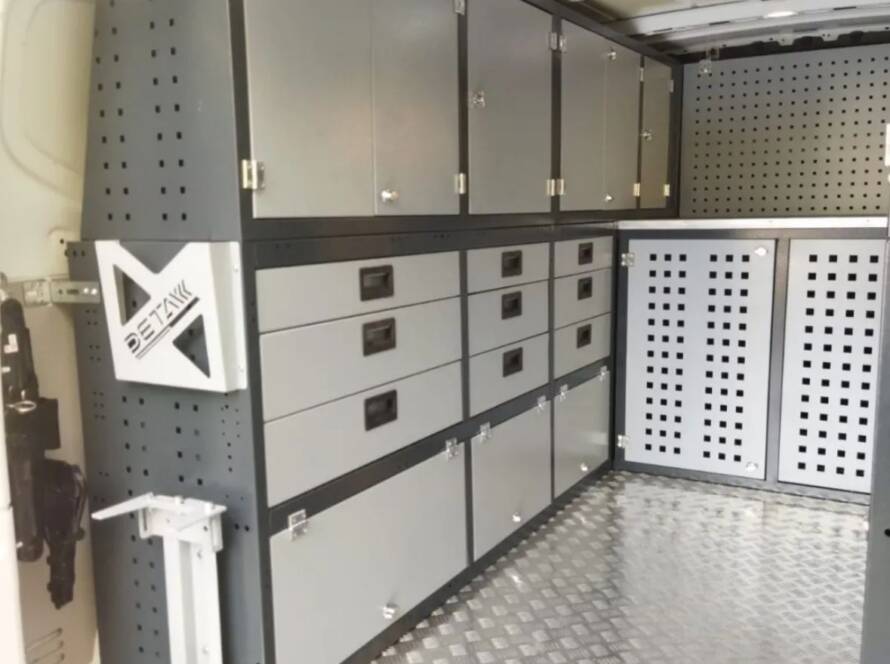
The in-vehicle cabinet and shelving systems offered by Detay Endüstri include modular storage solutions that can be considered for different vehicle bodies and operational needs. A well-planned project goes beyond simply fitting cabinets inside the vehicle; it considers the order in which materials will be used, the total weight of the cabinets, how loads will be restrained, and where users will access their equipment. Professional vehicle organization develops when these decisions are combined with everyday working habits. ✅
What Do In-Vehicle Cabinet Systems Do? 🧰
An in-vehicle cabinet system brings together drawers, enclosed compartments, shelves, and equipment-specific holders within a defined layout. Small parts can be sorted into divided drawers, hand tools can be kept in designated slots, and field service bags can be placed in easily accessible sections. The vehicle’s load compartment consequently becomes more than a space whose contents are understood only by the person who organized it; it becomes a working resource that different team members can use according to the same logic.
There is an important distinction here: making better use of storage space does not increase the vehicle’s permitted load capacity. Cabinets, lining, workbenches, and other fixed fittings all add weight to the vehicle. Available space and allowable load must therefore be assessed separately. In planning this type of layout, the question I would prioritize before “How many drawers can we add?” is “Which equipment do we need to carry, in what quantities, and where, to complete the daily work?”
Start Planning with an Equipment Inventory Before Vehicle Dimensions 📋
A successful vehicle layout starts with an accurate equipment list. Tools used every day, instruments required only for specific jobs, frequently consumed supplies, and parts brought back after a job should be considered separately. For example, protecting measuring instruments may be a priority for an electrical maintenance team, while retrieving heavy tool bags and organizing fasteners may be more influential for a mechanical service team. Two vehicles of the same model may require different cabinet layouts because they perform different tasks.
- Dimensions and weight: Record the space occupied by each item, including its carrying case, and its actual weight.
- Frequency of use: Identify materials used daily, weekly, and for specific jobs.
- Items used together: Consider the tools and consumables needed for the same operation as a job kit.
- Protection requirements: Identify equipment sensitive to impact, moisture, or contamination.
- Stock quantities: Define the minimum and maximum quantities to be carried in the vehicle.
- Return loads: Allocate separate space for removed parts and used equipment.
It is useful to involve the vehicle’s users when preparing this list. If a technician reaches for the same box repeatedly throughout the day, placing it in a difficult-to-access location can undermine a layout that looks organized on paper. Checking the layout drawing against actual equipment dimensions and, where possible, simulating the loading scenario before installation can help reduce later modifications. 📐
How Should Drawers, Shelves, and Enclosed Compartments Be Selected?
Instead of using the same storage method for every item, choose compartments suited to the size of the item and how it is used. When very small fasteners accumulate in layers inside a deep drawer, visibility can decrease; when compartments are too small for large tool bags, users may start leaving those bags in the aisle. The quality of a design can also be measured by how easily equipment can be returned to its designated place.
| Equipment group | Possible solution | Planning consideration |
|---|---|---|
| Screws, nuts, and small fasteners | Divided drawers or secured parts bins | Readable part codes and separation of different components |
| Hand tools | Designated slots or suitable holders | Easy identification of missing tools and retention during transport |
| Sensitive measuring instruments | A compartment suitable for the instrument’s protective case | Manufacturer-specified storage conditions and impact protection |
| Heavy tool bags | A low compartment and restraint arrangement consistent with the loading plan | Lifting access, compartment capacity, and vehicle load distribution |
| Frequently used consumables | Labeled, accessible bins or drawers | Visibility of minimum stock levels |
| Removed or dirty parts | A separate, secured collection container suitable for its contents | Prevention of contact with clean equipment and, where necessary, leakage |
Consider Space Utilization and Ease of Access Together 🚪
Storage areas arranged along the vehicle’s side walls can help organize the central space; however, increasing shelf depth reduces the space available for passage and work. Wheel arches, the sliding door opening, rear door movement, and drawers in their open positions should be included in the same layout. For drawers used while standing outside the vehicle, the user’s safe standing area is just as important as the space needed for opening.
Placing frequently used materials in accessible locations is a design choice that can reduce unnecessary searching and movement. However, positioning heavy equipment at an unsuitable height merely to make it easier to reach is not appropriate. Frequency of use, weight, and safe manual handling requirements should be assessed together. Loading and retrieving materials should take place when the vehicle is safely parked, and the layout should, wherever possible, avoid requiring personnel to work on the side exposed to traffic.
Cabinet Installation and Load Restraint Should Be Assessed Together 🔒
While a vehicle is moving, its cabinets and their contents are affected by braking, cornering, and road vibration. The attachment of the cabinet to the vehicle and the restraint of materials inside its drawers are therefore two separate matters to check. A locked door may not, on its own, prevent a heavy instrument inside from moving; likewise, a nonslip surface cannot be assumed to provide adequate restraint for every load. The DVSA load securing guidance emphasizes that the securing method should be selected according to the characteristics of the load and vehicle.
Installation should be consistent with the manufacturer’s instructions for the specific vehicle model and the approved mounting plan for the equipment system. Attachment points must be capable of withstanding the expected forces; this principle also appears in the DVSA guidance on load securing attachment points. Decorative lining or a thin interior panel should not automatically be treated as an adequate load-bearing structure. Rather than specifying a universal number of screws, fastener diameter, or tightening value, use mounting details verified for the vehicle and system.
The DVSA guidance for vans addresses grouping small items in containers, securing large or heavy objects, and using a suitable bulkhead to prevent loads from moving from the load compartment into the cab. 🦺 These sources are useful for understanding the technical approach; applicable requirements in Türkiye and the vehicle manufacturer’s instructions must be assessed separately for installations there. A product’s appearance or a description such as “robust” does not establish a particular level of crash performance; if such a claim is made, the scope of the test and the installation configuration it covers should be examined.
Establish a Weight Budget Before Selecting Equipment ⚖️
The empty weight of the cabinets affects the remaining allowance for equipment. Lining, fixed machinery, additional power systems, personnel, and other loads should also be included in the overall assessment. The GOV.UK explanation of vehicle weights states that maximum authorized mass includes the combined weight of the vehicle and its load. In practice, the applicable values should be verified against the specific vehicle’s documentation and manufacturer information.
For example, in an entirely hypothetical planning exercise, if fixed cabinets and lining weigh 180 kg in total and equipment and consumables weigh 260 kg, these two groups add 440 kg to the vehicle. This calculation alone does not establish that the loading arrangement is acceptable; other weights and the loads on individual axles must also be checked. Weighing the vehicle after installation helps establish the actual outcome of the plan. Instead of concentrating heavy materials on one side or filling every apparently empty space, the layout should be verified against the vehicle manufacturer’s load distribution limits.
Maintain Organization Through Labeling and Stock Tracking 🏷️
A good cabinet system becomes more useful when it clearly identifies the location of each item. A simple location system such as “left module, second drawer, third compartment” can be established, with labels showing the part name, stock code, and target quantity. Including readable text rather than relying on color alone makes the system easier for different users to understand. Whether a new employee can find a required part without repeatedly asking someone else is a practical measure of how understandable the arrangement is.
The vehicle’s location system can use the same part codes as the material cabinets in the main stockroom. Preparation before a job can be completed at workbenches, with defined job kits then transferred to the vehicles. Under this approach, vehicle organization forms part of a process that starts in the stockroom and is completed again when the service team returns. Recording missing consumables and returning tools to their slots at the end of the day makes preparation the following morning more predictable.
Daily Organization for a Technical Service Team ⏱️
Consider a team making five service visits each day. Suppose measuring instruments are stored in their protective cases in designated compartments, fasteners are placed in labeled drawers, and job-specific tool bags are secured at suitable attachment points. The required kit is retrieved before each visit; afterward, consumed materials are recorded and removed parts are placed in a separate container. This workflow aims to reduce the need to search through the entire vehicle at every stop.
Purely to demonstrate the calculation, suppose measurements after reorganizing show that preparation takes an average of four minutes less per visit: five visits would yield 20 minutes per day, or 440 minutes over 22 working days, equivalent to 7 hours and 20 minutes. This figure is neither a customer result nor a guarantee. Actual gains depend on the type of work, the initial arrangement, and how the team uses the system. Furthermore, time saved during preparation does not automatically translate into the same amount of billable work. To assess the effect, teams can track search time, return trips caused by missing materials, and stock replenishment time across comparable tasks. 📊
Choose a Solution Suited to the Vehicle Model and Future Needs
A compact service vehicle and a long-wheelbase van offer different layout possibilities. Examples such as the Ford Transit Connect in-vehicle cabinet installation provide a starting point for examining how different components can be combined inside a vehicle. However, rather than copying an installation photograph directly into another vehicle, reassess the model year, body dimensions, doors, equipment to be carried, and mounting points.
A modular structure may make future reorganization easier; ask the manufacturer about the replaceability of dividers, drawers, and mounting components. Transferring the system to another vehicle should not automatically be assumed possible either. Compatibility with the new vehicle’s dimensions and attachment points must be verified, and the design revised where necessary. When comparing quotations, consider the scope of installation, operating documentation, spare parts availability, and vehicle downtime alongside the initial price. 🔧
Establish a Daily Inspection Routine
- Before departure: Check that drawers and doors are in the closed and locked positions specified for travel.
- After each job: Return tools to their places and reassess the restraint of remaining equipment after removing any loads.
- During scheduled maintenance: Inspect connections, locks, slides, and holders according to the manufacturer’s inspection instructions.
- If damage is found: If looseness, cracks, or a failed lock are identified, do not use the affected system until it has been assessed.
- When adding equipment: Recheck compartment capacity, total weight, and the layout plan.
Make Professional Vehicle Organization Part of the Daily Workflow
The effectiveness of in-vehicle cabinet systems develops through an accurate inventory, suitable compartment selection, verified installation, and sustainable working habits. When every item has a clearly understood location, preparation and checking can be carried out more systematically. A vehicle planned around its users’ needs provides a workspace that supports field operations, makes shortages easier to identify early, and allows material movements to be tracked.
When evaluating vehicle equipment options with Detay Endüstri, use your daily tasks and the equipment you carry as the starting point. Considering a suitable cabinet and shelving layout alongside technical limits, access, and maintenance requirements helps maintain professional vehicle organization over the long term.