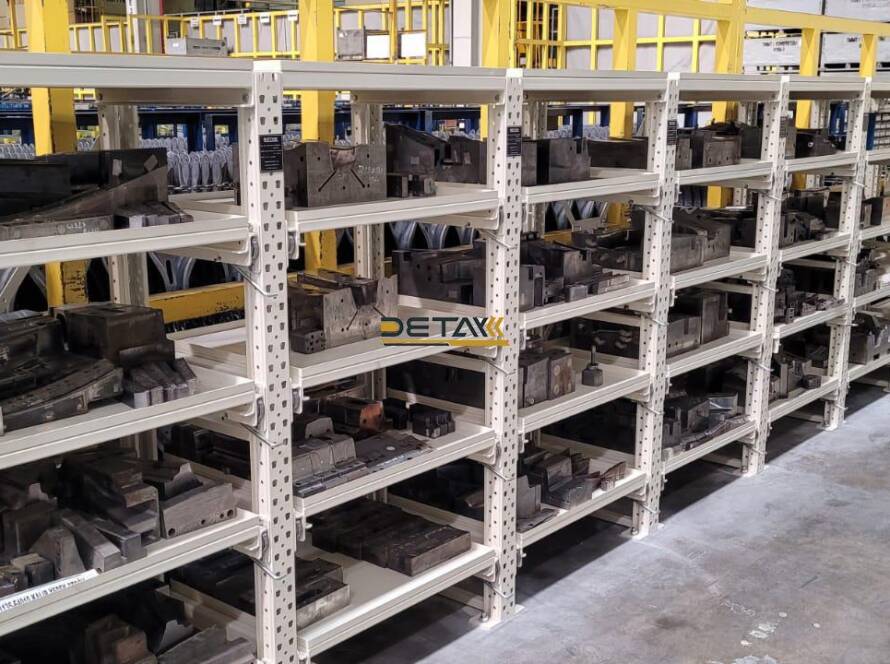
I always like to explain this topic in the following way 🤝 A drawer racking system is not a static storage element, but a moving load platform whose behavior changes every time it is opened. When the drawer is closed, you see one mechanical system; the moment you open it, a completely different balance comes into play. The load moves forward, the rails carry new forces, the frame resists a different moment, and if the calculation was not done correctly, the system gets a little more tired every time it is used. That is why, in the approach of manufacturers such as Detay Endüstri, which provide heavy-duty solutions, capacity calculation is not just a catalog figure, but the core of system safety. This becomes even more critical especially in heavy-tonnage applications such as drawer mold racks.
Why Is Weight Capacity Not Just a Single Number?
The first question most businesses ask is this 🙂 How many kilograms can this drawer carry? That question is of course important, but it is not enough on its own. Because the capacity value given by the manufacturer generally becomes meaningful under specific test conditions, specific extension behavior, and correct loading scenarios. If you apply that capacity without distributing the load evenly across the drawer base, if you pile the weight toward the front, if you change the real use scenario of the drawer, or if you disturb the overall balance of the unit, then a capacity that looks correct on paper may create problems in practice. For that reason, when reading a capacity value, it is necessary not only to look at the number, but also to understand under which conditions that number is truly safe.
At this point, I think the most valuable approach is to consider capacity calculation in three layers 😊 The first layer is the carrying capacity per drawer. The second layer is the total frame or unit capacity. The third layer is dynamic usage effect, meaning how the system behaves with that load when the drawer is opened. If only one of these three layers is considered, then the system has not really been understood. That is exactly why, in the approach of what to pay attention to when selecting a drawer mold rack, the safety factor, rail system, and loading logic are handled together. When you look at the product ecosystem of Detay Endüstri, you can clearly see this holistic way of thinking.
The Difference Between Capacity Per Drawer and Total System Capacity
There is a critical point here that is often misunderstood 🙌 Just because one drawer can carry 1,000 kilograms does not mean that a 10-drawer unit can automatically and safely carry 10,000 kilograms at the same time in the same configuration. Because total system load is related not only to the drawer rails, but also to the frame uprights, connection points, base, anchoring, and the overall center of gravity. In other words, capacity per drawer and total unit capacity are not the same thing. These two values must be read together.
| Calculation Layer | What Does It Represent? | Why Is It Important? | Most Common Mistake |
|---|---|---|---|
| Capacity Per Drawer | The safe carrying limit of a single drawer | Determines the behavior of the rails and the drawer base | Trusting the number alone without distributing the load evenly |
| Total Unit Capacity | The total load the entire rack frame can carry as a system | Critical for frame balance and anchoring safety | Assuming all drawers can be at maximum load simultaneously |
| Capacity Behavior During Extension | The moment and balance condition created when the drawer comes out | Affects tipping and excessive forward-load risk | Assuming the closed-position capacity is identical in the open position |
| Design with Safety Factor | Leaving a safety margin above the real load | Helps protect against surprise load increases and supports long life | Making the selection exactly equal to the net product weight |
For example, if a 1,000-kilogram mold is going to be stored, selecting a “drawer that carries 1,000 kilograms” is often not the right approach. Because small additional apparatus, support pads, tolerance differences, and usage mistakes also have an effect during operation. That is why it is necessary to leave a safety margin. I always compare this to an elevator 😊 It may seem technically possible to load an elevator right up to its theoretical limit, but for comfortable and safe use the system needs some breathing room. Drawer racking systems should be thought about in exactly the same way.
The First Step in Capacity Calculation Is Defining the Real Load Correctly
The first and most critical step in capacity calculation is knowing the real weight of the product to be stored. This may sound very simple, but this is where the most common mistakes begin in the field 🙂 Because in many cases, only the weight of the main product is considered. But a mold, motor, tool set, or heavy piece of equipment is never stored completely alone. There may be a support pad, a carrying foot, a clamping fixture, an auxiliary plate, or an additional protective support used because of an oily surface. All of these must be included in the real load calculation. In some cases, the catalog weight of the product may even differ from the actual on-site weight. For this reason, if possible, a scale reading or a verified real field weight should be used.
The second step is to add a safety margin to that verified net weight. The smart approach in the field is not to make the selection based on the bare product weight, but on the safety-factored weight. If your mold weighs 1,000 kilograms, it is much more correct to evaluate the system above 1,000 kilograms rather than selecting exactly at that number. This logic can also be clearly seen in the carrying capacity and safety factor approach. In the product logic of Detay Endüstri, this issue becomes especially meaningful in terms of preventing rail deformation and supporting long service life.
1) How Is the Load per Drawer Calculated?
To calculate the capacity per drawer correctly, it is not enough to look only at the product weight 💡 The following order should be used: first, determine the net weight of the product to be stored; then add any support pads, clamping fixtures, protective plates, and similar auxiliary elements; after that, add a safety margin appropriate to the usage scenario. The final value is the real requirement for drawer selection. For example, a 900-kilogram mold may already reach 1,000 kilograms once combined with a 70-kilogram support pad and roughly 30 kilograms of auxiliary securing equipment. In that case, the selection should be made not at the limit, but at a safely higher value.
In my opinion, the biggest mistake here is leaning right against the theoretical limit of the system 😊 Because the drawer is not only carrying the load; it is also moving that load. During opening, closing, maintenance, crane pickup, and replacement, micro-impacts occur in the system. For that reason, capacity per drawer should always be calculated according to a comfortable working logic. This becomes even more important in systems such as the 100% extendable drawer mold rack, which provide full access, because as access increases, correct capacity and correct balancing must be considered together.
2) How Is Total Unit Load Calculated?
The second critical topic is total frame load. Let us say you have 6 drawers, each with a capacity of 1,000 kilograms. On paper, this looks like 6,000 kilograms in total, but the frame design, anchoring logic, base structure, and load distribution determine how that total is actually carried. In addition, real usage scenarios where not every drawer is always used at full load must also be considered. In other words, total capacity calculation should not be based only on mathematical addition, but also on the real usage profile.
That is why I always recommend preparing two separate calculations 🙂 The first is the theoretical maximum load calculation, and the second is the real operational load calculation. The theoretical maximum shows you the upper structural limit of the frame. The operational load tells you what you are really storing, and for how long. If the actively used drawers are heavier and the upper drawers are lighter, the system behavior will be different. If all the heavy drawers are concentrated on the same side and at the same levels, the frame response will again be different. This is exactly where solutions such as the 65% extendable drawer mold rack, which keep the center of gravity more controlled, become especially valuable.
3) Capacity Calculation Cannot Be Done Without Considering the Center of Gravity
The most critical but also the most neglected part of capacity calculation in drawer racking systems is the center of gravity 😌 Because the same load can create completely different mechanical effects depending on where it is positioned. For example, if an 800-kilogram load is placed evenly and close to the center of the drawer base, the rails work more equally. If the same 800 kilograms are piled toward the front, the moment increases during opening. If that same weight is loaded mostly to one side, one of the rails becomes more stressed than the other. That is why, when calculating capacity, it is necessary to plan not only the weight itself, but also how that load will be positioned inside the drawer.
I always compare this to a suitcase carried by hand 😊 The suitcase is the same suitcase and the weight is the same weight, but if you pile the load into one corner, the imbalance is felt immediately when carrying it. The same applies in drawer racking systems. That is why support plates, load spreading across the base, centered placement, and special cradles when necessary are all complementary parts of capacity calculation. There is a reason why the topic of the importance of weight balance in drawer cabinets is specifically emphasized.
4) How Does Extension Ratio Affect Capacity Behavior?
Not every drawer system has the same access behavior. There is not only an access difference between 65% extendable systems and 100% extendable systems, but also a difference in load behavior 🚀 In 65% extendable systems, the drawer comes out in a controlled way and a significant part of the center of gravity remains on the frame. This provides more controlled use especially in narrow aisles, in safety-priority spaces, and in areas where heavy loads are used. By contrast, 100% extendable systems provide full access to the mold or load, which creates a major advantage in maintenance and changeover speed, but in those cases anchoring, frame rigidity, and correct capacity selection become more critical.
The important point here is this 😊 As the extension ratio increases, capacity calculation stops being only a matter of “carrying” and becomes a matter of “balance.” Full access is not worse, but it requires more conscious calculation. If your operation values fast mold change, direct crane pickup, and full surface access, then 100% extendable systems may be highly efficient. If space is limited and controlled safety is more important, then 65% extendable systems may make more sense. The different extension solutions offered by Detay Endüstri respond exactly to this need.
5) Why Must Frequency of Use and Dynamic Effect Be Included?
The same weight does not create the same effect in every drawer; frequency of use changes this significantly 🔧 For example, a heavily loaded drawer opened once a week and a heavily loaded drawer opened dozens of times a day should not be evaluated in exactly the same way. Because repetitive movement increases rail fatigue, connection stress, and maintenance needs. That is why, when calculating capacity, not only static weight but also dynamic usage intensity must be taken into account. I call this the difference between “paper load” and “real-life load.”
If the drawer will be used very frequently, the selection should be made from a more comfortable capacity range and the maintenance plan of the system should be established more carefully. This difference becomes especially large in active production areas. That is why, when workbenches, preparation areas, and drawer systems are planned together, load behavior can be made more controlled. This makes it very clear that the issue is not only storage, but flow management.
A Practical Method for Accurate Calculation
Now let us make this applicable 🙌 To calculate weight capacity correctly in drawer racking systems, the following steps should be followed:
| Step | What Should Be Done | Why Is It Important? |
|---|---|---|
| 1 | Verify the net weight of the product | Catalog data and real field weight may differ |
| 2 | Add support pads, fixtures, and auxiliary equipment | It allows you to see the real drawer load |
| 3 | Add a safety margin | It protects rail and frame life |
| 4 | Plan the load position inside the drawer | It affects the center of gravity and moment behavior |
| 5 | Calculate the total unit load separately | It verifies frame and anchoring safety |
| 6 | Consider extension ratio and frequency of use | It allows you to manage dynamic effect |
| 7 | Create a labeling and periodic inspection plan | It ensures the calculation remains sustainable in the field |
My personal opinion is this 😊 The most accurate capacity calculation is the one that combines engineering calculation with field observation. In other words, it is not enough for the numbers to look right in a table; it is also necessary to know how the user will load the drawer, which drawer will be opened most often, whether the heavy load stays low, whether the load will be piled to the front, and whether the system is fixed or mobile. Because theoretical correctness and operational correctness are not always exactly the same thing.
Example Scenario
Let us say that a 950-kilogram mold will be stored, and together with this mold a 60-kilogram support pad and 20 kilograms of auxiliary securing equipment will be used. The total real load becomes 1,030 kilograms. If this load is going to be stored in a frequently used drawer, then it is more correct to place it in a drawer with a more comfortable capacity range rather than in a system operating right at the limit. In addition, the load should be placed close to the center of the drawer, spread across the base with a support plate if possible, and this drawer should be positioned at lower levels. If there are other heavy drawers in the same unit, then the total frame capacity must also be checked separately. This is how correct calculation is really done, not only by adding numbers, but by reading system behavior.
A Short Anecdote
In one workshop, everyone was trying to understand why a certain drawer was getting tired earlier than expected 😊 The capacity had not been exceeded on paper. Later it became clear that the main product weight had been counted correctly, but the support pad, securing fixture, and extra plate used because of the oily surface had not been included. And on top of that, the mold was always left near the front of the drawer. So although the system looked “within capacity,” it was actually being strained in real life. Seeing how much that small oversight affected rail behavior was very instructive.
There Is an Emotional Side Too: Correct Calculation Creates a Sense of Confidence
This issue is not only technical 💙 When the user feels that the drawer they open moves comfortably, does not strain the system, and carries the load safely, they work more calmly and with more control. By contrast, a system chosen right at the limit, one that strains, makes noise, or feels unsafe, creates invisible stress for the user. In other words, correct capacity calculation does not only extend rail life; it also improves working comfort and the sense of confidence.
A Simple Diagram Related to the Topic
PRODUCT WEIGHT
Net load + support pad + fixture + auxiliary equipment
      ↓
SAFETY MARGIN
Defining a safe upper capacity
      ↓
PLACEMENT LOGIC
Centered position + lower level + balanced distribution
      ↓
SYSTEM CHECK
Capacity per drawer + total unit capacity + extension ratio
      ↓
RESULT
Safer use + longer rail life + smoother operation

Frequently Asked Questions
1. What is the first step in capacity calculation for drawer racking systems?
The first step is to verify the net field weight of the product to be stored accurately.
2. Is it enough to know only the product weight?
No. Support pads, fixtures, securing equipment, and auxiliary parts must also be added to the real load.
3. Why is a safety margin necessary?
It reduces the risk of rail deformation, early wear, and limit-level operation.
4. Are capacity per drawer and total system capacity the same thing?
No. Drawer capacity refers to one drawer, while total system capacity refers to the behavior of the entire frame.
5. Does the load position inside the drawer affect capacity?
Yes. Loading toward the front or to one side may increase moment and rail strain.
6. Does choosing between 65% and 100% extension affect capacity calculation?
Yes. As extension increases, balance, anchoring, and moment behavior become more critical.
7. Should heavily used drawers be calculated differently?
Yes. As dynamic usage intensity increases, selecting a more comfortable capacity range is safer.
8. Why should heavy loads be kept in lower drawers?
Because it lowers the overall center of gravity and increases system stability.
9. Why can a system still be strained even if the capacity is selected correctly?
Unbalanced loading, poor positioning, excessive usage frequency, or ignoring total unit load may cause that.
10. Does correct capacity calculation affect efficiency?
Yes. It provides smoother drawer movement, fewer failures, and safer access.
People Also Ask
- How is the safety factor determined for a drawer mold rack?
- How can total unit capacity be verified?
- How should the load be distributed to increase rail life?
- How should one choose between 65% and 100% extension systems?
- How should capacity labels be used in the field?
- Is a support plate necessary for heavy molds?
- Why is anchoring important in drawer systems?
- Does unbalanced loading effectively reduce usable capacity?
- How should a maintenance plan be made for frequently opened drawers?
- What kinds of failures can incorrect capacity calculation cause?
Conclusion
To sum it up 😊 The correct method for calculating weight capacity in drawer racking systems is not simply matching the product weight to a number in a table. The real method is to verify the actual field weight, include auxiliary apparatus, leave a safety margin, plan the load distribution inside the drawer, evaluate total unit capacity separately, consider extension ratio and usage frequency, and assess all of this together with the real workflow in the field. Only when this approach is adopted does the system become truly safe and long-lasting.
My clear opinion is this 👍 If a drawer racking system is going to operate smoothly for years, capacity calculation must be done correctly at the very beginning of product selection. Because even the strongest-looking system will wear early if it is forced to work at the limit due to wrong calculation. That is exactly why, with manufacturers such as Detay Endüstri, who provide heavy-duty solutions, discussing capacity not only as a number but as a real use scenario leads to much better results.
And perhaps the most important point of all 💙 A correctly calculated system gives confidence to the user, a system that inspires confidence works faster, causes fewer mistakes, and protects the value of the investment for many years. Real efficiency often begins precisely in this invisible discipline of calculation.