Why Is Mold Storage Area Organization About More Than Just Layout?
What makes a mold storage area efficient is not that the racks look visually neat, but that all movements, from mold entry to use, from maintenance to return storage, are tied to a logical sequence 🙂 Molds are heavy, bulky, often require special lifting methods, and if stored carelessly they can create risks both for equipment and for human safety. That is why, when organizing a mold room, the first question should not be “how many racks can fit here,” but rather “which mold is used how often, how is it transported, which equipment accesses it, and where does it wait.” In fact, the approach discussed in choosing the right rack for safe storage in mold rooms shows exactly this; rack type must be considered not only together with capacity, but also together with access time and space efficiency.
Another critical point is that a mold room is not made up of molds alone. Apparatus related to molds, connection elements, auxiliary parts, maintenance tools, measurement-control devices, and sometimes even document flow are all part of this area. If everything is stored according to the same logic, the mold room can quickly turn into a chaotic collection space. For this reason, there must be one storage logic for the main molds, another for auxiliary materials, and yet another for maintenance or preparation equipment. This is exactly where solutions such as light and medium duty racks, material cabinets, and drawer mold racks for main mold storage need to be considered together. This holistic view can be clearly seen in the product logic of Detay Endüstri.
Which Rack Systems Are More Efficient for Mold Storage Areas?
In mold rooms, the most efficient system is not a single rack type on its own 🙌 Because not every mold has the same dimensions, not every production flow operates at the same pace, and not every facility has the same aisle structure. Even so, in practice the solutions that stand out most are drawer mold racks, 65 percent extension systems, 100 percent extension systems, complementary light and medium duty racks, and in some operations supportive work areas. The table below makes this much clearer.
| Rack System | Main Purpose of Use | Advantage | Most Suitable Scenario |
|---|---|---|---|
| Drawer Mold Rack | To store heavy molds safely and in an organized way | Suitable for crane access, highly space-efficient | Frequently used heavy molds |
| 65% Extendable Drawer Mold Rack | Controlled access and safe extension | Safer operation in narrow aisles | Space-limited and safety-priority areas |
| 100% Extendable Drawer Mold Rack | Full access to the mold | Advantageous for maintenance, crane maneuvering, and quick changeovers | Facilities with frequent mold changes |
| Light and Medium Duty Racks | Organization of apparatus, consumables, and auxiliary materials | Relieves the main mold area | Systematic storage of non-mold equipment |
| Material Cabinets | Locked, controlled, and clean auxiliary storage | Reduces part loss and clutter | Hand tools, measuring devices, maintenance materials |
1) Drawer Mold Racks: The Backbone of Mold Room Efficiency
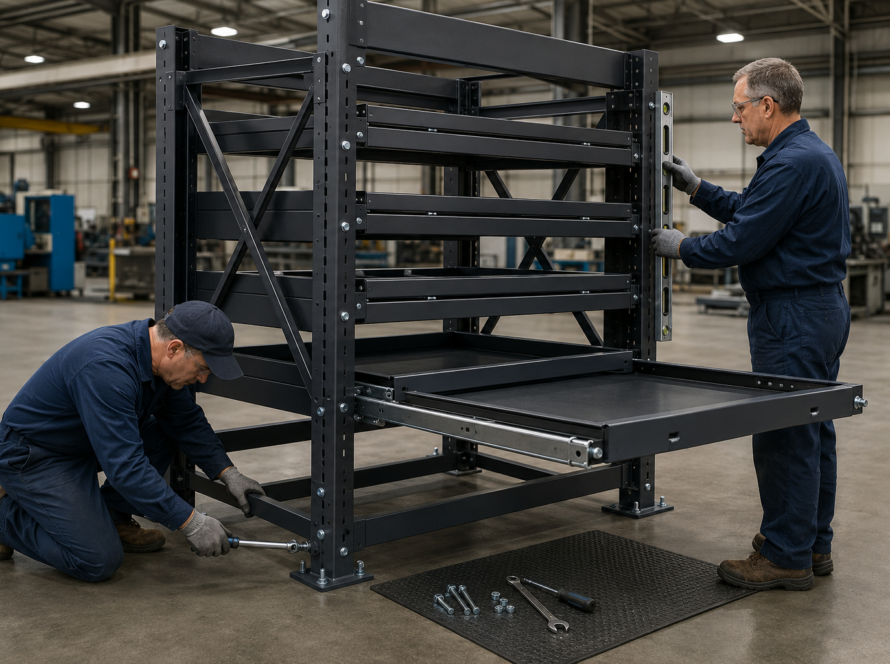
When talking about efficiency in mold rooms, it is almost impossible to separate drawer mold rack systems from the center of the discussion 💪 Because these systems help store heavy-tonnage molds safely and in a controlled way while using minimum space. Thanks to their telescopic rail structure, the mold can be pulled out from inside the rack, which makes access with cranes or lifting equipment far more ergonomic. Preventing molds from being dragged on the ground, stacked on top of each other, or hidden in the back offers a major advantage. In fact, the product logic of the drawer mold rack also clearly highlights safe storage, organized access, and minimum space use together.
In my opinion, the greatest strength of this system is not only its carrying capacity, but the way it improves access behavior 😊 Molds can be identified individually, each drawer can be organized separately, and the operator can intuitively learn where each mold is stored. That reduces time-wasting movements such as “that mold was in the back,” “it was over there,” or “we need to take this one down first.” This produces serious improvement in production changeover times. In this sense, the systems of Detay Endüstri strengthen mold room flow not only from a storage perspective, but also in terms of operational speed.
2) 65% Extension Systems: Safe Control in Narrow Aisles
Not every mold room has wide aisles and comfortable maneuvering areas 😌 Especially in facilities where available space is limited, where racks operate closer to one another, or where safety is considered slightly more important than pure access speed, 65 percent extendable drawer mold racks can be a very smart solution. Because in this system, the drawer opens in a controlled way and the center of gravity of the mold stays within safer limits. This logic offers important advantages both for operator safety and for rack stability in narrow spaces.
What stands out especially in the 65% extendable drawer mold rack solution is the strong balance between mold accessibility and controlled extension. If the mold room is dense but the area is limited, this approach is often highly efficient. Because efficiency is not only speed; safe and repeatable movement is also efficiency. That is why, when looking at the systems of Detay Endüstri, the right question is not “which system opens the most,” but “which extension rate best fits our space.”
3) 100% Extension Systems: Fast Mold Change and Full Access
If your facility performs mold changes frequently, if maintenance teams need full access to the entire mold, and if crane maneuvering requires more direct reach, 100 percent extension systems offer serious advantages 🚀 Because when the mold can be pulled out completely, surface inspection, access to connection points, and lifting operations all become much easier. This makes a real difference especially in production environments where time pressure is high.
The approach of the 100% extendable drawer mold rack provides major ease in maintenance and preparation processes because it gives complete access to the mold. In my view, the real value here is not merely that the drawer opens farther, but that the operator struggles less while working with the mold and that maneuvering becomes more predictable. If mold changeover time is one of the critical KPIs in your factory, these systems can be extremely meaningful. At this point, the fact that the product ecosystem of Detay Endüstri offers different extension options is highly valuable, because not every mold room works in the same way.
4) Light and Medium Duty Racks: Separating Auxiliary Materials from the Main Mold Area
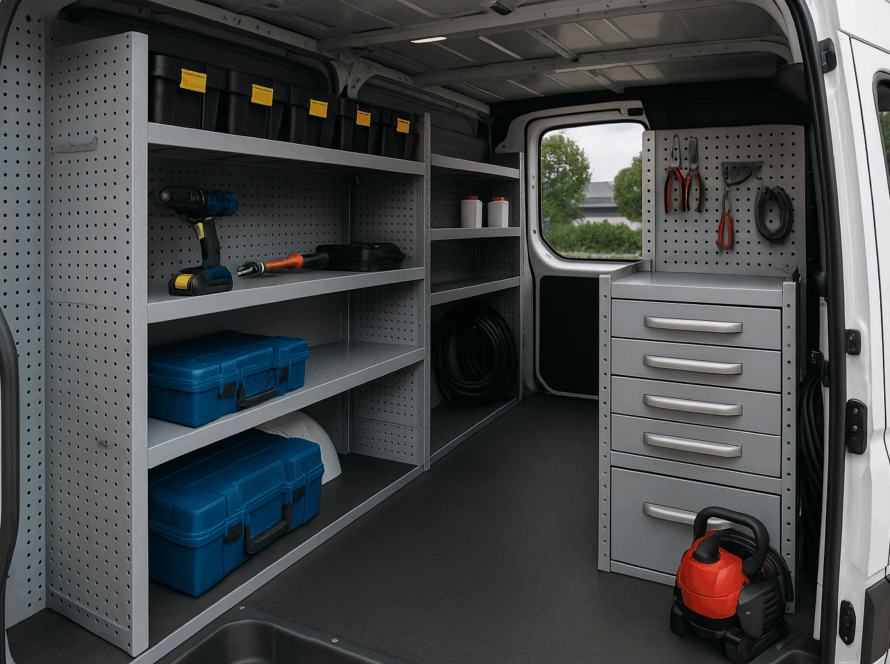
One common mistake in mold rooms is collecting everything related to molds in the same main storage zone 🙂 But when main molds and auxiliary apparatus, connection elements, consumables, labeled boxes, and small equipment are all kept in the same system, the organization quickly begins to collapse. For this reason, a complementary rack structure must be built alongside the main heavy mold racks. This is exactly where light and medium duty racks play a very smart role. These racks organize products related to the molds, but which should remain separate from the main mold bodies, in a collective, accessible, and cleaner way.
This separation may look small, but it has a major effect on efficiency. Because the main mold area begins to breathe, small parts no longer get mixed together, and the team can find auxiliary materials related to the mold more quickly. I usually compare this to an operating room logic 😊 When the main equipment, support sets, and consumables are all stored separately, the process flows more cleanly. The same is true in a mold room. Thanks to this integrated perspective, the solutions of Detay Endüstri offer an opportunity to organize not only the molds, but the entire ecosystem around them.
5) Material Cabinets and Work Areas: The Quiet Complements of Order
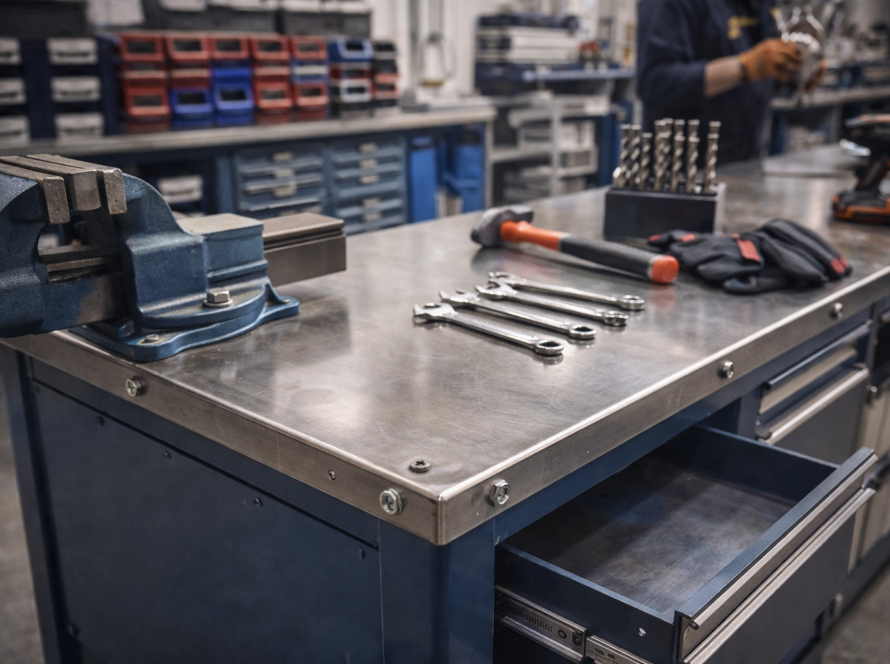
Mold room organization is not completed by racks alone; it also requires locked and controlled auxiliary storage as well as preparation and maintenance areas 🔧 Especially for maintenance tools, measuring devices, consumables, sensitive small parts, and documents, enclosed storage logic is extremely useful. This is where material cabinets come into play and prevent disorder from spreading beyond the racks. In a similar way, work areas reserved for maintenance or preparation also allow the mold room to operate in a much more controlled manner.
That is why simply saying “let us install a rack system” is often incomplete. A “rack + auxiliary storage + preparation area” logic is far more efficient. Solutions such as special workbench models for mold rooms are very meaningful in this respect. Because molds are not only stored; from time to time they are inspected, prepared, cleaned, and worked on before entering production. That is exactly why, in the approach of Detay Endüstri, the rack system and the work area should be considered as two elements that actively speak to one another.
What Really Increases Mold Room Efficiency Is Not the Number of Racks, but the Flow Design
In my opinion, the most critical insight on this subject lies exactly here 🙂 Placing more racks into a mold room does not automatically mean better organization. In fact, sometimes too many racks create poor flow. Real efficiency comes from designing the sequence of mold entry, storage, access, crane retrieval, maintenance waiting, active use, and return placement in a logical way. Which molds will stay in the active zone, which ones will wait longer, where will the maintenance molds be separated, how will auxiliary parts be labeled, and how will forklift or crane maneuvering areas be protected? Any layout built without answering these questions will remain incomplete.
That is why I always recommend this 😊 Before choosing the rack type, first draw the flow map of the mold room. Which molds are taken most frequently during the day, which equipment is searched for most often, where do delays happen most often, where do teams get stuck, and where is space being wasted? The answers to these questions determine which rack solution will be more efficient. That is why the subject of choosing the right rack is not merely about product comparison, but about process analysis.
Example Scenario
Let us imagine that you operate a facility working with injection molds, and mold changes are not weekly but an active daily part of the workflow. In such a facility, the most efficient setup could include 100 percent extendable drawer systems for actively used molds, 65 percent extendable systems for sections requiring safer and more controlled waiting, light and medium duty racks for apparatus and consumables related to the molds, material cabinets for maintenance tools and sensitive measuring equipment, and a separate preparation and inspection workbench. If some molds in the same facility are used only very rarely, their storage zone could be separated according to a different logic. In other words, keeping all molds at the same access level is not always the most efficient solution.
This is exactly why it is important to organize not according to mold value, but according to frequency of use. A very expensive mold does not always have to stand at the front; a frequently used mold that needs to be reached quickly may be more important. Businesses that can see this distinction use their space much more efficiently. At this point, systems such as those of Detay Endüstri, which allow modular thinking, provide serious flexibility.
A Short Anecdote
One of the most interesting things I once saw in a production plant was a mold room that everyone thought was very strong, but no one could use in an organized way 😊 The molds were being stored “securely,” but it took too long to reach the required mold, auxiliary parts were always found in different places, and maintenance-waiting molds were mixed together with active molds. There was a physically strong system, but an operationally exhausting arrangement. After the organization was revised according to access logic, the number of racks did not increase very much, but the workflow accelerated significantly. That day showed me very clearly that organization and capacity are not the same thing.
There Is an Emotional Side Too: Order Creates a Sense of Confidence and Control
In areas such as mold rooms, where heavy equipment is involved, order provides not only efficiency but also psychological comfort 💙 When workers know where things are, they move more confidently. The crane operator works more safely. The maintenance team does not get tired searching for parts. The production supervisor feels less stress about whether mold preparation will be delayed. In other words, a well-organized mold room gives the team an invisible but powerful sense of control. And that often reduces the error rate.
That is why it would be incomplete to look at the solutions of Detay Endüstri merely as metal systems carrying heavy loads. These are also tools that make the discipline of the business visible. When the mold room door opens and what you see is order instead of chaos, that is a much stronger sign of professionalism than many people realize.
A Simple Diagram Related to the Topic
MOLD ROOM NEED
Heavy molds + auxiliary apparatus + maintenance equipment + access speed
      ↓
CLASSIFICATION
Active molds / Passive molds / Maintenance-waiting molds / Auxiliary parts
      ↓
RACK SELECTION
Drawer mold rack + 65% extension + 100% extension + light/medium duty rack + cabinet
      ↓
FLOW DESIGN
Crane access + safe aisles + fast retrieval + organized return placement
      ↓
RESULT
Shorter access time + safer storage + more efficient mold changeover

Frequently Asked Questions
1. What should be the first priority in mold room organization?
The first priority should be safe storage and access flow. Mold movement and frequency of use should be analyzed before deciding on the number of racks.
2. Why is a drawer mold rack advantageous?
It stores heavy molds safely, systematically, and ergonomically, while making access easier with cranes and lifting equipment.
3. When is a 65% extension system more practical?
It is highly practical in mold rooms with narrow aisles, where controlled extension is needed and safety is the stronger priority.
4. When should a 100% extension system be preferred?
It is more advantageous in facilities where full mold access, fast maintenance, and frequent mold changes are required.
5. What is the function of light and medium duty racks in a mold room?
They organize apparatus, consumables, and auxiliary parts related to the molds, and relieve the main mold area.
6. Why are material cabinets necessary?
They help store small equipment, measuring tools, and maintenance materials in a controlled, clean, and safe manner.
7. Does mold room organization affect production time?
Yes. The right organization reduces mold locating, preparation, and changeover times, which accelerates production flow.
8. Should all molds be stored in the same area?
No. They should be classified according to frequency of use, weight, maintenance status, and access requirements.
9. Can an efficient mold room be established even in a narrow space?
Yes. With suitable extension-rate drawer systems and proper flow planning, efficient setups can be created even in limited areas.
10. What is the most common mistake when choosing a rack system?
Looking only at capacity while pushing process flow, aisle requirements, and operator access into the background.
People Also Ask
- Which is the safest rack system for a mold room?
- What is the difference between a drawer mold rack and pallet-type storage?
- Which rack solution is more advantageous in narrow mold rooms?
- How can mold changeover time be reduced?
- Should mold apparatus be stored together with the main molds?
- How should mold room aisle width be planned?
- How should one choose between 65% and 100% extendable drawer racks?
- Is a material cabinet necessary for a mold room?
- Should molds waiting for maintenance be stored in a separate area?
- How much does mold room organization affect occupational safety?
Conclusion
To sum it up 😊 Organizing a mold storage area is not just about placing heavy molds somewhere; it is about managing them safely, quickly, in a controlled manner, and in harmony with production flow. Shelf systems that increase efficiency enter the picture exactly at this point. Drawer mold racks create the main backbone, 65 percent extension systems support controlled safety, 100 percent extension systems provide full access and fast changeover advantages, light and medium duty racks organize auxiliary equipment, and material cabinets keep small parts under control. In other words, a good mold room is not built with a single product, but with the right system combination.
My clear opinion is this 👍 If molds are being found late in the mold room, if auxiliary parts are getting mixed together, if maintenance equipment is scattered around, or if the team has to make unnecessary movements just to retrieve a mold, then the problem is not only a lack of racks; there is also a weakness in the flow design. This is exactly why taking a holistic view of the process together with application-oriented manufacturers such as Detay Endüstri creates much better results. Because the best mold room organization is not the one with the most racks, but the one that provides the safest access in the shortest time.
And perhaps the most important point is this 💙 An organized mold room does not only save time; it creates a sense of confidence, relaxes teams, reduces stress, and makes the business look more professional. If, when the mold room door opens, what is felt is not weight but control, then the right organization has been established. And in many cases, efficiency begins exactly in that quiet order.