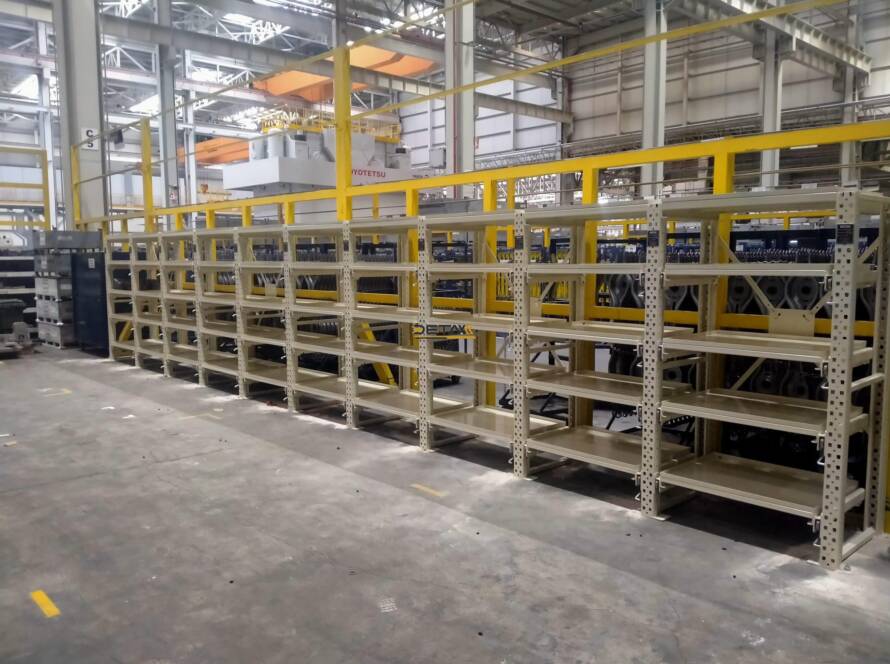
I always like to explain this subject in the following way 🤝 A drawer rack may look like a storage product from the outside, but in real life it is a silent bridge built between occupational safety, equipment life, operator comfort, operational speed, and investment confidence. That is exactly why, when evaluating manufacturers with field knowledge such as Detay Endüstri, it is necessary to look not only at the product photo, but at the system logic as a whole. Especially in solutions such as drawer mold racks, safety is created by thinking together about drawer extension ratio, load capacity, locking discipline, rail technology, frame rigidity, and operator access ergonomics.
Why Does Drawer Rack Safety Begin with Documentation?
One of the most common mistakes in industrial storage areas is reading rack safety only through “thick material” or “high load capacity.” In reality, safety in drawer rack systems is far more layered 🙂 Because here there is not only static load, but also drawer movement, the shift of the center of gravity during extension, operator intervention, integration with lifting equipment, floor conditions, repetitive use, and maintenance discipline. That is why, for a drawer rack system to be considered genuinely safe, it is not enough to look only at the figures in the product brochure; it is also necessary to examine which standards it was designed according to, by what kind of testing logic it was validated, which quality systems the manufacturer works with, and what operational rules are defined for use.
At this point, it is very important to clarify one distinction from the beginning 😊 In the field of drawer racks, the word “certificate” is often used somewhat incorrectly. Because some documents are not direct product certificates; some are design references, some relate to the manufacturer’s quality management system, and some concern the standards to be followed during installation and maintenance. In other words, when a purchasing team says “please send us the certificates,” what they actually want may sometimes be design information showing compliance with EN standards, sometimes load labels and calculation files, sometimes ISO 9001 quality system documentation, and sometimes welding quality discipline evidence. Companies that establish this distinction correctly manage the process much more effectively, and this is where application oriented brands such as Detay Endüstri stand out.
Is a “Mandatory Certificate” the Same Thing as “Expected Compliance Documents”?
No, they are not the same 🙌 And honestly, the biggest confusion in the market begins exactly here. Many companies purchasing drawer racks ask questions such as “Is there CE?”, “Is there an ISO certificate?”, or “Is it compliant with TSE?” All of these are valuable questions, but they do not all carry the same legal meaning. In some cases, CE marking is genuinely required, while in others the product does not automatically fall under CE marking. Some documents, meanwhile, demonstrate the manufacturer’s system discipline more than the product itself. For this reason, the professional approach is to read documentation not like a sticker, but like a risk management tool.
| Document / Standard | What Does It Do? | Is It a Product Certificate? | Its Role for Drawer Racks |
|---|---|---|---|
| EN 15629 | Defines the technical specification and project framework for storage equipment | No | Helps establish quotations, design inputs, and system responsibilities clearly |
| EN 15512 | Defines structural design principles for steel shelving systems | No | It is a critical reference for engineering calculations of the supporting system |
| EN 15620 | Defines tolerances, deformations, and clearances | No | It is important in terms of installation quality and safe operating clearances |
| EN 15635 | Provides the framework for use, maintenance, and damage management | No | It is the core standard for safe operation after installation |
| ISO 9001 | Provides a quality management system framework | No | It is a strong indicator of the manufacturer’s process discipline and traceability |
| ISO 3834 | Defines quality requirements in welded manufacturing | No | It creates confidence in welded steel frames and structures |
| CE Marking | Shows compliance where the product falls under relevant EU harmonization legislation | Depends on scope | It is not automatic for static racks; it may come into play if motorized, electrical, or other regulatory scopes are involved |
The mistake I see most often in the field is this 🙂 A company sees only the ISO 9001 certificate and assumes “all right, the product is safe,” or asks only for CE marking and pushes the other engineering documents into the background. In reality, the correct approach is to read all of these together. For example, the manufacturer may have ISO 9001 certification, but if the product’s load label, calculation report, anchoring plan, and operating instructions are weak, problems can still arise. The opposite is also possible; the product may appear well designed, but if manufacturing quality and process standardization are weak, it becomes difficult to maintain the same stability in the field. This is why, when evaluating solution providers such as Detay Endüstri, it is necessary to see documentation not in isolation, but as part of the whole safety story.
Which Standards Are Actually the Most Critical in Drawer Racks?
Now let us move to the most important section 😊 Instead of searching for a “single mandatory certificate list” for drawer racks, it makes much more sense to rank the core elements that form the safety file correctly. I think about it in five main layers: design standard, tolerance standard, use and maintenance standard, manufacturer quality system, and site documentation. When these five layers come together, the rack becomes not only strong, but also manageable and auditable.
1) EN 15629: The Technical Specification Backbone for Starting a Project Properly
One of the standards that is often overlooked yet very important in drawer rack projects is EN 15629. This is because the standard provides a framework for how the technical specification of storage equipment should be defined. In other words, it helps the parties who design, supply, install, and use the rack speak the same language. Clarifying from the outset topics such as the type of stored load, its dimensions, the condition of the floor, operational clearances, the mode of use, and the distribution of responsibilities is the first step toward safety. In my opinion, this standard is a bit like a seat belt before the project begins; most people do not notice it, but in a critical moment they understand exactly how important it is.
Especially in solutions such as the 100% extendable drawer mold rack, where access convenience is high, or the 65% extendable drawer mold rack, where the center of gravity is kept under tighter control, the usage scenario becomes even more important. Because as the extension ratio changes, operator behavior, space requirements, and the safety setup also change. That is why, in the approach of Detay Endüstri, linking product selection not only to the capacity table but also to real field needs is extremely valuable.
2) EN 15512: The Silent Hero of Structural Design
On the engineering side of the question “Is the frame, the supporting legs, the beam logic, and the load transfer system of the drawer rack truly safe?”, EN 15512 stands out as a highly critical reference. This standard specifically concerns the structural design principles of steel storage systems. A drawer rack is not always identical to a classic pallet rack, but in terms of structural safety logic in steel static storage systems, the design discipline offered by this standard is extremely valuable. In short, seeing a thick profile alone does not automatically mean safety; what really matters is how that profile was calculated, under which load combinations it was evaluated, and how the system was verified.
Let me share a small but important anecdote here 🙂 In one project, everyone was fixated only on the question “How many kilos does each drawer carry?” In reality, the real risk was how the frame behavior and floor anchoring worked together when the drawer was fully open. In other words, sometimes the most critical question is not the nominal load capacity, but how that capacity is preserved during real use. This is why a good manufacturer does not simply state a number; they also explain the calculation logic, the safety factor, and the layout conditions.
3) EN 15620: Tolerances and Clearances Matter More Than You Think
A drawer rack system may look excellent on paper, but if installation tolerances are not controlled, it can behave very differently on site 😌 This is exactly where EN 15620 comes into play. Tolerances, deformations, and operating clearances are not merely theoretical engineering concepts; they are directly critical for the drawer to slide properly, for the load to be distributed evenly on the rails, for the frame not to twist, and for the operator to maneuver safely around the equipment. Misaligned installation, incorrect clearances, weak leveling, or careless anchoring may turn into major operating problems not years later, but sometimes within the very first months.
That is why, when selecting racks, it is necessary not only to look at product images, but also to ask what kind of acceptance criteria will be applied after installation. Particularly in drawer systems operating within the same storage ecosystem as light and medium duty racks, dimensional discipline affects the safety of the entire flow. I always explain this with a carpentry metaphor 😊 A cabinet that looks beautiful and a cabinet that works properly are not the same thing; a system that pleases the eye may still tire you in daily use if millimetric accuracy is weak.

4) EN 15635: The Discipline of Use, Damage Tracking, and Periodic Inspection
This is where the backbone of real field safety begins 💡 Because even the most perfectly designed rack can become risky if misused, impacted, overloaded, poorly maintained, or if damage is ignored. EN 15635 defines the approach to application and maintenance in steel static storage systems. In short, this standard tells you the following: do not simply install the rack and leave it there; create operating instructions, manage damage, plan inspections, make load information visible, and keep the system safe throughout its operational life.
At this point, load labels, maximum drawer capacity, total unit capacity, the number of drawers that may be opened at one time, operator warnings, and periodic observation records become highly valuable. In the industry, load plaques and regular inspection mechanisms stand out strongly as good practice. In fact, it is valuable to see on the Detay Endüstri blog that content supporting a culture of safety and correct usage is frequently emphasized. Real professionalism is not only producing the product, but also carrying the correct usage knowledge into the field.
5) ISO 9001 and ISO 3834: Not “Product Certificates,” But Strong Signals of Confidence
Now let us come to two important but often confused topics 🙂 ISO 9001 is not a document that directly certifies the product itself; it shows that the manufacturer has established a quality management system, monitors its processes, and works with the logic of documentation and continual improvement. For this reason, it is very valuable for purchasing teams, but it does not replace the sentence “the rack is safe” on its own. ISO 3834, on the other hand, is especially valuable for manufacturers using welded fabrication; because in systems such as drawer racks that include steel construction, weld quality is extremely decisive for long service life and safety. A weld looking good to the eye is one thing, while being produced under controlled quality discipline is something completely different.
My personal opinion is this 😊 If you are buying a heavy duty drawer rack, instead of asking the manufacturer only for a catalog, you should also ask how their quality system works, what their welding discipline is, and how inspection records are maintained. Because a strong rack is often born not only in the workshop, but in the process itself. This is where the value of reading manufacturers such as Detay Endüstri as systems, not just sellers, becomes clear.
So Is CE Required? The Most Confused Topic
This part is very important, and it has to be discussed honestly 😊 CE marking is not always automatically, generally, and unquestionably mandatory for static drawer rack systems. CE marking becomes relevant if the product falls under the scope of the relevant EU harmonization legislation. In other words, if the product includes a motor, electrical drive, automatic movement, a separate machine function, or other regulatory scopes, then the picture may change. But when it comes to a classic static steel drawer rack, in many projects what is actually sought is not CE so much as engineering compliance, manufacturer documentation, load information, operating instructions, and a safe installation file.
My recommendation here is very clear 👍 As a purchasing team, instead of asking only “Is there CE?”, ask these questions together: According to which standard was this product designed? For which loads was it calculated? Are there operating instructions? Is a load plaque provided? Are installation and anchoring details supplied? Is there a recommendation for periodic inspection? How does the quality system work? These questions will lead you to a much safer result. Especially thinking with the logic of safe rack selection allows you to read documentation not as a single logo, but as the entire risk chain.
Which Documents Should You Request from the Supplier When Buying Drawer Racks?
This is where the practical side really begins 🙌 If I were a business buying drawer racks, I would definitely ask for the following documentation package, because these documents make real safety visible:
| Document to Request | Why Is It Important? |
|---|---|
| Technical quotation and system description | Clarifies exactly what the product offers and under what scope it will be delivered |
| Load capacity table | Makes drawer by drawer, level by level, and total unit limits visible |
| General layout and anchoring plan | Verifies floor safety and secure fixing |
| Operating and maintenance instructions | Reduces operator error and establishes a culture of periodic inspection |
| Material and manufacturing information | Makes visible the steel grade, rail system, and surface protection approach used in the frame |
| Quality certificates | Shows the manufacturer’s system approach such as ISO 9001 |
| Welding quality approach | Creates confidence in welded structures |
| Sample load label / load plaque | Brings safety information directly to the user in the field |
This list may sound technical, but in reality it serves a very human purpose 😊 People make mistakes. A safe system is one that reduces the likelihood of user error. A well labeled drawer rack clearly shows how much each drawer can carry. A well prepared maintenance instruction explains what the operator needs to pay attention to. A well designed locking logic prevents dangerous simultaneous extension. That is why documentation is not requested just to sit in a file; it is requested so that behavior in the field becomes safer.
Which Document Is More Critical in Which Project?
Let us imagine that a mold shop is making a new investment in drawer racks for storing heavy injection molds. In this project, the first thing to examine is not simply the load capacity per drawer; it is the real mold weights, dimensions, crane access, drawer extension ratio, floor capacity, and operator flow. Here, the technical specification should be established properly with the logic of EN 15629, while supporting structural safety should be evaluated with the logic of EN 15512. After installation, tolerances and alignment should be checked. The facility should be given load plaques, operating instructions, and maintenance procedures. If the manufacturer works under an ISO 9001 quality system, that is a plus; if there is heavy welded construction, the ISO 3834 approach becomes even more valuable.
Likewise, in a more compact layout where mezzanine rack systems, material cabinets, and drawer racks operate together, user training and load labeling become even more critical. Because safety is not only the behavior of a single product, but the combined behavior of the whole system. That is why, from companies such as Detay Endüstri, it is necessary to ask not only for the product, but also for the usage scenario.
A Safe Rack Creates a Quiet Sense of Trust
This topic has not only a technical side, but also a human one 💙 For someone working in a factory, a mold shop, or a maintenance area, a safe rack is not just storage equipment. If, when opening that drawer, the questions “Is this load unbalanced?”, “Will the rail jam?”, or “Could the system tip?” are not constantly running in the back of their mind, they can do their job more calmly, more quickly, and with more confidence. That feeling of trust should not be underestimated. Sometimes the real difference in efficiency comes exactly from this. A team that works with confidence makes fewer mistakes, decides faster, and focuses better on the job itself.
I have always believed this 😊 Good industrial equipment does not prove itself by shouting, but by not creating problems. It works quietly, gives confidence for years, and does not make the user uneasy. That is why a safety focused rack approach is not just about collecting documents; it is about bringing together the right material, the right standard, the right label, and the right usage culture.
Simple Diagram Related to the Topic
NEEDS ANALYSIS
Load type + weight + usage frequency + space constraints
      ↓
TECHNICAL SPECIFICATION
Project inputs with the logic of EN 15629
      ↓
ENGINEERING DESIGN
Supporting system + rail + frame + anchoring
      ↓
INSTALLATION AND TOLERANCES
Alignment + clearance + deformation control
      ↓
OPERATIONAL SAFETY
Load label + instructions + periodic inspection + damage management
      ↓
SUSTAINABLE SAFETY
Long service life + operator confidence + low risk + orderly workflow

Frequently Asked Questions
1. Is there a single mandatory certificate for drawer racks?
No. In most projects, instead of a single magic document, a set of standards and documents showing design, production, installation, and operational safety together is expected.
2. Is CE marking mandatory for drawer racks?
Not always. In static rack systems, CE should not be assumed automatically; the product’s regulatory scope must be evaluated technically.
3. Does ISO 9001 prove that the product is safe?
Not by itself. ISO 9001 shows the manufacturer’s quality management system discipline; engineering and operating documents are also required for product safety.
4. Why is ISO 3834 important?
It is highly valuable for showing that weld quality is managed in a controlled way in racks containing welded steel structures.
5. Why is EN 15635 mentioned so often?
Because it concerns not only installing the rack, but also using it safely, inspecting it, and managing damage throughout its life.
6. Is a load plaque really necessary?
Yes, it is extremely important from a practical safety perspective. It allows the user to see safe limits and helps reduce the risk of overloading.
7. Does the drawer extension ratio affect safety?
Absolutely yes. 65% and 100% extension systems offer different usage behaviors and different safety advantages.
8. Why are anchoring and floor information critical?
Because in drawer systems the load acts not only vertically, but also horizontally and through moment forces during extension. This makes secure fixing highly important.
9. Which first documents should I ask for when buying racks?
A technical quotation, capacity table, operating instructions, anchoring information, sample load plaque, and quality system information are a strong starting point.
10. Why is choosing a safe rack more economical in the long run?
Because the wrong product may look cheaper at the investment stage, but in total it can become much more expensive through damage, downtime, maintenance, accident risk, and replacement costs.
People Also Ask
- How is maximum load capacity calculated in drawer racks?
- Is it risky to use a rack without a load plaque?
- Is a locking system mandatory in drawer mold racks?
- Which is safer, a 65% extension system or a 100% extension system?
- Who should carry out periodic rack inspections?
- Which rail system should be preferred for heavy molds?
- How can the risk of tipping in drawer racks be reduced?
- Is a custom designed rack necessary for a mold shop instead of a standard rack?
- How important is operator training for rack safety?
- Which questions should be asked to the supplier when buying drawer racks?
Conclusion
To sum it up 😊 The issue of safety standards in drawer racks is not simple enough to be read as “show one certificate and that is it.” Real safety is created through the right technical specification, the right engineering, the right installation tolerance, the right operating instructions, the right load labeling, and the right maintenance culture. EN 15629 strengthens project definition, EN 15512 supports the structural safety perspective, EN 15620 reinforces installation and clearance discipline, and EN 15635 forms the living side of the matter, meaning safe use and maintenance logic. Documents such as ISO 9001 and ISO 3834 are also important indicators that support manufacturer reliability and manufacturing quality.
That is why my clear recommendation is this 👍 When buying drawer racks, do not ask only “How much weight does it carry?” or “Is there CE?” Instead ask, “According to which standard was this product designed, which documents support it, how is load information displayed, how is operator safety protected, and what is provided for installation and maintenance?” Because a truly safe rack is not only a rack that carries weight; it is a rack that protects the user, reduces risk, and gives a sense of order for years. With this point of view, approaching solution manufacturers such as Detay Endüstri leads to much healthier results.
And the most beautiful part of it is this 💙 A safe drawer rack system does not make itself known through grand statements, but through small comforts. The drawer opens smoothly, the load stays balanced, the worker does not hesitate, the space looks orderly, the maintenance team understands the system, and the warehouse manager does not have to ask the same question every day: “Is there a risk here?” That quiet feeling of trust is the clearest reflection of good standards and correct manufacturing. For this reason, a storage plan considered holistically together with workbenches, material cabinets, and advanced rack solutions does not only save space; it also brings peace of mind 😊