The good part of this question is this 🤝 Today, the market is no longer limited to one-size-fits-all metal shelves. When you look at manufacturers such as Detay Endüstri, who treat in-vehicle equipment not as a product but as a system, you see a very wide range of choices, from open shelves to drawer modules, from cabinet units to custom compartments, from upper shelves to underfloor solutions, from setups integrated with workbenches to arrangements supported with LED lighting and accessories. In other words, customization here does not simply mean “make it a bit smaller or bigger”; on the contrary, it is a real engineering approach extending from shelf depth to drawer layout, from lock type to equipment restraint, from vehicle-specific modules to industry-based use scenarios.
Why Is Customization So Important in In-Vehicle Shelving?
One of the biggest mistakes in in-vehicle shelving systems is assuming that one solution fits everyone 🙂 In reality, as the interior volume of a panel van changes, as the door opening, wheel arch structure, floor height, usable height up to the roof, and equipment carrying habits differ, the correct shelving layout also changes. And this is not only about storage. Details such as which tools are used several times a day, which ones are heavy, which ones are fragile, which ones need to stay locked, which ones must not move during driving, and which ones should stay within easy reach of the technician all directly influence the decision. That is why in-vehicle cabinet and shelving systems are not simply an application meant to fill empty space, but a design solution that directly accelerates workflow.
I always think about this in the following way 😊 The inside of a service vehicle is actually the combination of a small workshop, a mini warehouse, and a moving workstation. If the layout is poor, even the simplest task takes longer; the technician wastes time looking for a screwdriver, struggles to separate cables, small connection parts get mixed together, fragile devices shift around, and when heavy equipment is placed in the wrong spot, both driving safety and working ergonomics suffer. But once the right customized system is installed, the flow inside the vehicle begins to work almost like a reflex. People find what they need instantly, everything has a defined place, materials do not move around while driving, and the company creates a much more professional impression in front of customers. This is why, in the approach of Detay Endüstri, customization is not an aesthetic luxury, but an operational necessity.
What Main Options Exist in Customizable In-Vehicle Shelving Solutions?
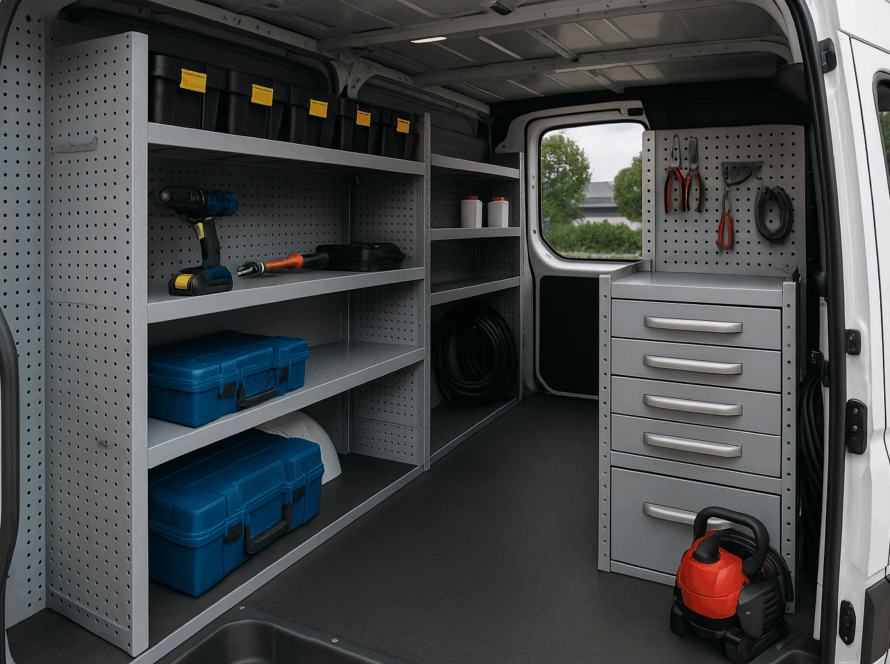
Now let us move to the practical side 🙌 When we talk about customization in in-vehicle shelving systems, we are actually talking about several main module families. These can be grouped as open shelves, drawer modules, enclosed cabinets, upper shelves, custom compartments, in-vehicle tool cabinets, integrated work areas, and accessory-supported systems. Each one responds to a different usage behavior. That is why there is no single answer to “the best system”; there is only “the most suitable combination.”
| Option | Best Use Case | Main Advantage | Point to Consider |
|---|---|---|---|
| Open Shelf Modules | Frequently used bins, consumables, parts that require quick access | Instant visibility and fast access | Fragile or loose parts may require additional restraint |
| Drawer Systems | Hand tools, small connection parts, categorized storage | Organized classification and safer storage | Load distribution and rail quality are important |
| Enclosed Cabinets | Sensitive devices, valuable equipment, materials that need protection from dust | More secure and protected storage | The lock and door mechanism should be chosen correctly |
| Upper Shelves | Light equipment, protective products, materials used less often | Makes high space more efficient | Not suitable for heavy parts |
| Custom Compartments | Devices, cylinders, charging units, measuring equipment, cables, or specially shaped parts | Maximum organization tailored to the product | The needs analysis must be done correctly |
| Integrated Bench / Workstation | Teams performing assembly, cutting, tightening, testing, or paperwork in the field | Turns the vehicle into a mobile workshop | Corridor and movement space must be preserved |
1) Open Shelving Systems: The Most Practical Choice for Speed-Oriented Work
Open shelving systems are one of the simplest yet most useful parts of an in-vehicle layout 🚐 They are highly efficient especially for boxed stock, consumables, frequently needed hand tools, cable kits, and often-used spare parts, because the technician can access the equipment directly without opening a cabinet door or pulling out a drawer. That is why open shelves save serious time in distribution, light maintenance, electrical work, and fast service operations. In fact, the approach discussed in in-vehicle shelving and storage layout in mobile workshops also especially highlights the visual accessibility advantages of open shelves.
But to be honest 🙂 Open shelving is not ideal for everything. If the material being transported is fragile, easy to scatter, or likely to move during sudden maneuvers, then open shelves alone will not be enough. This is where customization comes in, through solutions such as adding barriers to the front of the shelf, using box dividers, supporting the system with custom compartments, or converting certain modules into drawer-based structures. In that sense, a modular approach like the one offered by Detay Endüstri becomes valuable, because the system is not fixed to a single logic but shaped around the rhythm of the work itself.
2) Drawer Modules: The Heart of Organization for Small Parts and Hand Tools
In my view, one of the strongest players in vehicle interior customization is the drawer system 😊 Because for small parts, consumables, connection elements, socket sets, electrical accessories, clamps, measuring accessories, and equipment that easily gets mixed up, few solutions are as effective as drawers. The beauty of a drawer module is this: it creates categorized organization within the same volume, makes the required part visible, and prevents small equipment from scattering around the vehicle. If service speed matters, a drawer-based setup creates a major advantage.
Moreover, a drawer is not only a storage element; when designed correctly, it is also an ergonomic tool. The most frequently used products can be placed in waist-level drawers, while less often used items can be positioned lower or higher. This way, the technician does not have to bend or stretch every time. If the system is supported with locking mechanisms, the risk of drawers opening during driving is also reduced. This protects both the equipment and the user. In short, the drawer module is one of the most functional parts of the in-vehicle tool cabinet concept, and in this sense it is also aligned with the general organizational logic seen in tool trolleys.

3) Enclosed Cabinets: A Safe Zone for Sensitive and Valuable Equipment
In every in-vehicle system, protection matters just as much as visible access 🔒 This is where enclosed cabinets stand out. For measuring devices, electronic testing equipment, expensive hand tools, documents, special kits, or components that need stronger protection from dust and impact, enclosed modules make a great deal of sense. They also help the inside of the vehicle look more organized. Sometimes the first thing the customer sees when the vehicle door opens is not only technical competence, but the feeling of order. In that respect, enclosed cabinets also strengthen the professional appearance of the service team.
The important part of customization here is selecting the right door style and inner layout. Fixed shelf cabinets, adjustable shelf cabinets, lockable cabinets, partitioned cabinets, or compartments tailored to the size of the device can all be designed. This perspective also overlaps with the product logic of material cabinets, because order and security often need to be considered together. Especially when open shelves and enclosed cabinets are used side by side inside the vehicle, frequently used materials remain visible while sensitive equipment stays protected. This combination is one of the most practical examples of customization in the approach of Detay Endüstri.
4) Upper Shelves and High-Space Utilization: Making Every Centimeter Count
In panel vans and similar vehicles, one of the most underused areas is the section close to the roof 😌 Yet upper shelves are a fantastic solution for light but bulky equipment, protective supplies, glove boxes, packaging products, cloths, lightweight consumables, and products that are not needed every single minute of the day. The goal here is to reserve the floor and waist-level zones for heavy and frequently used equipment while making sure the upper space does not go to waste.
But there is a balance rule here: the use of upper space must be smart, and the center of gravity must not be compromised. In fact, one of the main principles of in-vehicle organization is the preservation of weight balance. Heavy parts should stay close to the floor, while lighter ones can be placed higher up. This simple rule can sometimes completely change both driving comfort and safety. I always compare it to moving house 😊 You do not place the heaviest moving boxes on top of a wardrobe; the same logic applies inside a vehicle.
5) Custom Compartments and Industry-Specific Modules: The Real Face of Customization
In my opinion, the most exciting part of customization is custom compartments ✨ Because this is where the system moves beyond the logic of standard shelving and becomes truly tailored to the user. Compartments precisely fitted for measuring devices, custom spaces for cable reels, fixed storage points for gas cylinders, laptop or printer sections, charging stations, magnetic holders, small-box organizers, document pockets, fire extinguisher brackets, generator or compressor zones, and mini working points where a vise can be attached all elevate the vehicle interior from ordinary storage to the level of a professional mobile workshop. Both the special compartments in in-vehicle cabinets approach and project examples underline exactly these types of customizations.
For example, in projects such as the Peugeot Partner mobile service vehicle and the Ford Transit Connect in-vehicle equipment, it becomes clear that modular shelves, drawer cabinets, workbenches, aluminum cladding, LED lighting, and even compressor or generator integration can all be combined in one coherent system. This shows us something important: in-vehicle customization is not just about choosing shelves, but about redesigning the entire mobile working experience from the ground up. That is why, with companies such as Detay Endüstri, it makes much more sense to think in terms of industry, vehicle model, and usage habits.
Standard Shelving or Custom Design?
This question comes up often, and honestly it does not have just one answer 🙂 Standard modules usually offer faster decision-making, meet basic organizational needs, and make cost control easier. But as work intensifies, equipment variety increases, and the vehicle starts being used as a real mobile workshop throughout the day, the value of custom design rises dramatically. Because custom design does not simply fill the vehicle; it adapts the vehicle to the workflow. In fact, the whole point behind the question asked in in-vehicle shelf selection: standard or custom design? is exactly this.
My personal opinion is this 😊 If the vehicle is opened and closed constantly during the day, if the same tools are used again and again, if certain job scenarios happen regularly, and if the team has started saying things like “this part always ends up lying around,” “it takes too long to find this,” or “we really need a separate compartment for that,” then the time for custom design has already come. Because those comments are not luxury demands; they are efficiency signals coming directly from the field. And this is exactly where modular systems from companies such as Detay Endüstri create real value, since the setup can be revised according to vehicle type, industry, and user habits.
Example Scenario
Let us say you have an HVAC service team. This team carries hand tools, uses measuring devices, keeps spare parts, and sometimes performs small installation or dismantling work in the field. For a team like this, the most logical setup could be heavy-duty drawers for tools and parts at the lower level, open shelves for bin-based storage in the middle area, lightweight consumables on the upper level, a lockable cabinet on one side for sensitive devices, and a small work surface near the rear door. If the same vehicle is used for electrical service instead, the focus may shift more toward cables, fuses, connection elements, and testing devices, which means a greater number of drawers, denser compartment systems, and more custom small-box organizers may become important. In other words, the vehicle can be the same vehicle, but the interior layout changes. That is exactly what customization means 👍
A Short Anecdote
Years ago, a technician friend of mine told me something I still remember very clearly: “There is space in the vehicle, but there is no time.” To me, that sentence feels like the summary of in-vehicle shelving design 😊 Because the issue is often not the total square footage of the space, but how that space is used. Spending three minutes searching for a tiny part in a large but badly organized vehicle is far worse than finding it in ten seconds inside a smaller but properly arranged system. That is why the subject discussed in optimum space utilization is not theoretical at all; it is directly about everyday performance.
There Is an Emotional Side Too: Order Creates Confidence
This subject has a psychological side as much as a technical one 💙 A messy vehicle drains people. Constantly searching for something, facing a chaotic image every time the doors open, worrying about heavy equipment moving out of place, wondering whether small parts have been lost or not, all create mental load. But a well-planned in-vehicle system calms the user down. People know where everything is, trust that they can find what they need, feel more professional in front of the customer, and focus better on the actual work. For that reason, a customized in-vehicle shelving system does not only carry materials; it also carries a sense of confidence, order, and flow. In that sense, the solutions offered by manufacturers such as Detay Endüstri are not just metal modules, but tools that improve work habits.
A Simple Diagram Related to the Topic
VEHICLE TYPE + JOB SCENARIO
      ↓
Equipment Analysis
Heavy / Light / Fragile / Frequently Used / Must Stay Locked
      ↓
MODULE SELECTION
Open Shelf + Drawer + Enclosed Cabinet + Upper Shelf + Custom Compartment
      ↓
ADDITIONAL SAFETY and COMFORT
Lock + LED + Non-slip Floor + Fixing + Bench + Accessories
      ↓
RESULT
Faster access + Safer driving + More organized vehicle + More professional service

Frequently Asked Questions
1. Can in-vehicle shelving systems be fully customized?
Yes. Modular or more tailored layouts can be created according to the vehicle model, industry, equipment type, usage frequency, and working style.
2. Which module is the most commonly preferred?
That depends on the job. In many projects, the combination of open shelves and drawer modules is one of the most practical solutions.
3. Is an enclosed cabinet necessary?
If there are sensitive devices, valuable tools, documents, or parts that need protection, an enclosed cabinet is very useful.
4. Can customization also be applied in small vehicles?
Yes. In fact, in smaller vehicles proper layout becomes even more important because every centimeter is more critical.
5. Do drawer systems open while driving?
When proper locking mechanisms and solid installation are used, this risk is greatly reduced.
6. Are upper shelves safe?
Yes, but only for light equipment. Heavy parts should be placed closer to the floor.
7. Can a workbench be added inside the vehicle?
Yes. In some projects, a mini work surface, vise area, or processing point can be integrated.
8. Which industries benefit the most from these solutions?
Maintenance and repair, electrical service, HVAC, field service, roadside assistance, installation teams, and mobile technical service operations are among the main ones.
9. Which is better, open shelving or drawers?
Not one on its own; in most cases, the right combination of both produces the best result.
10. Does investing in in-vehicle shelving really save time?
Yes. An organized layout makes it easier to reach the required part faster, accelerates workflow, and strengthens the professional image.
People Also Ask
- How should panel van interior shelving systems be planned?
- For which jobs is an in-vehicle drawer tool cabinet suitable?
- Can enclosed cabinets and open shelves be used together?
- How is weight balance maintained inside a vehicle?
- Is LED lighting necessary in in-vehicle shelving systems?
- What type of cabinet is more suitable for sensitive measuring devices?
- Does a mini workbench make sense in mobile service vehicles?
- What is the difference between a custom shelving system and a standard one?
- How are custom compartments inside a vehicle determined?
- How much do locking mechanisms affect in-vehicle safety?
Conclusion
To sum it up 😊 When we talk about customizable in-vehicle shelving solutions, we are not talking about a single shelf option; we are looking at a broad world that includes open shelves, drawer systems, enclosed cabinets, upper shelves, custom compartments, mini workstations, accessory support, and vehicle-specific installation concepts. The real value here lies not in the existence of these parts one by one, but in bringing them together in the right combination according to your workflow. In other words, the best solution for a vehicle is not the one filled with the most modules, but the one in which the right modules create the smoothest and most usable layout.
That is why my very clear view is this 👍 If your vehicle has truly become a place where work is produced throughout the day, then you should no longer leave the interior layout to chance. Questions such as which tool is used most often, which one is heavy, which one is fragile, which one should stay visible, which one should remain locked, and which area should function as a work surface all directly affect system design. For that very reason, the modular logic we see in the product structure and Detay Endüstri blog is not only aesthetic, but a way of thinking that genuinely works in the field. The fact that project-based evaluation can also be carried out through the contact side is the natural continuation of that approach.
And perhaps the best part of all this is the following 💙 A properly customized in-vehicle system saves a little time every day, but when those small gains accumulate, they create a very large difference. The technician gets less tired, the vehicle looks more organized, the equipment is better protected, the customer perceives a more professional level of service, and the workflow is interrupted less often. In other words, a good in-vehicle shelving solution is not only a set of cabinets and metal modules; it is a quietly working productivity machine. When you look at it this way, the customizable systems offered by brands such as Detay Endüstri make mobile working much more controlled, safe, and professional.