I always see this topic in the following way 🤝 Organizing a small space is like working as a professional chef in a compact kitchen. The area is limited, but if the flow is designed correctly, that space does not become inefficient; on the contrary, it becomes an extremely powerful working environment. The same logic applies in industrial settings. If products are classified correctly, vertical space is used intelligently, frequently used loads are separated from infrequently used ones, auxiliary equipment is positioned without disrupting the main flow, and the rack system is chosen according to the geometry of the space, then a small warehouse, a back-of-workshop stock area, an archive room, or a production line support zone can become surprisingly efficient. This is exactly why modularity, adjustability, and vertical storage logic stand out so strongly in the product structure of Detay Endüstri.
What Is the Biggest Mistake in Small Spaces?
The biggest mistake made in small spaces is thinking about storage only on the horizontal plane 🙂 As the square meter shrinks, ceiling height and vertical volume become much more valuable. Most businesses focus on floor occupancy, but fail to fully use the available height along the walls. As a result, the floor becomes crowded, aisles get tighter, finding products becomes more difficult, and the area begins to feel even smaller than it really is. Yet with the right racking system, the same space can become more organized, more accessible, and safer at the same time. For that reason, in small-space planning, the first question should not be “how many racks can fit here,” but rather “which volume are we still not using?”
This logic is also very clearly reflected on Detay Endüstri’s light and medium duty racks page. It states that these systems are designed in a modular structure for the organized storage of boxes, cartons, spare parts, e-commerce packages, and similar products, and that adjustable shelf heights make it easy to adapt to different sizes. This is an extremely valuable advantage. Because the main thing that destroys efficiency in small spaces is the mismatch between product dimensions and shelf spacing. Shelf gaps that are too high create wasted empty space, while shelf gaps that are too low make operation more difficult. This is exactly where an adjustable structure creates a major difference. That is why, in the approach of Detay Endüstri, small-space management is not random stacking, but controlled modular organization.
Which Racking Solutions Are the Most Efficient in Small Spaces?
The system to be used in small spaces is not limited to a single rack type 🙌 Because the same area may contain light products, boxed stock, spare parts, and also longer or irregularly shaped items. That is why, in most cases, the best solution for small spaces is a multifunctional combination. Light and medium duty racks can form the main backbone, mezzanine systems can create a second layer, material cabinets can keep small and sensitive equipment under control, and certain vertical drawer systems can provide maximum category discipline within a limited footprint.
| Solution | Main Benefit | Most Suitable Use | Contribution to Small Spaces |
|---|---|---|---|
| Light and Medium Duty Racks | Modular and adjustable storage | Boxes, cartons, spare parts, back-line stock | Reduces wasted gaps and optimizes volume with height adjustment |
| Mezzanine Racking Systems | Transforms ceiling height into second or multiple levels | High-ceiling but narrow-floor spaces | Creates additional usable levels on the same footprint |
| Material Cabinets | Keeps small and sensitive products under control | Tools, measuring equipment, critical parts | Reduces clutter and relieves load from open racking |
| Vertical Drawer Systems | High-density category organization in narrow areas | Long equipment, tools, specialty parts | Provides maximum storage efficiency in a limited footprint |
| Workbench + Rack Combination | Brings preparation and storage together at one point | Workshop-back areas and process zones | Reduces the need for separate furniture |
Light and Medium Duty Racks: The Most Flexible Solution for Small Spaces
One of the solutions that creates the biggest difference in small spaces is light and medium duty racking 😊 The most important reason for this is that these systems can adapt not to a single type of product, but to many different product varieties. On Detay Endüstri’s related page, it is clearly stated that adjustable shelf heights and bolted or boltless connection structures allow easy adaptation to different product dimensions. This is a major advantage. Because the main thing that damages efficiency in small spaces is when product dimensions and shelf spacing do not match. Excessively high shelf spacing creates unnecessary empty space, while excessively low spacing makes usage difficult. Adjustable construction makes a major difference exactly at this point.
In my opinion, the smartest approach in small-space management is to classify products according to their volume behavior. Small boxes, medium cartons, spare parts, consumables, and long items should not all be placed on the same rack according to the same logic. If they must share the same module, then adjustable level logic becomes essential. This very clearly explains why the modular structure highlighted on the light and medium duty racks page is so valuable in small spaces. For this reason, the products of Detay Endüstri should be seen in small volumes not only as storage equipment, but as space-organizing tools.
Mezzanine Systems: Growing Upward Instead of Outward
In places that have a small floor area but strong ceiling height, I believe the biggest opportunity is mezzanine systems 🚀 On Detay Endüstri’s mezzanine racking systems page, the multi-level storage logic that creates additional floors by using the existing ceiling height in the most efficient way is especially emphasized. This is a very critical subject for small spaces. Because some businesses may be looking for a new warehouse while in reality they are not using the vertical height of their current space at all. Mezzanine systems stand out exactly here as intelligent solutions that increase storage capacity without expanding the floor area.
The best part of these systems is this 😊 They can offer not only storage, but also working-area logic. The upper level can be used for stock while the lower level becomes a preparation area; or the lower level can hold main products while the upper level is used for spare parts and archives. This system produces especially strong results in warehouses with high product variety, order preparation areas, spare-parts depots, and archive-like environments where clear organization is needed. In this sense, the mezzanine solution is not just a rack, but directly a storage strategy that multiplies usable square meters. That is what makes the approach of Detay Endüstri even more valuable for small spaces.

Vertical Drawer Systems: Maximum Efficiency in a Narrow Footprint
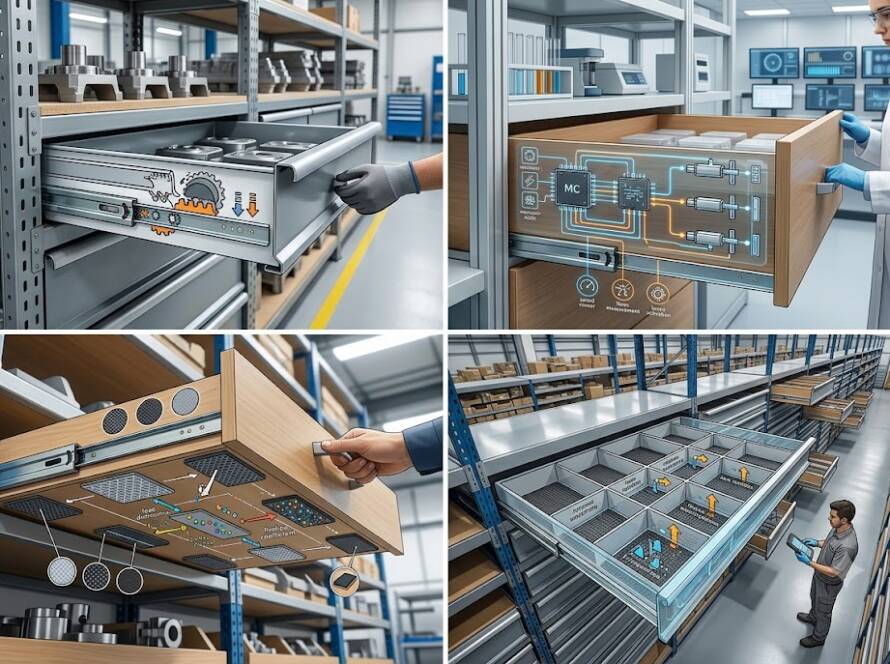
In small spaces, sometimes the solution is not taller shelving, but smarter drawer architecture 😌 On Detay Endüstri’s vertical drawer press brake tool cabinet page, the phrase “maximum storage efficiency in limited spaces” stands out very clearly. This is a very valuable example, because in small spaces some products can be managed far more efficiently not with conventional shelving logic, but with vertical drawer logic. Especially for long items, category-sensitive equipment, or products that easily get mixed up, vertical drawer solutions provide serious advantages.
I find this logic extremely strong not only for press brake tools, but also as a general principle 😊 Because in small spaces the problem is not always a lack of square meters; sometimes it is a lack of access discipline. Instead of lining products up side by side, storing them in classified drawers both uses the area better and strengthens inventory control. For this reason, the vertical drawer approach on the Detay Endüstri side is very inspiring for businesses that have limited space but a high need for structured organization.
Why Are Material Cabinets and Controlled Storage Even More Important in Small Spaces?
The biggest enemy of small spaces is often not large products, but uncontrolled small parts 🔒 Because if small equipment, measuring devices, sensitive products, consumables, and frequently used accessories are not managed correctly, every level of the rack starts to look disorganized. As a result, the area feels full, but in reality it is not being used efficiently. That is why material cabinets are among the quiet heroes of small-space management. They transfer the clutter that would otherwise pile up on open shelving into controlled compartments, reduce the risk of losing small products, and create a calmer overall storage appearance.
From my observation, maintaining order in small spaces is harder than in large warehouses, but also more effective when done correctly 😊 Because the benefits of proper classification become visible immediately in a small environment. One material cabinet can bring dozens of small parts under control at a single point, and that in turn relieves the true capacity of open shelving. That is why, when cabinets and racks are considered together in the solutions of Detay Endüstri, a much more professional order can be established even in a very limited space.
The Real Secret of Maximum Storage in Small Spaces: Zoning
In my opinion, the real secret of maximum storage in small spaces is proper zoning 🙌 In other words, it is wrong to try to store every product with the same density and the same access logic. Frequently used products should stay in easy-access zones, rarely used products in upper or more passive zones, sensitive ones in cabinets, large-volume products at lower levels, and light but bulky items in upper layers. If this zoning logic is not established, the space will lose functionality very quickly no matter how well it is filled with racks.
I always explain this with the following example 😊 In a small office, placing the printer right next to the desk and archive folders up near the ceiling makes sense; but if you also move the files used every day to the highest level, then the space you gained turns into time you lose. The same thing happens in storage areas. That is why thinking of solutions such as mezzanine, modular racking, and controlled cabinets together makes a small area not just full, but truly efficient.
What Could a Sample Setup Look Like?
Let us say you have a small production workshop, and in the back section you need to keep spare parts, consumables, and seasonal stock together. In such an area, light and medium duty racks can be used at lower levels for heavy cartons that require fast access and for daily-use boxes. Stock that is used more rarely can be stored at upper levels. If the ceiling height allows it, a small mezzanine solution can be installed to create an archive, reserve stock, or preparation area as a second layer. A material cabinet can be added for small and sensitive parts. And if there are long, category-based products, a vertical drawer logic should be considered. This kind of configuration makes the small area not merely full, but controlled.
In my view, this is exactly where the real difference emerges 👍 Because success in small spaces is not about simply building very tall racks; it is about giving different storage logic to different types of products. Instead of searching for one single answer for everything in the same volume, intelligent layers should be established. This becomes much more possible with companies such as Detay Endüstri, which have a wide product family and a strong modular approach.
A Short Anecdote
At one company, people kept saying the storage area was insufficient, but at first glance the issue was not a lack of racks; it was a lack of classification 😊 The same rack held spare-part boxes, archive cartons that were rarely used, and daily consumables all together. Later, products were separated with adjustable-height racks, small parts were moved into cabinets, and upper volume was used more intelligently. Without opening a new warehouse, the area became significantly easier to manage. That reminded me once again of something very simple: the problem in a small space is often not lack of room, but lack of decisions.
There Is an Emotional Side Too: Order Makes a Small Space Feel Bigger
The psychological side of this subject is also very powerful 💙 Working in a cramped-looking area tires employees, increases mental load, and constantly creates a sense of disorder. By contrast, when the same area is planned with the right rack system, the right use of height, and the right classification, people feel much more comfortable. In other words, the small area does not physically grow, but it becomes mentally spacious. And that reduces error rates, calms movement, and makes the work more controlled.
A Simple Diagram Related to the Topic
SMALL SPACE
Narrow footprint + limited aisle + high ceiling potential
      ↓
CLASSIFICATION
Frequently used / rarely used / small sensitive parts / long products
      ↓
SOLUTION LAYERS
Modular racking + mezzanine + material cabinet + vertical drawer structure
      ↓
RESULT
Higher capacity + faster access + more organized area + less clutter
Frequently Asked Questions
1. Which racking system is the most efficient in small spaces?
Not one single system; the right combination of modular light and medium duty racks, mezzanines, and, when necessary, cabinet solutions gives the most efficient result.
2. Can ceiling height solve the small-space problem?
Yes. Especially with mezzanine systems, ceiling height can be turned into an additional storage layer.
3. Why are light and medium duty racks advantageous?
Because they are adjustable and modular, they can adapt to different product dimensions and reduce wasted empty space.
4. Why should small parts be kept in cabinets?
Because in open racks, small parts create clutter and a risk of loss; cabinet systems provide control.
5. In which areas do vertical drawer systems make sense?
They are highly logical for storing long, special, or category-based products in narrow spaces.
6. Is it essential to leave an aisle in a small warehouse?
Yes. A layout that completely destroys access in the name of maximum storage creates inefficiency in the long term.
7. Why is it wrong to place all products on the same rack?
Because every product does not have the same access frequency, volume, and protection requirement.
8. Are mezzanine systems only suitable for large warehouses?
No. In spaces with a small floor area but high ceilings, they can be even more strategic.
9. How can storage efficiency in a small area be understood?
If the required product is found quickly, the area does not feel suffocating, and access flow is uninterrupted, then the system is efficient.
10. How should the right solution be selected?
Product type, frequency of use, ceiling height, sensitivity, and access need must all be evaluated together.
People Also Ask
- Which is more advantageous in small warehouses, mezzanine or modular racking?
- How much difference does adjustable shelf height really make?
- How should aisles be planned for maximum storage in narrow spaces?
- For small-part storage, is a cabinet or a rack more practical?
- In which sectors are vertical drawer systems used more often?
- How can stock and work areas be designed together in small production spaces?
- Are mezzanine systems cost-effective?
- How is safety maintained in small areas with tall racks?
- Which products should be placed in upper layers?
- What kind of organization logic makes a small area feel bigger?
Conclusion
To sum it up 😊 Achieving maximum storage in small spaces with industrial racking systems does not mean forcing the space to hold more than it naturally should, but understanding the nature of the area and layering it intelligently. Light and medium duty racks provide modular flexibility, mezzanine systems turn height into storage, material cabinets keep small and sensitive products under control, and vertical drawer solutions create dense category order in narrow spaces. In other words, the best result comes not from a single product, but from the right system combination.
My clear opinion is this 👍 If a business truly wants to use a small space efficiently, it should first analyze product behavior and space geometry, not simply count how many racks can fit. That is exactly why it makes much more sense to think in terms of solutions with companies such as Detay Endüstri, which offer modular and varied product families. Because the right system is not one that only makes a small space look full; it is the one that makes that same space work faster, safer, and in a more controlled way.
And perhaps the most important part is this 💙 When a small space is planned correctly, it does not create a sense of limitation; on the contrary, it creates a feeling of order, control, and efficiency. If, when the storage area door opens, what you see is not congestion but flow, then maximum storage has truly been achieved.