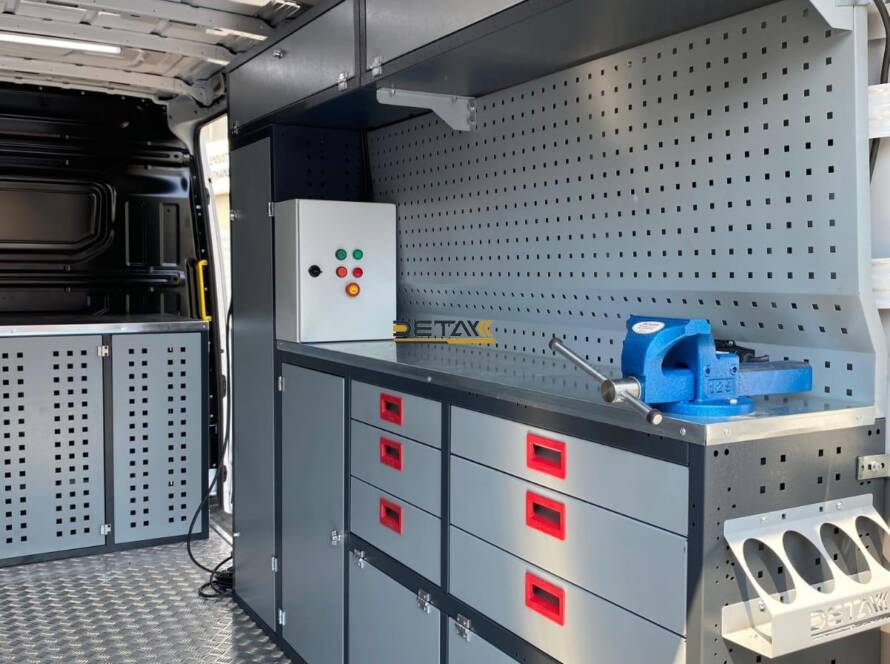
I always interpret this issue in the following way 🤝 The inside of a commercial vehicle is a combination of a small warehouse, a mini workshop, and a moving workstation. If these three functions are not managed correctly at the same time, even the simplest service task takes longer than necessary. The required tool cannot be found, small parts get mixed together, expensive devices remain under impact risk, and because heavy equipment is positioned incorrectly, both driving balance and access ergonomics are compromised. This is exactly why the approach of brands such as Detay Endüstri, which treat in-vehicle equipment not merely as a product but as a use scenario, is extremely valuable. The existing pages on the site clearly state that these systems transform panel vans, minibuses, and pickup trucks into mobile workshops through modular storage, and that equipment is organized safely and accessibly through combinations of drawer cabinets, enclosed compartments, and shelving.
Why Is the Same Solution Not Right for Every Commercial Vehicle?
The most critical reality here is this 🙂 Not every commercial vehicle does the same job, and not every job requires the same storage logic. There is not only a difference in volume between a small panel van service vehicle and a large truck-bodied mobile maintenance vehicle; the access order, load type, securing requirements, aisle use, need for a working area, and safety priorities also change. In a small vehicle, every centimeter becomes more critical, while in a larger commercial vehicle correct zoning becomes more important. For that reason, a good solution is not one that fills the vehicle with the highest possible number of modules, but one that establishes the module combination most suitable for the vehicle type and the rhythm of the work.
The vehicle interior cabinet and shelving systems page on the Detay Endüstri website also states that the systems aim to organize equipment safely and accessibly, from hand tools to spare parts and from consumables to measuring devices, through modular structures designed specifically for the vehicle body. In the project pages, features such as modular shelving, drawer cabinets, workbenches, floor coverings, aluminum side panel cladding, LED lighting, and in some examples compressor or generator integration are seen together in vehicles such as the Peugeot Partner, Citroen Berlingo, Volkswagen Transporter, and Citroen Jumper. This tells us something very clearly: the right solution is a modular solution shaped according to the vehicle type.
The Main Solution Families Most Commonly Used in Trucks, Pickups, and Light Commercial Vehicles
The healthiest way to understand in-vehicle systems is to read them not as individual products, but as functional families 🙌 Open shelves provide fast visibility and access, drawer cabinets keep small and easily mixed parts under control, enclosed cabinets protect sensitive and valuable equipment, upper shelves make use of vertical space, workbenches provide convenience for field operations, and tool cabinet or tool trolley logic turns organization into a more professional flow. Detay Endüstri’s product and project pages emphasize exactly this modular logic.
| Solution Type | Main Function | Strongest Advantage | Most Suitable Vehicle / Scenario |
|---|---|---|---|
| Open Shelf Modules | Fast visibility and access | Immediate access to frequently used equipment | Service vans, roadside assistance, rapid response teams |
| Drawer Cabinets | Organization of small parts and hand tools | Reduces clutter and enables systematic storage | Electrical work, HVAC, maintenance and repair, field service |
| Enclosed Compartments / Cabinets | Protection of sensitive equipment | Safer and cleaner storage | Vehicles carrying measuring devices, documents, expensive tools |
| Upper Shelves | Use of vertical space | Creates room for light but bulky products | Panel vans, minibuses, high-roof service vehicles |
| Workbench | Field preparation and small task area | Turns the vehicle into a mobile workshop | Maintenance, testing, assembly, technical service applications |
| Tool Cabinet / Tool Trolley Logic | Compact and fast tool access | Professional workflow and order | Mobile technical teams and high-intensity field service |
Open Shelving Systems: Why Are They So Valuable in Speed-Focused Vehicles?
Open shelving systems are an extremely powerful solution especially in commercial vehicles that require fast intervention 🚐 Because the user sees the equipment immediately when the door is opened and can reach it directly. In the content on who prefers in-vehicle shelving systems, it is especially emphasized that properly organized loads save time and create practicality when taking items out again. In the article on shelving systems for roadside assistance vehicles, it is also stated that open shelves provide quick access, while drawers keep small parts under control. This shows us that open shelving is highly efficient especially for reflectors, cables, flashlights, consumable boxes, small tool cases, and frequently used basic items.
However, open shelving is not the right answer for everything 😊 If the product is expensive, sensitive, likely to fall, or if movement during driving would create a problem, then open shelving should not be considered on its own, but together with barriers, partitions, box systems, or enclosed modules. In my opinion, in trucks and larger commercial vehicles, open shelves should be defined more as a “fast access zone,” and the entire interior should not be filled only with open shelving. This way, speed is preserved while overall safety is not weakened.
Drawer Cabinets: The Center of Order and Small-Part Control
The greatest time loss inside a commercial vehicle is often caused not by large equipment, but by small parts getting mixed together 😌 Screw sets, fasteners, cable ends, clamps, fuses, measuring probe tips, socket sets, small hand tools, and similar items, when left loose inside the vehicle, do not only create clutter; they also create serious time loss. This is where drawer cabinets come into play. Drawer modules keep small and medium-sized equipment categorized and give the user the ability not to “search,” but to “know where it is.” The use of drawer cabinets together with modular shelves in Detay Endüstri’s project pages is also a strong indicator of this.
In my view, the most critical difference here is that the drawer is not only a storage element, but also an ergonomic tool 😊 Frequently used materials can be positioned at waist level, heavier materials can be placed in lower drawers, and more sensitive products can be protected with dividers. In this way, the interior of the vehicle does not only look cleaner; it also reduces fatigue for the user. Especially in the content about locking and safety in in-vehicle cabinets, it is emphasized that central locking and security solutions provide the convenience of control from a single point. This shows how valuable drawer systems are also in terms of driving safety.
Enclosed Cabinets and Material Cabinets: The Layer of Protection and Professionalism
Inside trucks and commercial vehicles, not only speed but also protection is very important 🔒 Because measuring devices, sensitive electronics, expensive hand tools, documents, special kits, and materials that must appear orderly cannot always be managed correctly with an open-shelf logic. On Detay Endüstri’s material cabinets page, it is specifically explained that material cabinet applications used in panel vans and pickups offer integrated order together with in-vehicle shelving and cabinet systems. This same logic can very easily be adapted to larger commercial vehicles. In other words, an enclosed cabinet is not just a storage box; it is a professional control layer that reduces the risk of impact, dust, disorder, and visible clutter.
In my opinion, one of the most important contributions of enclosed cabinets is also the level of professionalism seen when the vehicle doors are opened 😊 If a customer or field supervisor looks inside the vehicle and sees defined compartments instead of materials scattered in the open, then the sense of trust they form about the team also becomes stronger. This is a difficult-to-measure but very real benefit. Especially in maintenance and repair, energy, telecom, mobile service, and technical support fields, interior vehicle order directly becomes a sign of corporate seriousness.
Why Are Upper Shelves, Floor Covering, and Side Cladding Important?
When building an in-vehicle system, most people focus only on cabinet and shelving modules; however, the floor, side surfaces, and upper volume usage are at least as decisive 🙂 On the Peugeot Partner, Citroen Berlingo, Volkswagen Transporter, and Citroen Jumper project pages, it is stated that MDF or aluminum-covered MDF floor application can be made on the vehicle floor, and additions such as aluminum side cladding and LED lighting in the shelving and cabinet sections can also be applied. At first glance these details may seem secondary, but they are actually very important in terms of durability, ease of cleaning, impact management, and comfort of use.
Upper shelves are also highly valuable especially in higher-volume commercial vehicles. When light but bulky products, protective equipment, packaging materials, spare boxes, and infrequently used items are kept in the upper sections, the lower space remains available for more active equipment. I always evaluate this with the following logic 😊 When heavy loads are placed low and light loads are placed high, both vehicle balance and access ergonomics improve. This simple rule makes a much bigger difference than many people expect in terms of both safety and speed.
Workbench and Mini Workshop Setup: The Layer That Creates Real Difference in Larger Commercial Vehicles
On the workbenches page, it is clearly stated that these solutions are considered not only in fixed production areas, but also together with in-vehicle systems. The same logic is visible in the Peugeot Partner and other mobile service vehicle examples: modular shelving, drawer cabinets, and a workbench are configured together, effectively turning the vehicle into a mobile workshop. This detail creates even greater value especially in larger commercial vehicles and truck-based mobile service scenarios. Because the vehicle is not only transporting equipment; it is also providing an area for preparation, adjustment, testing, and small interventions.
My personal opinion is this 🚛 In trucks and larger-volume service vehicles, the biggest mistake is using the entire volume only as storage space. As the volume grows, it becomes much more possible to allocate space for a small preparation area or mini workbench. This allows the team to work in a less scattered way in the field, equipment to be prepared in a more controlled manner, and dependence on external conditions to be reduced. Especially in commercial vehicles with integrated generators, compressors, or special equipment, this approach creates much stronger results. The Citroen Jumper project page also states that compressor and generator installations can be made on request.
The 5 Main Criteria That Determine the Right Configuration in Trucks and Commercial Vehicles
The real question here should be not “which product should we choose,” but “with what logic should we build the system” 🙌 I believe there are five main criteria that determine the right configuration. The first is the vehicle type and interior volume. The second is the weight and shape of the load being carried. The third is access frequency, meaning how often each piece of equipment is reached during the day. The fourth is the safety requirement, meaning the need for locking, fastening, enclosed protection, and driving balance. The fifth is whether the work involves only transport or also includes preparation and application in the field. If these five headings are read correctly, the shelving and cabinet configuration also forms much more accurately.
Especially in the content about customizable in-vehicle shelving solutions, examples are given showing that modular shelving, drawer cabinets, workbenches, LED lighting, aluminum covering, and equipment integrations can all be planned together. This makes one thing very clear: a good system is not one that places standard products next to each other randomly, but one that brings them together modularly according to need. The same logic applies on the truck and larger commercial vehicle side as well.
An Example Layout Scenario
Let us say you have a field maintenance and repair team, and you use two different commercial vehicles, one a large panel van and the other a medium-size truck-bodied vehicle. In the panel van, a combination of open shelving and drawer cabinets along one side panel, fast-access equipment at the rear, light-material shelving in the upper section, and one enclosed cabinet zone for sensitive devices may make sense. In the truck-bodied vehicle, this setup could additionally include a larger material cabinet, a mini preparation bench, special equipment compartments, and if necessary a power equipment integration. In other words, as the vehicle grows, the system does not only become longer; its functional layer also expands.
In my opinion, this is where real mastery begins 😊 Because a good solution is not the one that fills every empty space, but the one that completes the workflow with the least amount of unnecessary movement. Open shelves provide fast access, drawers bring order, enclosed cabinets provide protection, upper shelves bring space efficiency, and the working surface adds operational comfort. When these modules come together in the right sequence, the vehicle becomes a quiet but highly effective productivity machine.
A Short Anecdote
One sentence I heard from a field service team has always stayed with me 😊 “Our vehicle got bigger, but our work did not get faster at first, because we had only used the larger vehicle to carry more things.” Later the layout was redesigned, a fast-access zone was created, small parts were placed into drawers, sensitive devices were moved into enclosed cabinets, and a preparation surface was added. The same vehicle, the same equipment, the same team, but a completely different workflow emerged. This example always reminds me of one thing: an increase in capacity and an increase in efficiency are not the same thing.
There Is an Emotional Side Too: Order Creates a Sense of Professionalism
This subject has a human side as much as a technical one 💙 A messy vehicle tires the worker, while an orderly vehicle relieves them. When people know where everything is, they work more calmly, appear more trustworthy in front of the customer, and feel more in control of the job, which reduces mental load. For that reason, shelving and cabinet solutions for trucks and commercial vehicles are not only a storage investment; they are also an investment in work comfort and corporate appearance.
A Simple Diagram Related to the Topic
VEHICLE TYPE
Panel van / Pickup / Minibus / Truck-bodied service vehicle
      ↓
NEEDS ANALYSIS
Fast access + small part organization + sensitive equipment protection + work area
      ↓
SOLUTION LAYERS
Open shelf + drawer cabinet + enclosed cabinet + upper shelf + bench + floor/cladding
      ↓
RESULT
Safer driving + faster access + more organized vehicle + more professional service

Frequently Asked Questions
1. Which is better in trucks and commercial vehicles, open shelving or drawer cabinets?
Not one on its own; in most cases the right combination of both produces a more efficient result.
2. In which situations are enclosed cabinets necessary?
They are very useful when there are sensitive devices, expensive equipment, documents, or materials that need protection.
3. Should upper shelves be used in every vehicle?
They are very useful in high-volume vehicles, but they should be used for light and bulky items, not for heavy loads.
4. Is a workbench really necessary inside the vehicle?
If field preparation, testing, adjustment, or small interventions are carried out, it creates significant efficiency.
5. Why is floor covering important?
It is important for impact resistance, ease of cleaning, and the long-term durability of the system.
6. Is LED lighting used only for comfort?
No. It also increases visibility, enabling faster access and more controlled work.
7. Can the same modular logic be applied to truck-bodied vehicles?
Yes. Although the site mainly highlights examples for panel vans, minibuses, and pickups, the same modular planning logic can also be adapted to larger commercial vehicle bodies.
8. Why is central locking important?
It provides ease of control from a single point and increases security.
9. Can tool trolleys be part of an in-vehicle system?
Yes. Especially in mobile service scenarios, they can be evaluated with a compact workstation logic.
10. How should the right system be selected?
Vehicle type, equipment weight, access frequency, safety requirements, and field working style should all be evaluated together.
People Also Ask
- Is the same in-vehicle shelving system suitable for panel vans and pickups?
- Which locking mechanism is the safest in truck interior cabinet systems?
- Where should heavy equipment be placed inside the vehicle?
- How can the risk of falling be reduced in open-shelf systems?
- Does using a workbench in mobile service vehicles really save time?
- How much does LED lighting affect work quality inside the vehicle?
- How are generators and compressors integrated into the vehicle?
- How should the most efficient storage zones be determined in a large commercial vehicle?
- Should enclosed cabinets and drawer modules be used together?
- Can modular in-vehicle systems later be adapted to another vehicle?
Conclusion
To sum it up 😊 Shelving and cabinet solutions for trucks and commercial vehicles are not just about choosing storage products; they are operational decisions that determine how the vehicle will function. Open shelves create speed, drawers establish order, enclosed cabinets provide protection, upper shelves expand usable space, floor and side-surface solutions improve durability, and workbenches transform the vehicle into a mobile work area. That is why the best configuration is not the result of a single module, but the result of the right module combination.
My clear view is this 👍 If a truck or commercial vehicle is a space that produces real work throughout the day, its interior organization cannot be left to chance. For this exact reason, thinking about solutions with structures such as Detay Endüstri, which move forward with modular logic, is much healthier. Because a strong system is not only the one that holds many items; it is the one that makes the work faster, safer, and more professional.
And perhaps the most important part is this 💙 If what appears when the vehicle door opens is not chaos but flow, then the right shelving and cabinet solution has been established. Real efficiency usually begins exactly there.