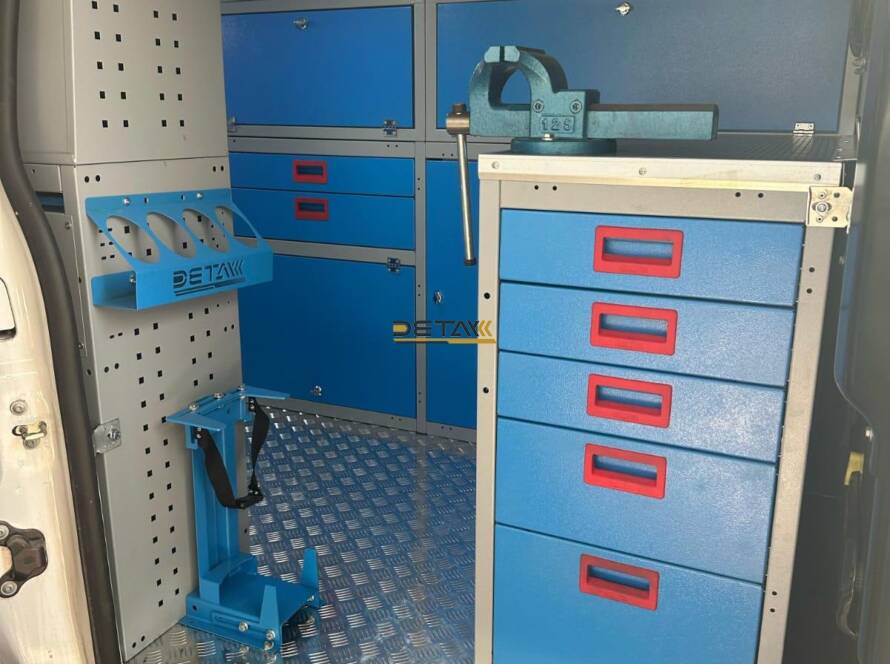
When you step into a production area, your attention is usually drawn to machines. However, a large part of production progresses on a much quieter yet equally critical element: industrial tables. Assembly, maintenance, quality control, packaging, testing, and measurement operations are all carried out directly on these tables.
An industrial table carries heavy loads, absorbs impacts, is exposed to vibration, may come into contact with chemicals, and is often used continuously across multiple shifts. For this reason, choosing an industrial table is not merely a matter of size or price — it is a matter of safety, efficiency, and long-term durability. A poorly selected table can lead to ergonomic problems, workplace accidents, and production losses.
🧠 Why Is Industrial Table Selection a Technical Decision?
Tables used in industrial environments are exposed to conditions entirely different from those faced by household or office furniture. In addition to static loads, dynamic loads, vibrations, and sudden impacts constantly stress the structure of the table.
Therefore, when selecting an industrial table, the following questions must be clearly answered:
- How much load will the table carry?
- What type of work will be performed on it?
- Who will use it and how frequently?
- Is the environment exposed to moisture, oil, chemicals, or heat?
The answers to these questions form the foundation for defining the correct technical specifications.
⚙️ Key Technical Features to Consider When Choosing an Industrial Table
1️⃣ Load Capacity (Weight Resistance)
One of the most critical technical features of an industrial table is its load capacity. The table must safely support not only static loads but also dynamic loads generated during operation.
While heavy industry applications may require load capacities of 500 kg and above, lower capacities may be sufficient for assembly and packaging areas. In all cases, the load capacity should be selected with an adequate safety margin.
2️⃣ Frame and Structural Profile
The durability of an industrial table largely depends on its supporting frame. Thin-walled profiles may seem sufficient in the short term but pose a high risk of bending and deformation over time.
Key aspects to consider include:
- Use of thick-walled steel profiles
- Welded main load-bearing joints
- Cross-bracing between table legs
These features ensure that the table maintains its form under heavy loads 💪
3️⃣ Tabletop Material and Surface Properties
The tabletop should be selected based on the type of work being performed. Common tabletop options include:
- Steel tops: Suitable for heavy-duty and impact-intensive tasks
- Wooden or plywood tops: Ideal for assembly and general use
- Composite or phenolic surfaces: Designed for chemically demanding environments
Additionally, non-slip surfaces and resistance to scratches and chemicals provide significant operational advantages.
4️⃣ Ergonomics and Working Height
Ergonomics in industrial tables is directly linked to productivity. A table at an incorrect height can cause long-term back, neck, and shoulder issues.
For this reason, important technical criteria include:
- Adjustable height options
- Table depth suitable for the task
- A layout that allows comfortable reach for the operator
These factors significantly improve user comfort and efficiency 🧍♂️
5️⃣ Vibration Control and Floor Compatibility
In environments where vibration-generating machinery is used, the interaction between table legs and the floor is critical. Adjustable legs with rubber bases help absorb vibration and compensate for uneven flooring.
This feature prevents loosening and instability over time.
6️⃣ Modularity and Accessory Compatibility
Modern industrial tables are no longer limited to a tabletop and legs alone. They can be expanded with shelves, drawers, lighting systems, panels, and hanging accessories.
A modular structure allows the table to adapt easily to changing production needs, offering a significant long-term investment advantage 🔧
📊 Industrial Table Comparison Based on Technical Features
| Technical Feature | Light Duty | Medium Duty | Heavy Industry |
|---|---|---|---|
| Load Capacity | 150–300 kg | 300–500 kg | 500 kg + |
| Profile Structure | Thin steel | Medium thickness | Thick-walled steel |
| Tabletop Type | Wood | Composite | Steel |
| Ergonomics | Fixed | Partially adjustable | Fully adjustable |
| Modularity | Low | Medium | High |
🧠 The Right Table Means Fewer Problems
In one assembly workshop, tables with insufficient load capacity began to bend over time. This made work more difficult for employees and reduced assembly quality. After replacing them with industrial tables featuring adequate load capacity and adjustable feet, productivity increased and ergonomic issues were eliminated.
This example clearly shows why technical specifications should never remain just numbers on paper.
🧭 Technical Details Define Daily Performance
Industrial table selection should be approached not with short-term cost calculations, but with a focus on long-term performance, safety, and sustainability. A table with the right technical features becomes a quiet yet reliable support element on the production floor.
From the Detay Endüstri perspective, a well-chosen industrial table is not just a piece of equipment — it is one of the cornerstones of efficient production.
❓ Frequently Asked Questions
1️⃣ Are industrial tables and workbenches the same?
They serve similar purposes, but workbenches are typically designed for heavier loads.
2️⃣ Is an adjustable-height table really necessary?
Yes, it provides major ergonomic advantages for long working hours.
3️⃣ Is a steel table always better?
No, it depends on the application.
4️⃣ Should the table be fixed to the floor?
It is recommended for heavy-duty and vibration-intensive applications.
5️⃣ Which tabletop is suitable for chemical environments?
Phenolic or stainless-steel surfaces are ideal.
6️⃣ Are modular tables durable?
Yes, when designed with proper connection systems.
7️⃣ How is the correct table height determined?
Based on the operator’s height and the type of work performed.
8️⃣ Can industrial tables be manufactured to custom dimensions?
Yes, most manufacturers offer custom sizing.
9️⃣ Does table selection affect workplace accidents?
Yes, choosing the right table significantly reduces risk.
🔟 Is buying a cheap table a good idea?
It may seem cost-effective initially, but not in the long run.
🤔 People Also Ask
🔹 How much weight should an industrial table support?
🔹 Is an adjustable table better than a fixed table?
🔹 Does the warranty period matter for industrial tables?
🔹 Does table ergonomics affect productivity?
🔹 Can industrial tables be customized?
🔩 Final Words
Industrial tables are the invisible yet indispensable building blocks of production. A table selected with the right technical features protects employees and accelerates work processes. Because in industry, success often begins with the table you work on 💪