Safe Work Begins with a Solid Table
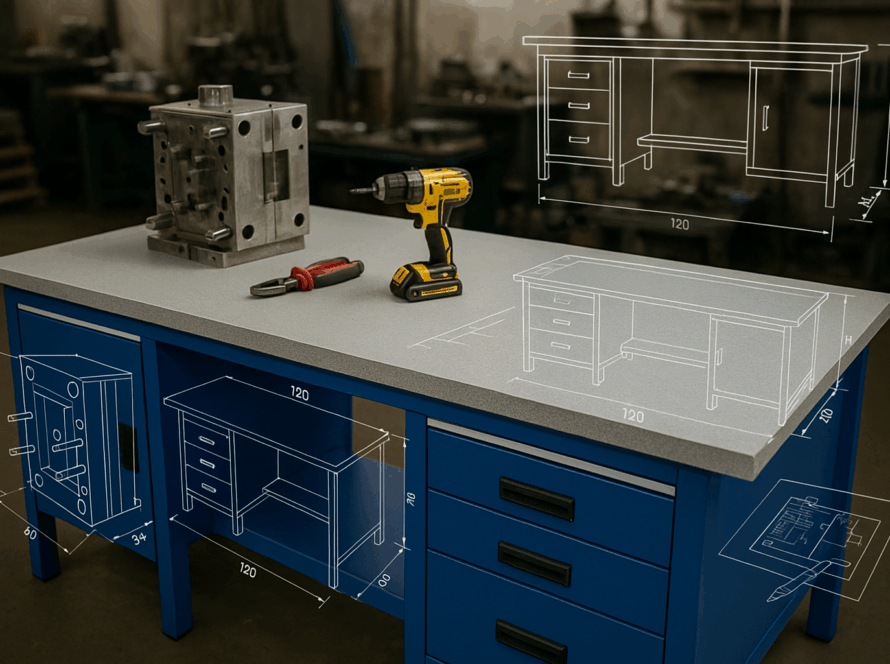
In industrial production environments, safety is often evaluated in relation to machinery. However, a significant portion of production processes takes place on industrial tables. Assembly, maintenance, measurement, testing, quality control, and packaging operations are carried out directly on these surfaces. For this reason, an industrial table is not merely a work surface; it is a fundamental component of workplace safety.
A poorly selected table or one that does not meet safety standards can lead to serious hazards such as tipping risks, structural deformation under load, injuries caused by sharp edges, and ergonomic problems. Therefore, compliance with established safety standards in the use of industrial tables is of critical importance.
🧠 Why Are Safety Standards Essential for Industrial Tables?
Industrial environments involve multiple risk factors simultaneously, including heavy loads, dynamic forces, vibration, chemical exposure, and high personnel traffic. As a result, the design and use of industrial tables must follow strict engineering criteria.
International best practices typically focus on load resistance, tipping stability, surface safety, and ergonomic compliance. The objective is not only to prevent accidents but also to create a safe and sustainable working environment.
⚙️ Core Safety Standards in Industrial Table Usage
1️⃣ Load Resistance and Static Testing
Industrial tables should be tested beyond their stated maximum load capacity. A safety margin of 25–30% is generally recommended for secure operation.
The table must remain stable under both static and dynamic loads. These tests are particularly critical in environments where heavy equipment is used.
2️⃣ Tipping and Stability Control
Tables must maintain full contact with the floor and include adjustable feet to compensate for uneven surfaces.
Even when heavy loads are concentrated in a single area, the table should not tip. Wide-base leg structures and cross-braced chassis designs are essential 🦺
3️⃣ Edge and Surface Safety
Sharp edges and rough surfaces can cause serious injuries. Industrial tables should feature:
- Rounded corners
- Removal of burrs and sharp edges
- Non-slip surface coatings
These small design details make a significant difference in daily use.
4️⃣ Ergonomic Standards
Table height must be suitable for the operator’s height and the type of work performed. Incorrect height can lead to long-term musculoskeletal disorders.
Adjustable height features provide a major ergonomic safety advantage.
5️⃣ Electrical and ESD Safety
In electronic assembly environments, ESD-protected table surfaces must be used. Static electricity poses risks to both employees and sensitive equipment.
Workstations with proper grounding systems should be preferred.
6️⃣ Vibration and Fixation Standards
In areas where vibration-producing machinery is used, tables should either be fixed to the floor or equipped with vibration-dampening feet.
This increases structural stability and protects equipment safety.
7️⃣ Chemical and Heat Resistance
In facilities where chemicals are used, the tabletop material must be selected accordingly. Phenolic coatings, stainless steel surfaces, or other specialized materials are recommended.
Heat resistance must also be considered in environments exposed to high temperatures.
📊 Risk Level Based on Safety Measures
| Safety Element | Risk When Not Applied | Outcome When Applied |
|---|---|---|
| Load Testing | Structural collapse risk | Stable operation |
| Stability System | Tipping hazard | Safe use |
| Edge Protection | Injury risk | Safe contact |
| Ergonomics | Musculoskeletal disorders | Long-term comfort |
| ESD Protection | Electronic damage | Safe production |
🧠 A Short Anecdote: Safety Lies in the Details
In an assembly workshop, worktables had sharp edges that were left untreated. Employees frequently experienced minor injuries. After switching to a design with rounded corners, these incidents were completely eliminated.
This example shows that safety is often ensured not through large investments, but through attention to the right details.
🧭 Practical Recommendations for Safe Use
1️⃣ Do not exceed the table’s load capacity
2️⃣ Regularly check full contact with the floor
3️⃣ Perform periodic maintenance
4️⃣ Provide ergonomics training to employees
5️⃣ Repair damaged surfaces immediately
These steps help maintain compliance with safety standards over time.
🧩 Safety Is the Foundation of Production
Safety standards in the use of industrial tables are not merely procedural requirements; they are fundamental to production continuity and employee well-being. A safe table is the starting point of an efficient production environment.
From the Detay Endüstri perspective, a strong and standards-compliant industrial table protects not only equipment, but also people. Because sustainable production success is only possible within a safe working environment.
❓ Frequently Asked Questions
1️⃣ Is load testing mandatory for industrial tables?
It is strongly recommended and typically performed by professional manufacturers.
2️⃣ Is ESD protection required in every industry?
No, it is primarily required in electronic production environments.
3️⃣ Should the table be fixed to the floor?
It is recommended for heavy-duty and vibration-intensive applications.
4️⃣ Is ergonomics truly a safety issue?
Yes, it is critical for long-term employee health.
5️⃣ Are sharp edges a serious risk?
Even minor sharp edges can cause significant injuries.
6️⃣ Why is chemical resistance important?
Surface damage can create safety hazards.
7️⃣ Does vibration affect table lifespan?
Yes, it can lead to loosening and deformation over time.
8️⃣ Are safety certifications important?
Yes, tested and certified products should be preferred.
9️⃣ How often should periodic inspections be performed?
Frequency depends on usage intensity.
🔟 Does a safe table improve productivity?
Absolutely — fewer accidents and interruptions mean higher efficiency.
🤔 People Also Ask
🔹 How much weight should an industrial table support?
🔹 How do you select an ergonomic table?
🔹 What is an ESD table?
🔹 What standards apply to industrial tables?
🔹 Why is table design important for workplace safety?
🔧 Final Words
Safety in industrial tables is an invisible yet fundamental element that sustains production. A table that complies with the right standards protects both employees and operations. Because strong production stands on a safe foundation 💪