In a solar power plant, panels are laid out string by string following a clear logic, and each string connects to its own line; I think about shelving inside a panel van in exactly the same way, because measuring instruments, personal protective equipment, MC4 connectors, cleaning equipment and spare parts also need to stay in their own “strings”, on their own lines 🔆. When one string gets mixed up, the plant’s output drops; when one zone inside the vehicle gets mixed up, the crew’s output drops too. In this article I will walk you through, step by step, how to build a panel van shelving layout for solar maintenance crews, drawing on my work with field teams, the mistakes I have seen in vehicle upfit projects and international safety sources, and along the way I will share examples from service vehicle projects by the Detay Endüstri team 🚐✨.

🤔 What Makes Solar Maintenance Vehicles Different?
The first thing that sets a solar maintenance crew’s vehicle apart from other service vehicles is electrical risk, because photovoltaic arrays keep producing direct current as long as there is daylight, and OSHA’s page on electrical hazards in solar energy stresses that workers in this field are more vulnerable to electrocution and arc flash hazards ⚡. This directly shapes the vehicle layout: insulating gloves, lockout and tagout kits and DC rated measuring instruments must sit in a protected, easy to reach place, not in a random box.
The second difference is heat 🌡️. Solar plants are, by definition, built where the sun hits hardest, and in summer the temperature inside a panel van climbs to serious levels; OSHA’s guidance on insulating gloves and sleeves clearly states that proper storage means gloves must not be folded and must be kept away from excessive heat, sunlight, humidity, ozone and any chemical that could damage the rubber. The cracked gloves I described at the start were exactly the result of ignoring this rule.
The third difference is carrying long, bulky and heavy equipment together 🪜. Panel cleaning poles, ladders, spare modules, cable reels and a cleaning water tank all have to fit in the same vehicle, and OSHA’s page on fall hazards in solar energy reminds us that different fall protection requirements apply to installation and maintenance work; in other words, harnesses, lanyards and connectors also need their own protected place in the vehicle. That is why, in a solar maintenance vehicle, vehicle cabinet and shelf systems should be planned not only for organization but for equipment life and crew safety.
⚖️ Equipment Groups in a Solar Maintenance Vehicle and Where They Belong
Splitting the equipment in a solar maintenance crew’s vehicle into five groups makes the shelving plan much easier, because each group has its own risk, its own protection needs and its own ideal place in the vehicle. The table below puts these five groups side by side 👇
| Equipment group | ⚠️ Main risk | 🛡️ Right storage | 📍 Place in the vehicle |
|---|---|---|---|
| Measuring instruments (clamp meter, insulation tester, IV curve tracer, thermal camera, irradiance meter) | Impact, vibration, excessive heat | Foam lined, lockable drawers | Lower and middle zone, shaded and secured |
| Personal protective equipment (insulating gloves, arc rated face shield, harness, lockout kit) | Heat, sun, folding, crushing | Lidded, ventilated cabinet with gloves hanging in their bag | Near the door, on the wall that stays out of the sun |
| Small electrical parts (MC4 connectors, DC fuses, cable lugs, labels) | Mixing, loss, dust | Lidded, divided and labeled boxes | Middle zone, shallow drawers at eye level |
| Long and bulky equipment (cleaning poles, ladder, spare module, cable reel) | Shifting, scratching, breaking | Channel holders, padded vertical slot, roof rack | Along the side wall, ceiling and exterior roof rack |
| Water and cleaning system (purified water tank, pump, hose reel) | Weight, leaks, balance | Secured tank, overflow protected connections | At floor level, close to the rear axle |
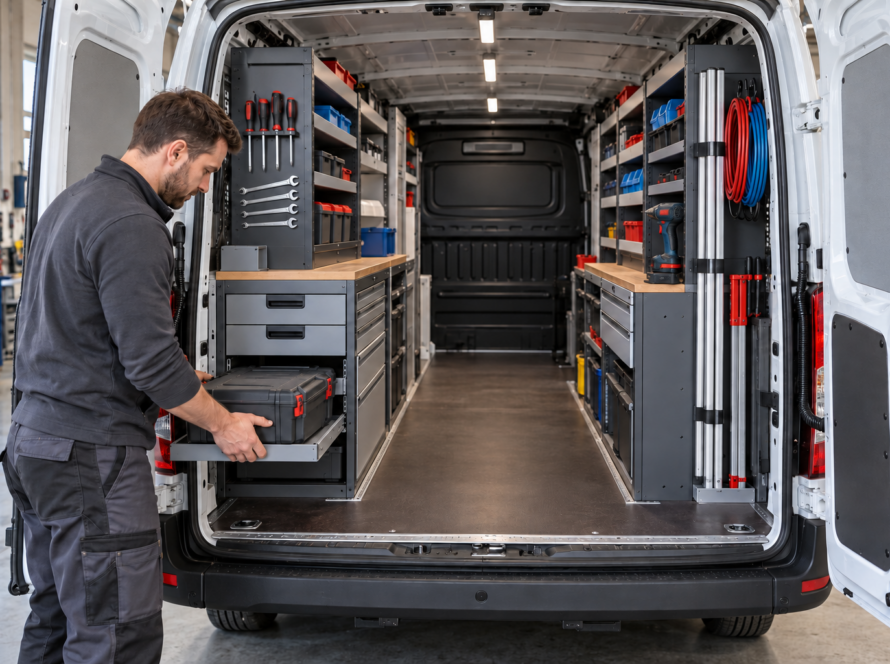
The table makes one thing very clear: a single type of shelving is not enough in a solar maintenance vehicle, because instruments need protection from impact, PPE from heat, small parts from mixing, long equipment from shifting and the water tank from upsetting the vehicle’s balance. As the article on shelving and cabinet solutions for trucks and commercial vehicles explains, open shelving modules are strongest for fast access and drawer cabinets for small parts organization, so both structures need to be combined in the same vehicle 💪. The healthiest approach I have seen in Detay Endüstri projects is to separate these five groups on paper first and then define a dedicated zone inside the vehicle for each one.

💡 Building the Panel Van Shelving Layout, Step by Step
1️⃣ Start from the maintenance plan and build the inventory around it
A shelving layout starts with knowing what work the vehicle will go out to; the equipment carried for small rooftop systems and for large ground mounted plants differs considerably, and the NREL fact sheet on PV operations and maintenance best practices stresses that O&M requirements and costs depend on the type of system, the details of the site and environmental conditions 📋. The U.S. Department of Energy page on PV operations and maintenance also recommends keeping an inventory of on site or easily accessible spare parts, and lists hot spots, cell cracks and water intrusion into the junction box among the most common module issues; this tells you which spare parts and measuring instruments the vehicle must always carry.
2️⃣ Move long and bulky equipment to the walls and ceiling
For long items such as panel cleaning poles, cable trays and mounting rails, channel holders running along the side wall or a long carrying channel near the ceiling keep the floor and shelves free; moving the ladder to an exterior roof rack both preserves interior space and stops the ladder from shifting inside the vehicle 🪜. If you carry a spare module, the safest way is a vertical slot against the side wall, padded on both sides and secured with straps, because a panel wedged horizontally between shelves gets damaged at the first hard brake and scratches the equipment around it.
3️⃣ Give measuring instruments a foam lined, lockable and shaded home
The clamp meter, insulation tester, IV curve tracer and thermal camera are the eyes and ears of the maintenance crew; carrying them in full extension, lockable drawers with foam cut to each instrument’s shape, on the shaded side of the vehicle and in the lower or middle zone, gives the best protection against both impact and overheating 📏. In a vehicle moving along dirt roads and gravel tracks inside a plant, a single drawer sliding open while driving can throw off the calibration of an expensive instrument; this is why the guide to in-vehicle equipment selection for mobile service vehicles recommends balancing shelves against vehicle vibration and using locking systems, and for electrical services it also suggests insulated shelving and cable spool organizers. The Detay Endüstri team builds on the same logic in its projects, treating locks and vibration control as part of the design rather than an afterthought.
4️⃣ Set up a cool, ventilated cabinet for personal protective equipment
Insulating gloves, arc rated face shields, harnesses and lockout kits need a lidded, ventilated cabinet on the side of the vehicle that stays out of the sun; in this cabinet the gloves should hang unfolded in their own bags, and harnesses should travel on hooks where they will not be crushed and can dry 🧤. Placing this cabinet near the door lets the technician grab their protective equipment in a single move before heading to the inverter room or combiner box, and keeping the lockout and tagout kit in the same cabinet, on the most visible shelf, is a small but effective reminder that stops the de-energizing step from being skipped.

5️⃣ Move small electrical parts into lidded, labeled boxes
For MC4 connectors, DC fuses, cable lugs and labels, lidded and divided boxes in shallow drawers at eye level are the best solution, and clear labels on each compartment showing the connector type, fuse rating and cable cross section prevent the wrong part from being installed in the field 📦. For parts that run out often, setting aside two compartments for the same item and refilling the empty one at the depot in the evening eliminates the “we’re out of fuses” surprise in a remote corner of the plant, while frequently used hand tools can travel in drawer based tool trolleys that keep them within reach and stop them from getting lost. As the Detay Endüstri team explains in its article on achieving professional vehicle organization, preparation and checks become noticeably easier when every item has a clear address.
6️⃣ Place the water tank and heavy loads with balance in mind
The purified water tank used for panel cleaning becomes the heaviest item in the vehicle when full, and securing it at floor level, close to the rear axle and balanced between left and right makes a big difference to driving safety 💧. Automotive Fleet’s guide to upfitting cargo vans also recommends storing heavy equipment right at the door opening or on a mechanism that slides outward, because repeatedly lifting a heavy load from arm’s length away greatly increases the risk of injury. As the Detay Endüstri Volkswagen Crafter mobile service vehicle build shows, a generator installation and a fire extinguisher holder can be planned into the same layout when needed 💡.

🧑🔧 My own experience: even the wall a cabinet sits on makes a difference
With the crew I mentioned at the start, the simplest change we made had the biggest effect: we moved the PPE cabinet from the van’s sunny right wall to the left wall, which stays mostly in the shade during the day, added hanging bags for the gloves and moved the thermal camera into a foam lined, lockable drawer. In the first weeks the crew saw it as a minor detail, but over the summer we all noticed that the daily glove inspections turned up no cracks at all, the instruments stayed put even on rough roads, and the technicians started their work far more comfortably 🙌. A layout planned with Detay Endüstri gives you the physical infrastructure, but what keeps that infrastructure alive is the small check routine the crew repeats every morning and evening.
❤️ Organization Is Care for People Working Under the Sun
Setting the technical side aside, we should not forget that solar maintenance crews often work in shadeless fields, in scorching heat, on rooftops and among panel strings stretching for kilometers; carrying the extra stress of not finding a tool in the vehicle or starting work with a cracked glove slowly wears down their love for the job. An organized vehicle tells the technician “we care about you and your safety”, reassures the plant owner, and at the end of the day means going home less tired and with peace of mind 🏡. Builds like the Detay Endüstri Citroen Jumpy mobile service vehicle, with LED lighting and aluminum cladding around the cabinets and shelves, show how a well planned interior turns a van into a proper workplace for the people who spend all day in it.
I would also remind you that safety is not limited to electricity: according to a Fleet News report on research by the UK’s Transport Research Laboratory, even a 200 gram screwdriver can hit with the force of an 8 kilogram object in a crash at around 31 mph (50 km/h), which means an unsecured spare module or instrument case can fly toward the cab in an accident. Lockable material cabinets that protect stored items from loss and damage greatly reduce this risk, and planning the total weight without exceeding the vehicle’s payload is one of the topics Detay Endüstri specialists pay particular attention to during the site survey ⚖️.

I would also remind you that experience matters when choosing a manufacturer: more than 50 years of steel goods experience, which started in Istanbul and has continued in Bursa since 1984, brings field knowledge gathered across many sectors from roadside assistance and maintenance vehicles to factories, and Detay Endüstri carries that know how into its vehicle interior projects 🏭.
🎯 A Sun Resistant, Balanced and Safe Shelving Layout
Building a panel van shelving layout for solar maintenance crews is a process that sets the inventory based on the maintenance plan, splits the equipment into five groups (measuring instruments, PPE, small electrical parts, long and bulky equipment, and the water system), moves long items to the walls and ceiling, gives instruments a foam lined and lockable home, stores insulating gloves unfolded in a cool, ventilated cabinet and places the water tank with balance in mind. When you apply these steps you do not just save minutes; you also protect your equipment from heat and impact, and your crew from electrical risk and from loads flying around in a crash 🛡️.
If you would like to plan the right shelving layout for your own vehicle or maintenance fleet, you can reach out to Detay Endüstri, explore their full range of vehicle equipment and workshop solutions, and share your instruments, protective equipment and daily maintenance plan to get a layout plan built around your needs. Remember, what sets a great solar technician apart in the field is not only diagnosing the fault correctly but finding everything they need, intact and in a single move; what makes that single move possible is a well designed shelving layout, and a setup built by Detay Endüstri makes that move repeatable every single day 🚐☀️✨.