🤔 Why Is Layout So Critical in Mobile Tire Service?
The first reason is safety, and in tire service safety is a far more serious matter than most people think. OSHA standard 1910.177, which governs rim wheel servicing in the United States, requires a restraining device or barrier when inflating large vehicle tires, a clip on chuck on the inflation line and enough hose length for the technician to stand outside the potential trajectory 🚨. This rule directly affects your vehicle layout, because the position of your hose reel and the length of your hose determine how close the technician is forced to stand to the tire.
The second reason is air quality ⚠️. Running a gasoline powered compressor inside a closed or partially closed cargo area is a serious mistake; NIOSH’s alert on small gasoline engines clearly recommends not using such engines inside buildings or partially enclosed spaces unless the engine unit is outdoors and away from air intakes, and it stresses that carbon monoxide can build up quickly in enclosed spaces and overcome people without warning. In other words, the type of compressor determines its position inside the vehicle and the ventilation plan from the very start.
The third reason is driving safety and load balance 🚚. When you put a compressor, an air tank, a tire changer and a wheel balancer together, the vehicle carries significant weight, and according to a Fleet News report on research by the UK’s Transport Research Laboratory, even a 200 gram screwdriver can hit with the force of an 8 kilogram object in a crash at around 31 mph (50 km/h). Picture a van full of socket sets, air guns and wheel weights, and it becomes obvious what every unsecured item means; that is why vehicle cabinet and shelf systems are installed not only for organization but for the safety of everyone on board.
⚖️ Which Compressor Type Calls for Which Layout?
In mobile tire service I usually come across three different compressor approaches, and each places very different demands on the vehicle layout. The table below puts these three approaches side by side against real field conditions 👇
| Criterion | 🔌 Electric piston compressor with tank | ⛽ Standalone gasoline or diesel unit | ⚙️ Engine driven rotary screw system |
|---|---|---|---|
| Space used in the cargo area | Medium, the tank needs extra room | Large | Very little, compressor sits in the engine bay |
| Exhaust risk in enclosed space | None | High, exhaust must be routed outside | None, exhaust leaves through the vehicle’s own system |
| Power source | Generator or battery with inverter | Its own fuel | The vehicle’s engine |
| Continuous operation | Depends on the manufacturer’s duty cycle | Generally good | Continuous, according to manufacturer data |
| Noise and vibration | Medium, mounts are essential | High | Low, varies with engine speed |
| Effect on layout | Low and fixed, close to the axle | At the rear door, on an outward sliding platform | Cargo area stays entirely for tools |
As the table shows, systems mounted in the engine bay leave almost the entire cargo area to tools; for example, the underhood rotary screw compressors featured by Work Truck integrate with the vehicle’s engine to free up cargo space and can deliver between 70 and 150 CFM for tire service trucks. Electric compressors with tanks offer a more flexible starting point but require a well built power setup, and as the guide to in-vehicle equipment selection for mobile service vehicles points out, generator capacity, inverter type and battery wiring must be matched to the vehicle’s energy demand ⚡. The healthiest approach I have seen in Detay Endüstri projects is to make the compressor decision before the shelf and drawer plan, because the compressor’s type and position form the backbone of the entire layout.

💡 Compressor and Tool Layout, Step by Step
1️⃣ Map the workflow first, then place the equipment
Everything starts by writing down the sequence of a tire change in the field: the vehicle is lifted, the lug nuts come off with the impact wrench, the tire is separated from the rim, repaired or replaced, balanced, inflated, refitted, and finally the lug nuts get their last tightening with a torque wrench 📋. Once you map this sequence, it becomes obvious which piece of equipment belongs in front of which door, and I always tell crews the same thing: the most frequent movement should take the shortest path. Automotive Fleet’s guide to upfitting cargo vans also recommends storing heavy equipment right at the door opening or on a mechanism that slides outward, because repeatedly lifting a heavy load from arm’s length away greatly increases the risk of injury.
2️⃣ Position the compressor and tank around the center of gravity
If you use an electric or standalone engine compressor, the compressor and air tank are among the heaviest items in the vehicle, and placing them low, as close to the rear axle as possible and balanced between left and right makes a big difference to driving safety. Mounting the compressor on a solid base fixed to the chassis with vibration isolators both reduces noise and stops vibration from spreading to shelves and drawers; if you use an engine driven unit, the exhaust must always be routed outside the vehicle and the rear door must be open while it runs. As the Detay Endüstri Volkswagen Crafter mobile service vehicle build shows, compressor and generator installations are much easier to balance when they are planned in the same project as the shelf and drawer system 🔩.
3️⃣ Design the air line like a circulatory system
Before reaching the hose reel, air from the compressor should pass through a water separator, a pressure regulator and an easy to read pressure gauge, so that no water reaches your air tools and no more pressure than intended reaches the tire 💧. The tank’s drain valve is another detail the layout plan must not forget, because the Safe Work Australia information sheet on compressed air explains that drain valves must sit at the lowest point of the receiver to empty all condensate, that water should be drained daily unless an automatic drain is fitted, and that internal corrosion can thin the tank walls and in extreme cases lead to a rupture. So instead of burying the drain valve behind a cabinet, bring it to a spot where it can be opened at the end of the day without crouching.
4️⃣ Move the hose reel to the rear door and the tools to the door opening
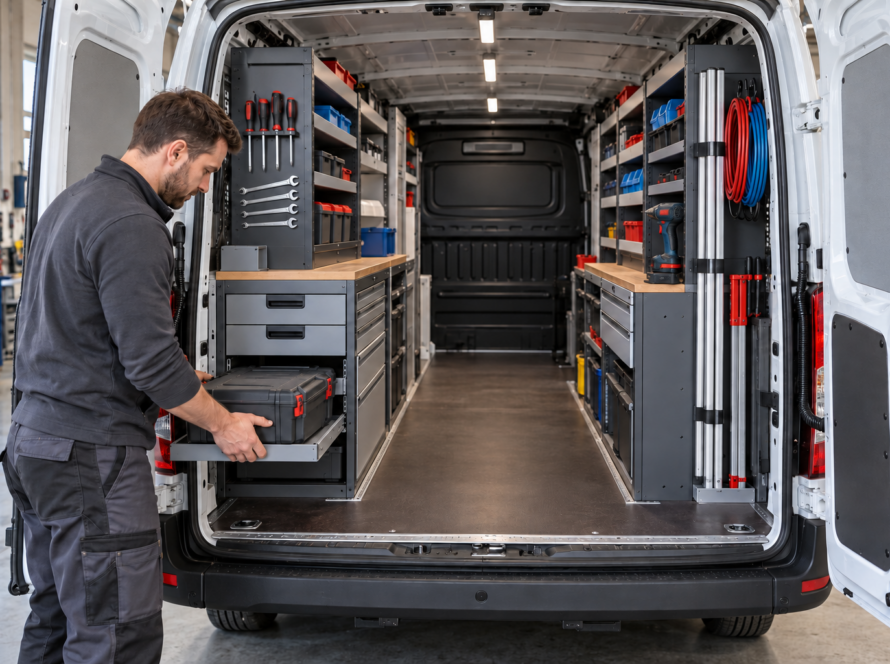
Mounting an automatic retracting hose reel on the inside of the rear door is one of the changes that saves the most time in the field, and when choosing the hose length you need to remember the OSHA rule mentioned above: the technician must be able to stand outside the trajectory while the tire inflates 🛞. The impact wrench, socket set and torque wrench should live in lockable drawers at the door opening; as the Modern Work Truck Solutions article on ergonomic upfits highlights, sliding trays and tool drawers let technicians reach their most used equipment from the ground without climbing into the van. Drawer based tool trolleys are also very useful here, because they can be rolled out of the vehicle to the tire and secured back in place when the job is done 🧰.

5️⃣ Lock the drawers, secure the machines, light up the work area
In tire service, drawers carry heavy loads: when socket sets, torque wrenches, jack adapters and boxes of wheel weights come together, a single drawer sliding open while driving can create a serious hazard. Lockable drawers largely remove this risk, and the drawer and lock system offered by industrial material cabinets is a good example of how locking keeps stored items from being lost or damaged 🔐. The bases of the tire changer and balancer should also be bolted to the vehicle floor, and the work area should be equipped with LED lighting, as in the Citroen Jumpy mobile service vehicle build where LED lighting is fitted around the cabinets and shelves, because spotting the right place for an adhesive weight on a rim at midnight on a highway shoulder is only possible with good light.

🧑🔧 the hose reel’s position changed everything
When we reworked the layout of a roadside assistance vehicle with one crew, the smallest change we made had the biggest effect: we moved the hose reel, which used to sit in the middle of the van right next to the compressor, to the inside of the rear door and placed the air gun holder beside it. In the first week the crew did not think much of the change, but a few weeks later we all noticed that technicians were climbing in and out of the vehicle far less on every job, the hose no longer tangled, and the work went much more calmly, especially on rainy nights 🙌. A layout planned with Detay Endüstri gives you these right positions from the start, but what makes the real difference is the crew deciding to keep that order every single day.
❤️ Organization Is a Form of Respect for the Technician
Setting the technical side aside, we should not forget that people working in mobile tire service often do their jobs in the toughest conditions; a technician changing a tire in the rain, in the snow, in the roar of highway traffic and in the middle of the night, under the worried eyes of a stranded family, slowly loses love for the job when they also have to fight a tangled hose or a missing socket. An organized vehicle tells the technician “we value you and your work”, reassures the stranded driver, and at the end of the day means getting home a little earlier and a little less tired 🏡. The Detay Endüstri team makes the same point in its article on achieving professional vehicle organization: professional order develops when layout decisions are combined with everyday working habits.
If your fleet includes vehicles of different sizes, the article on shelving and cabinet solutions for trucks and commercial vehicles is a good starting point for understanding how the same modular logic adapts to different bodies. The key thing to remember is that using storage space more efficiently does not increase the vehicle’s permitted payload, so factoring the combined weight of the compressor, tank, machines, cabinets and tools into the load calculation is one of the topics Detay Endüstri specialists pay particular attention to during the site survey ⚖️.

I would also remind you that vehicle organization does not end in the field: when the depot the vehicle returns to every evening has sturdy workbenches where hoses and air tools are serviced and missing wheel weights are restocked, the vehicle leaves fully equipped every morning. Experience matters when choosing a manufacturer, too: more than 50 years of steel goods experience, which started in Istanbul and has continued in Bursa since 1984, brings field knowledge gathered across many sectors from roadside assistance and maintenance vehicles to factories, and Detay Endüstri carries that know how into its vehicle interior projects 🏭.
🎯 The Right Compressor in the Right Place Means the Job Gets Done on Time
Planning compressor and tool layout in mobile tire service vehicles is a process that starts with mapping the workflow, decides on ventilation and exhaust according to the compressor type, places the compressor and tank low and close to the axle, completes the air line with a water separator, a regulator and an accessible drain valve, and moves the hose reel to the rear door and the tools to lockable drawers at the door opening. When you apply these steps you do not just save minutes; you also protect your crew from carbon monoxide, from the trajectory zone and from heavy tools flying around in a crash 🛡️.
If you would like to plan the right layout for your own vehicle or fleet, you can reach out to Detay Endüstri, explore their full range of vehicle equipment and workshop solutions, and share your compressor, machines and daily workflow to get a layout plan built around your needs. Remember, what sets a great tire technician apart in the field is not only the strength of their wrist but the ability to find the air and the tool they need in a single move; what makes that single move possible is a well designed layout, and a setup built by Detay Endüstri makes that move repeatable every single day 🚐🛞✨.